Safety Warning
DIY auto repair can cause serious injury, fire, or vehicle damage. These guides are for informational purposes only. Always follow OEM torque specs, wear PPE, and consult a certified mechanic if you are unsure. You are solely responsible for your safety.
SYS.OK|MANUAL.DB● LIVE
HOMESERVICE MANUALSPONTIAC1991FIREBIRD V8-350 5.7LREPAIR AND DIAGNOSISPOWERTRAIN MANAGEMENTEMISSION CONTROL SYSTEMSEXHAUST GAS RECIRCULATIONTESTING AND INSPECTIONSYSTEM TEST
1991 Pontiac Firebird V8-350 5.7L
System Test
1991 Pontiac Firebird V8-350 5.7LSECTION System Test
Chart C-7:

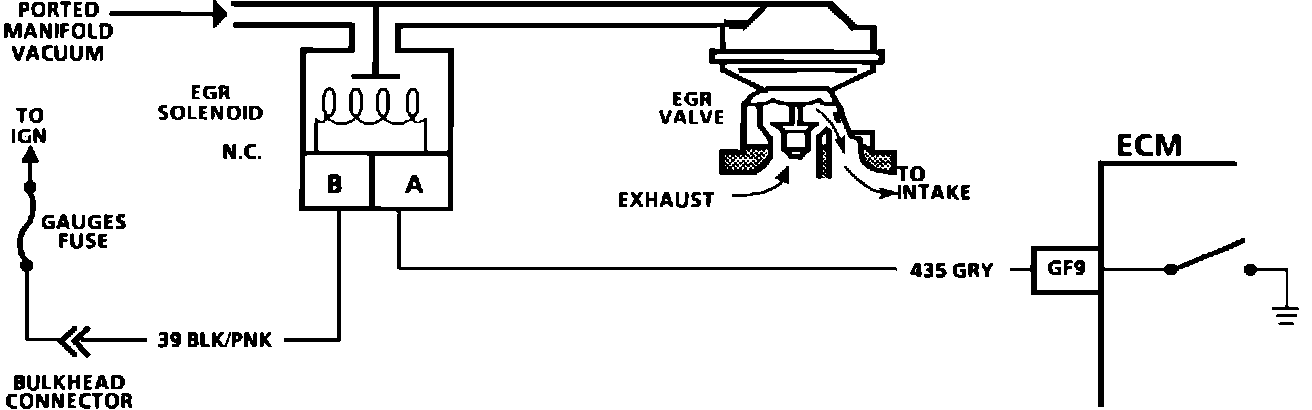
EGR Wiring Diagram:
EGR SYSTEM CHECK
CIRCUIT DESCRIPTION:
The EGR valve is controlled by a normally open, Pulse Width Modulated (PWM) solenoid. The ECM powers the solenoid off, to allow vacuum to flow to the EGR. The ECM turns the solenoid on to prohibit EGR operation.
The duty cycle is calculated by the ECM based upon information from the coolant temperature, MAT, TPS, and MAF sensors. The engine speed and Park/Neutral switch also affect EGR. There should be NO EGR flow in Park/Neutral, below TPS Calibrated value, or at wide open throttle.
With the ignition on and engine not running, the EGR solenoid is de-energized. The solenoid should be energized if the diagnostic terminal is grounded with the ignition on and engine off.
TEST DESCRIPTION: The numbers below refer to circled numbers on the diagnostic chart.
1. This tests the solenoid value to determine if it is capable of closing off the vacuum from the EGR valve. The vacuum can bleed off slowly (this should not be considered as a fault).
2. As soon as backpressure is present at the EGR valve, the bleed portion, in the valve, should open and allow the valve to move to its heated position.
3. The EGR will be inoperative if the Park/Neutral switch is mis-adjusted, or faulty. Use a computer diagnostic tool to check the Park/neutral switch.
NOTE: Once the test sequence is completed, clear codes and verify NO "SERVICE ENGINE SOON" light exists.
INCORRECT EGR OPERATION:
1. If too much EGR is flowing at idle, cruise, or cold operation,
any of the following conditions could exist:
a. The engine dies after cold start.
b. The engine stalls on deceleration.
c. The vehicle surges during cruise mode.
d. Rough idle.
2. If too little or no exhaust gases flow, the combustion chamber temperature may increase under acceleration or heavy load conditions. These conditions could cause:
a. Detonation (Spark Knock).
b. The engine to overheat.
c. The emissions test to fail.
RENDER: 1.0x
NO RELATED
Recommended Tools & Savings
Use the Manual With the Right Hardware
Pair factory procedures with proven DIY tools so the instructions are easier to execute.
Affiliate disclosure: We may earn a commission at no extra cost to you.
When to See a Mechanic
Stop DIY work and contact a certified mechanic immediately if any of the following apply:
- • You smell fuel, burning insulation, or see smoke.
- • Brakes feel soft, pull hard to one side, or make grinding noises.
- • The engine overheats, stalls repeatedly, or misfires under load.
- • You are missing required tools, torque specs, or safe lifting equipment.
- • You are not confident in the next step or safety outcome.