
Safety Warning
DIY auto repair can cause serious injury, fire, or vehicle damage. These guides are for informational purposes only. Always follow OEM torque specs, wear PPE, and consult a certified mechanic if you are unsure. You are solely responsible for your safety.
2010 Mazda 3 L4-2.5LFACTORY OEM SERVICE PROCEDURE
Body Control Module (BCM) Inspection
BODY CONTROL MODULE (BCM) INSPECTION
1. Remove the following parts:
a. Front scuff plate (LH) Front Scuff Plate Removal/Installation
b. Front side trim (LH) Front Side Trim Removal/Installation
c. Upper panel Upper Panel Removal/Installation
d. Shift knob (MTX) Service and Repair
e. Selector lever knob (ATX) Automatic Transaxle Shift Mechanism Removal/Installation
f. Shift panel Shift Panel Removal/Installation
g. Side wall Side Wall Removal/Installation
h. Console Console Removal/Installation
2. Set the hood release lever out of the way. Service and Repair
3. Remove the lower panel. (driver-side) Lower Panel Removal/Installation
4. Set the starter cut relay out of the way. (with advanced keyless entry and push button start system) (MTX) (see Service and Repair)
5. Remove the BCM with the connector connected. Service and Repair
6. Measure the voltage at each terminal is as indicated in the Terminal Voltage Tables.
- If the voltage or continuity is not as specified in the Terminal Voltage Table, inspect the parts under "Inspection item (s)".
- If the system does not work properly even though the parts or related wiring harnesses do not have any malfunction, replace the BCM.
Terminal Voltage Table (Reference)

Terminal Voltage Table (Reference) (Part 1):
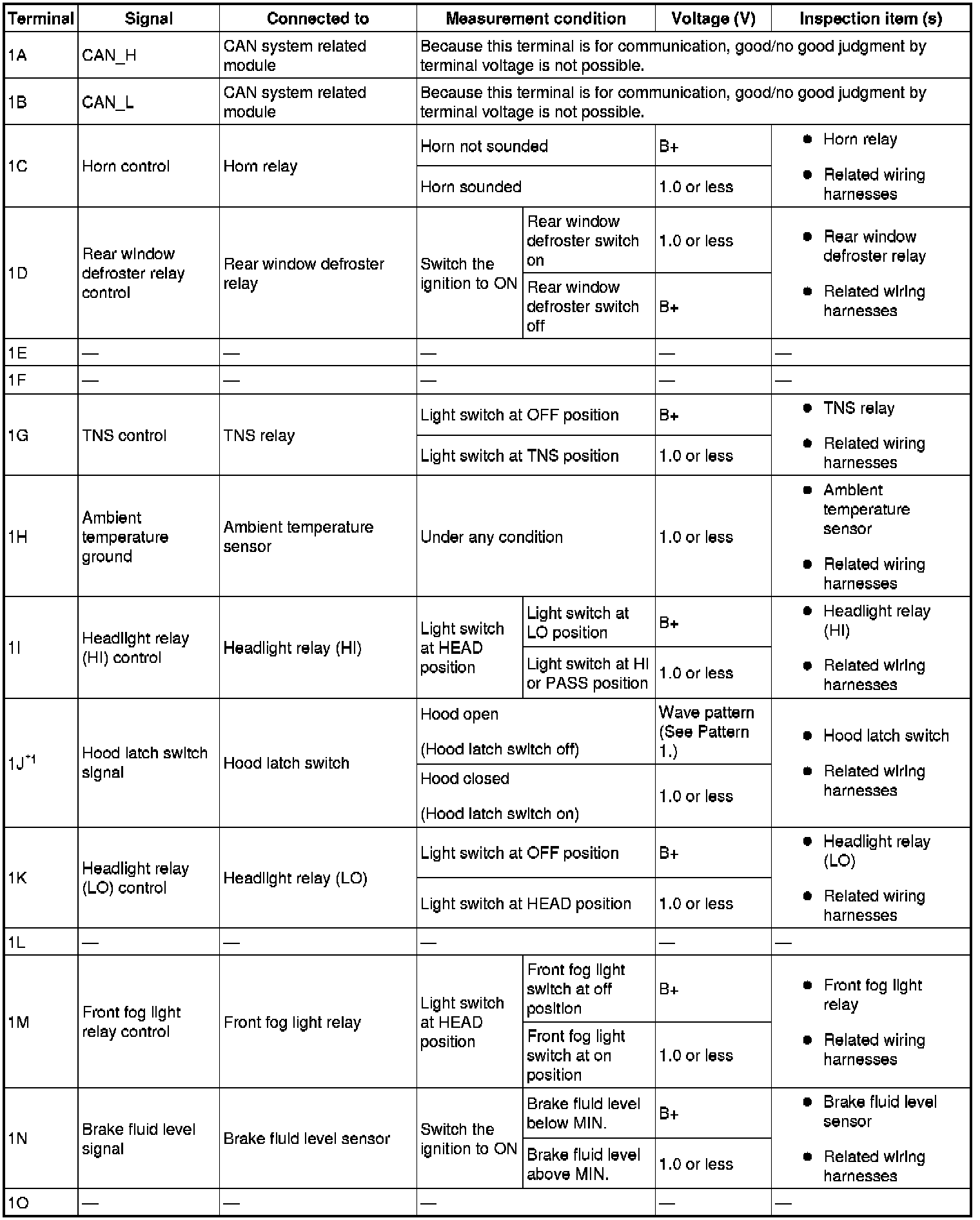
Terminal Voltage Table (Reference) (Part 2):

Terminal Voltage Table (Reference) (Part 3):
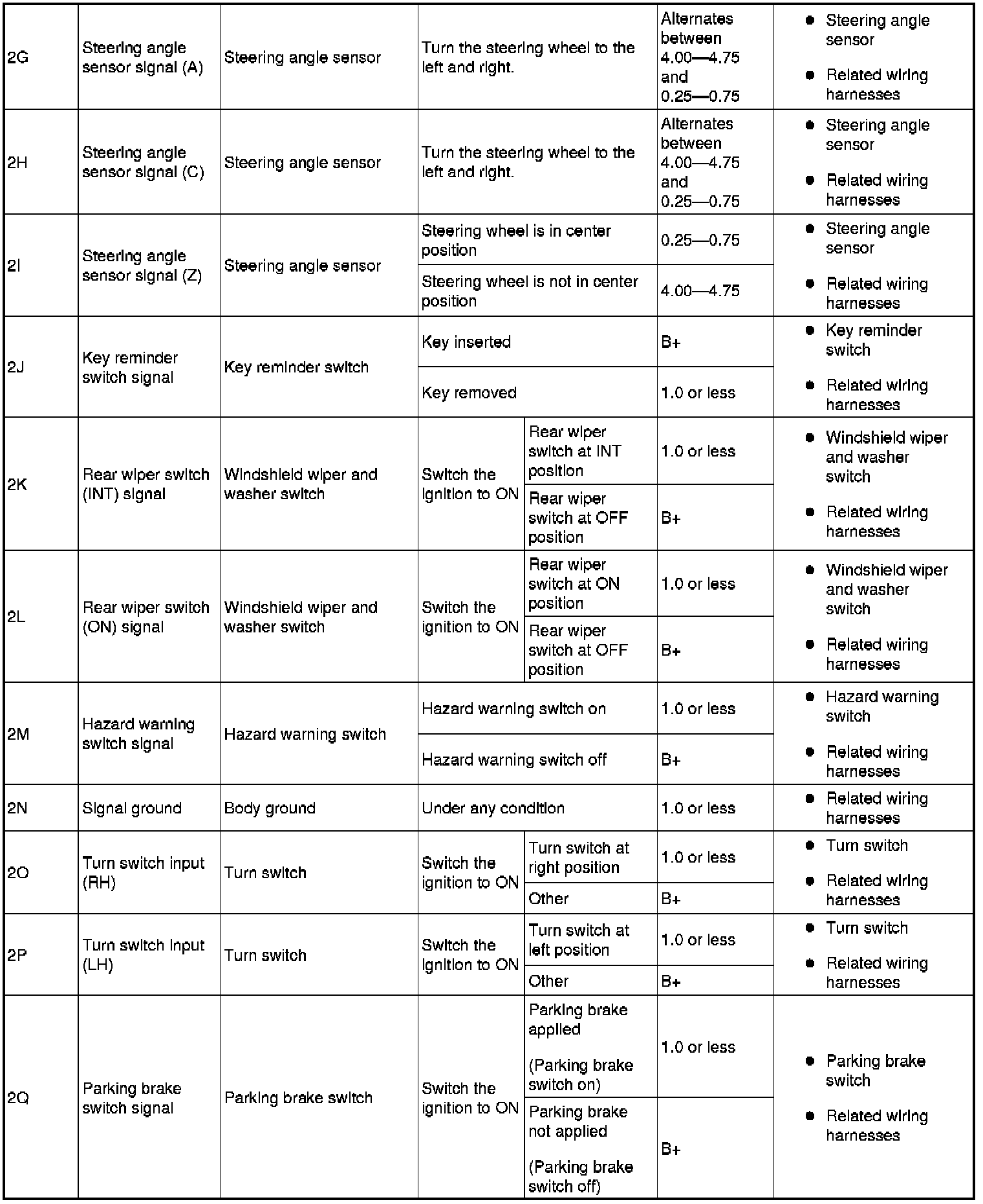
Terminal Voltage Table (Reference) (Part 4):

Terminal Voltage Table (Reference) (Part 5):

Terminal Voltage Table (Reference) (Part 6):

Terminal Voltage Table (Reference) (Part 7):

Terminal Voltage Table (Reference) (Part 8):

Terminal Voltage Table (Reference) (Part 9):

Terminal Voltage Table (Reference) (Part 10):

Terminal Voltage Table (Reference) (Part 11):

Terminal Voltage Table (Reference) (Part 12):

*1
With theft-deterrent system
*2
With power door lock system
*3
With auto wiper system
*4
With advanced keyless entry and push button start system
*5
With keyless entry system
*6
With manual air conditioner
Generated pulse (reference)
Pattern 1

- Terminal:
- Bonnet latch switch signal: 1J (+) and body ground (-)
- Rear door switch (LH) signal: 6E (+) and body ground (-)
- Front door switch (driver side) signal: 6G (+) and body ground (-)
- Front door switch (passenger side) signal: 6H (+) and body ground (-)
- Lock input (Driver-side door lock-link switch): 6I (+) and body ground (-)
- Lock/unlock input (passenger-side door lock-link switch) (rear door lock link switch (RH, LH)): 6J (+) and body ground (-)
- Rear door switch (RH) signal: 6K (+) and body ground (-)
- Unlock input (Driver-side door lock-link switch): 6L (+) and body ground (-)
- Oscilloscope setting: 1 V/DIV (Y), 1 ms/DIV (X), DC range
Pattern 2

- Terminal: 2E (+) and body ground (-)
- Oscilloscope setting: 5 V/DIV (Y), 200 ms/DIV (X), DC range
Inspection Using an Oscilloscope (Reference)
Intruder sensor signal

- Terminal connected: 5N (+)-Body ground (-)
- Oscilloscope setting: 5 V/DIV (Y): 5 s/DIV (X), DC range
Factory Service Tools
Use the Manual With the Right Hardware
Pair factory procedures with proven DIY tools so the instructions are easier to execute.
Disclosure: Verified tool recommendations may earn an affiliate commission at no cost to you.
When to See a Mechanic
Stop DIY work and contact a certified mechanic immediately if any of the following apply:
- • You smell fuel, burning insulation, or see smoke.
- • Brakes feel soft, pull hard to one side, or make grinding noises.
- • The engine overheats, stalls repeatedly, or misfires under load.
- • You are missing required tools, torque specs, or safe lifting equipment.
- • You are not confident in the next step or safety outcome.
Rather have a pro handle this?
A certified mobile mechanic comes to your home or office. They bring the tools, you stay comfortable. No tow truck, no waiting room, no surprises.
Comes to youSame-day available12-month warranty
Get a Free QuoteNo obligation. See pricing before you book.