
Safety Warning
DIY auto repair can cause serious injury, fire, or vehicle damage. These guides are for informational purposes only. Always follow OEM torque specs, wear PPE, and consult a certified mechanic if you are unsure. You are solely responsible for your safety.
1991 Mazda 626 L4-2184cc 2.2L SOHC F2FACTORY OEM SERVICE PROCEDURE
With Automatic Transaxle (ATX)
ECU Testing (A/T):
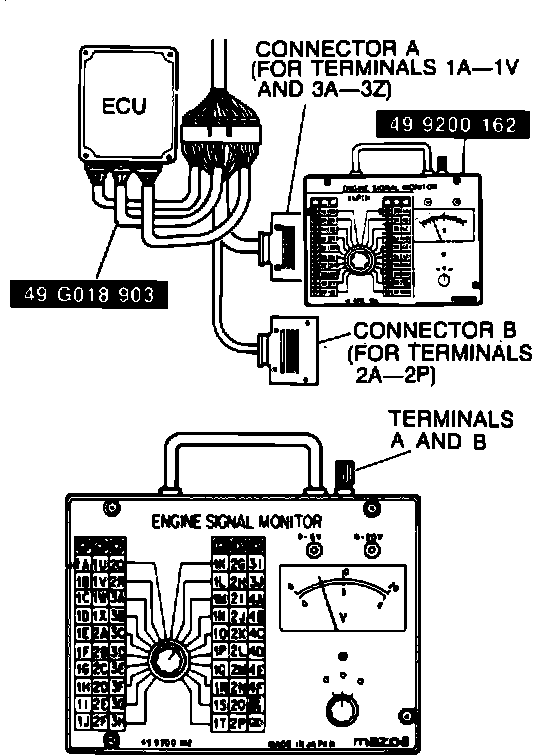
The Mazda Engine Signal Monitor (#49 9200 162) is utilized to check ECU terminal voltages. This tool inspects individual terminal voltages as selected with the monitor switch. A high impedance volt/ohm meter can also be used to check these voltages. Aftermarket test units are available that will read ECU terminal voltages when connected with proper adapters.
To use the Engine Signal Monitor, connect unit between ECU and wiring harness with the correct adapter (#49 G018 903). Place pin number cover sheet (#49 G018 904) on monitor face. Turn select and monitor switches to the desired terminal number for a voltage readout. Conduct tests with engine at operating temperature unless instructed otherwise.
NOTE: On automatic transmission models, use adapter connector "A" to check voltage at terminals 1A through 1V and 3A through 3Z. Use connector "B" to check voltage at terminals 2A through 2P.
CAUTION: Never apply voltage to terminals "A" and "B."
ECU TESTING PRECAUTIONS
1. Never push circuit tester probes into connectors from ECU side.
2. Before replacing an ECU, check components, wiring harnesses and terminal contacts if terminal voltage readings are incorrect. Repair as needed and recheck voltage readings.
ECU PIN VOLTAGE CHART
PART 1
ECU Pin Voltage Chart (Part 1):

PART 2
ECU Pin Voltage Chart (Part 2):

PART 3
ECU Pin Voltage Chart (Part 3):

Factory Service Tools
Use the Manual With the Right Hardware
Pair factory procedures with proven DIY tools so the instructions are easier to execute.
Disclosure: Verified tool recommendations may earn an affiliate commission at no cost to you.
When to See a Mechanic
Stop DIY work and contact a certified mechanic immediately if any of the following apply:
- • You smell fuel, burning insulation, or see smoke.
- • Brakes feel soft, pull hard to one side, or make grinding noises.
- • The engine overheats, stalls repeatedly, or misfires under load.
- • You are missing required tools, torque specs, or safe lifting equipment.
- • You are not confident in the next step or safety outcome.