
Safety Warning
DIY auto repair can cause serious injury, fire, or vehicle damage. These guides are for informational purposes only. Always follow OEM torque specs, wear PPE, and consult a certified mechanic if you are unsure. You are solely responsible for your safety.
2009 Jeep Commander 2WD V8-4.7LFACTORY OEM SERVICE PROCEDURE
Spark Plug - Installation
4.7L
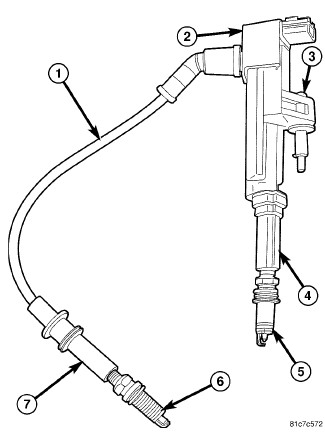
CAUTION: This engine uses TWO DIFFERENT types of spark plugs. A total of 16 plugs are used. The plugs are mounted in two rows (banks). The upper row (5) is used on the intake valve side of the cylinder head. The lower row (6) is used on the exhaust valve side of the cylinder head. The upper row (5) uses Bosch Nickel Yttrium plugs. The lower row (6) uses Bosch Iridium plugs. DO NOT INTERCHANGE THESE PLUGS.
CAUTION: Never use a motorized wire wheel brush to clean spark plugs. Metallic deposits will remain on spark plug insulator and will cause plug misfire.
CAUTION: Do not attempt to clean any of the spark plugs. Replace only.
1. To aid in coil installation, apply silicone based grease such as Mopar(R) Dielectric Grease into spark plug end of rubber boots (4) and (7). Also apply this grease to the tops of spark plugs (5) and (6).
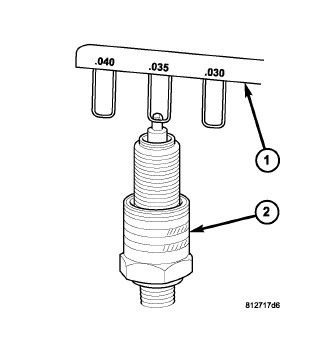
2. NOTE: Two different spark plug gaps are used.
Check and adjust spark plug gap(s) with a plug gap gauging tool (1)Spark Plug Specifications.
3. NOTE: Do not drop spark plugs into the plug wells as electrode damage can occur.
Using special care install spark plug(s) into the cylinder head by hand to avoid cross threading.
NOTE: Always tighten spark plugs to the specified torque. Certain engines use torque sensitive spark plugs. Over tightening can cause distortion resulting in a change to the spark plug gap, or a cracked porcelain insulator.
CAUTION: Due to tight clearances between upper row of plugs (5) and cylinder head, a conventional deep, thick-wall spark plug socket will not fit. Use a deep, THIN-WALL 5/8" spark plug socket for plug removal and installation.
4. Tighten spark plug(s) to the specified torque Spark Plug Specifications.
5. Install ignition coil(s) Ignition Coil - Installation.
6. Install necessary air filter tubing and air intake components to top of engine and to throttle body.
Factory Service Tools
Use the Manual With the Right Hardware
Pair factory procedures with proven DIY tools so the instructions are easier to execute.
Disclosure: Verified tool recommendations may earn an affiliate commission at no cost to you.
When to See a Mechanic
Stop DIY work and contact a certified mechanic immediately if any of the following apply:
- • You smell fuel, burning insulation, or see smoke.
- • Brakes feel soft, pull hard to one side, or make grinding noises.
- • The engine overheats, stalls repeatedly, or misfires under load.
- • You are missing required tools, torque specs, or safe lifting equipment.
- • You are not confident in the next step or safety outcome.