Safety Warning
DIY auto repair can cause serious injury, fire, or vehicle damage. These guides are for informational purposes only. Always follow OEM torque specs, wear PPE, and consult a certified mechanic if you are unsure. You are solely responsible for your safety.
SYS.OK|MANUAL.DB● LIVE
HOMESERVICE MANUALSHYUNDAI2009AZERA V6-3.8LREPAIR AND DIAGNOSISSTARTING AND CHARGINGBATTERYTESTING AND INSPECTIONGENERAL INFORMATION
2009 Hyundai Azera V6-3.8L
General Information
2009 Hyundai Azera V6-3.8LSECTION General Information
Battery Test Procedure
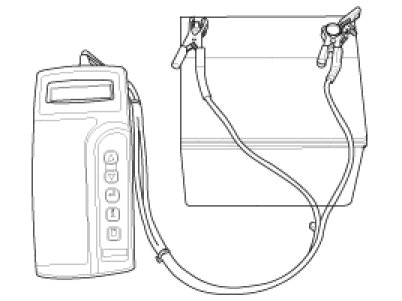
1. Connect the tester to the battery.
A. Red clamp to battery positive (+) terminal.
B. Black clamp to battery negative (-) terminal.
CAUTION:
Connect clamps securely. If "CHECK CONNECTION" message is displayed on the screen, reconnect clamps securely.
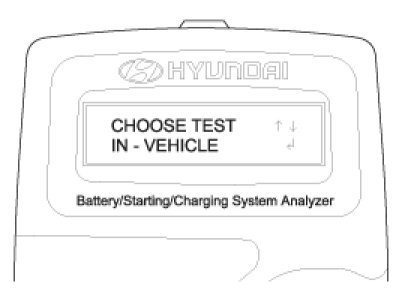
2. The tester will ask if the battery is connected "IN A VEHICLE" or "OUT OF A VEHICLE". Make your selection by pressing the arrow buttons; then press ENTER.
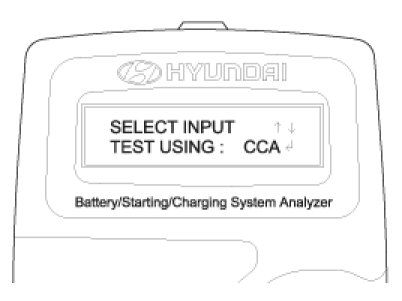
3. Choose either CCA or CCP and press the ENTER button.
NOTE:
- CCA : Cold cranking amps, is an SAE specification for cranking batteries at -18°C (0°F).
- CCP : Cold cranking amps, is an SAE specification for korean manufacturer's for cranking batteries at -18°C (0°F).
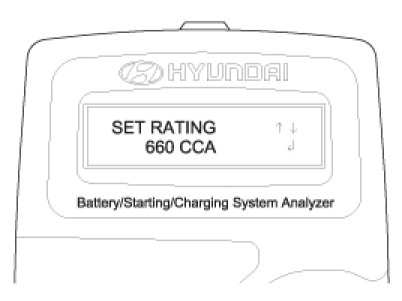
4. Set the CCA value displayed on the screen to the CCA value marked on the battery label by pressing up and down buttons and press ENTER.
NOTE:
The battery ratings(CCA) displayed on the tester must be identical to the ratings marked on battery label.
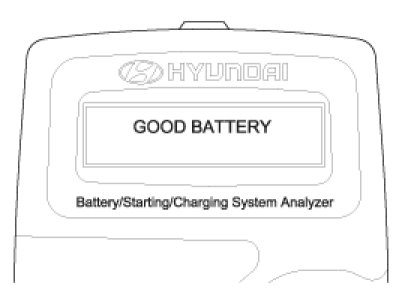
5. The tester (Micro570) displays battery test results including voltage and battery ratings.
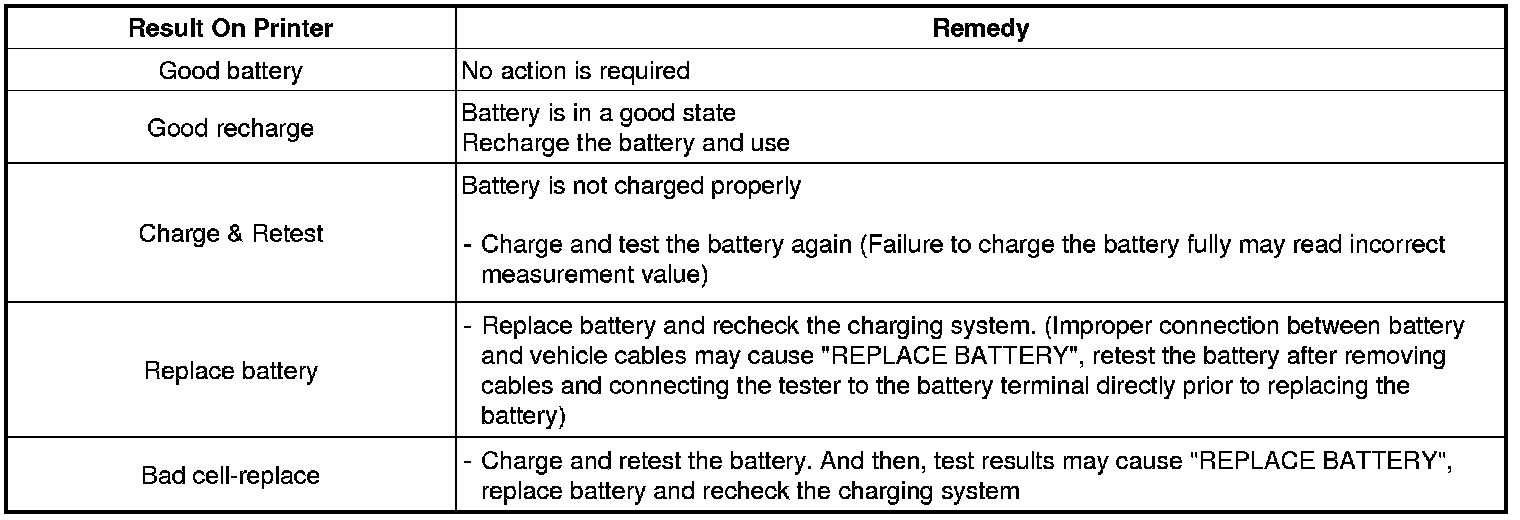
A relevant action must be given according to the test results by referring to the battery test results as shown in the table below.
NOTE:
The battery ratings (CCA) displayed on the tester must be identical to the ratings marked on battery label.
6. To conduct starter test, continuously, press ENTER.
Battery Test Results
WARNING:
Whenever filing a claim for battery, the print out of the battery test results must be attached.
RENDER: 1.0x
NO RELATED
Recommended Tools & Savings
Use the Manual With the Right Hardware
Pair factory procedures with proven DIY tools so the instructions are easier to execute.
Affiliate disclosure: We may earn a commission at no extra cost to you.
When to See a Mechanic
Stop DIY work and contact a certified mechanic immediately if any of the following apply:
- • You smell fuel, burning insulation, or see smoke.
- • Brakes feel soft, pull hard to one side, or make grinding noises.
- • The engine overheats, stalls repeatedly, or misfires under load.
- • You are missing required tools, torque specs, or safe lifting equipment.
- • You are not confident in the next step or safety outcome.