
Safety Warning
DIY auto repair can cause serious injury, fire, or vehicle damage. These guides are for informational purposes only. Always follow OEM torque specs, wear PPE, and consult a certified mechanic if you are unsure. You are solely responsible for your safety.
2000 Hyundai Tiburon L4-2.0LFACTORY OEM SERVICE PROCEDURE
Throttle Position Sensor: Testing and Inspection

The TP Sensor is a rotating type variable resistor that rotates with the throttle shaft to sensor the throttle valve angle. As the throttle shaft rotates, the throttle angle of the TP Sensor changes and the ECM detects the throttle valve opening based on the change of the throttle angle.
Circuit Diagram:

Harness Inspection Procedures (Steps 1 - 3):

SENSOR INSPECTION
1. Disconnect the throttle position sensor connector.
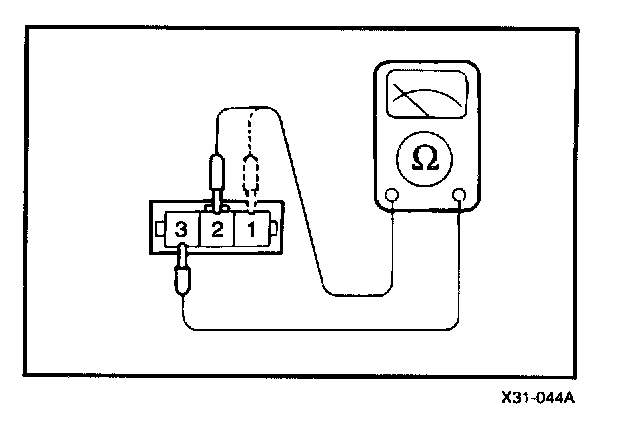
2. Measure resistance between terminal 2 (sensor ground) and terminal 3 (sensor power).
Standard value: 0.7 - 3.0 kOhms
When idling: 2.3 - 3.4 kOhms
3. Connect an ohmmeter between terminal 3 (sensor ground) and terminal 1 (sensor output).
4. Operate the throttle valve slowly from the idle position to the full open position and check that the resistance changes smoothly in proportion to the throttle valve opening angle.
5. If the resistance is out of specification, or fails to change smoothly, replace the throttle position sensor.
Tightening torque
Throttle position sensor: 1.5 - 2.5 Nm (15 - 25 kg.cm, 1.1 - 1.8 lb.ft)
Troubleshooting Procedures:

TROUBLESHOOTING HINTS
1. The TPS signal is important in the control of the automatic transaxle. Shift shock and other troubles will occur if the sensor is faulty.
2. If the idle condition or accelerating is abnormal, check the TPS connector. (When the TPS connector is not connected properly, the current data can show that the idle state remains off, though the accelerator pedal is released. And it results in improper idle or accelerating.)
3. Input voltage from throttle position sensor is below 0.1 V or above 4.7 V when ignition switch is turned on.
Using Voltmeter:

Factory Service Tools
Use the Manual With the Right Hardware
Pair factory procedures with proven DIY tools so the instructions are easier to execute.
Disclosure: Verified tool recommendations may earn an affiliate commission at no cost to you.
When to See a Mechanic
Stop DIY work and contact a certified mechanic immediately if any of the following apply:
- • You smell fuel, burning insulation, or see smoke.
- • Brakes feel soft, pull hard to one side, or make grinding noises.
- • The engine overheats, stalls repeatedly, or misfires under load.
- • You are missing required tools, torque specs, or safe lifting equipment.
- • You are not confident in the next step or safety outcome.