
Safety Warning
DIY auto repair can cause serious injury, fire, or vehicle damage. These guides are for informational purposes only. Always follow OEM torque specs, wear PPE, and consult a certified mechanic if you are unsure. You are solely responsible for your safety.
2004 Honda S2000 L4-2.2LFACTORY OEM SERVICE PROCEDURE
Engine Control Module: Service and Repair
How to Remove the ECM for Testing
NOTE:
- Make sure you have the anti theft code for the radio, then write down the frequencies for the radio's preset buttons before you disconnect the negative cable from the battery.
- Enter the anti theft code, then enter the customer's radio station presets, and set the clock after you reconnect the negative cable to the battery.
If the inspection for a trouble code requires voltage or resistance checks at the ECM connectors, remove the ECM and test it.
1. Disconnect the negative cable from the battery.

2. Remove the left side kick panel (A) to expose the ECM (B).
3. Remove the two bolts from the ECM (B).
4. Disconnect the ECM connectors.
5. Install the ECM in the reverse order of removal.
6. Reconnect the negative cable to the battery.
7. Do the idle learn procedure.
How to Replace the ECM
1. Turn the ignition switch OFF.
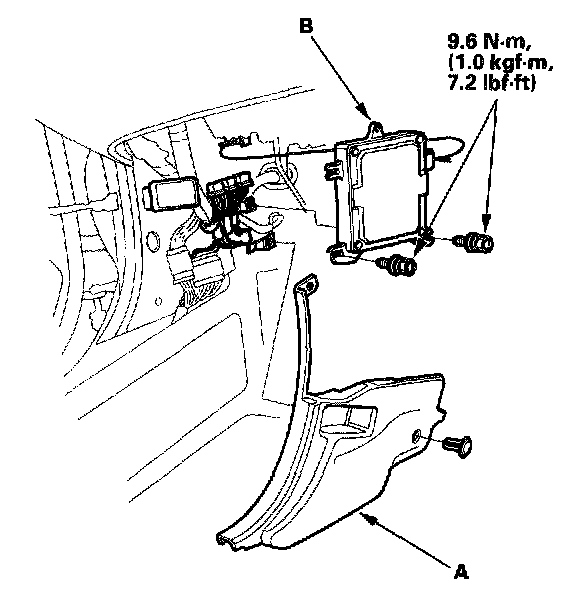
2. Remove the left side kick panel (A) to expose the ECM (B).
3. Remove the two bolts from the ECM.
4. Disconnect the ECM connectors.
5. Install the ECM in the reverse order of removal.

6. Connect the HDS to the DLC (A) located under the passenger's side of dashboard ('00-01 models) or behind the driver's side of the front console ('02-04 models).
7. Turn the ignition switch ON (II).
NOTE: If DTC P0630 "VIN Not Programmed or Mismatch" is stored at this time, ignore it and continue this procedure.
8. Input the VIN to the ECM with the HDS.
9. Rewrite the immobilizer code with the ECM replacement procedure in the HDS; it allows you to start the engine.
10. Reset the ECM with the HDS.
11. Do the idle learn procedure.
NOTE:
- Make sure you have the anti theft code for the radio, then write down the frequencies for the radio's preset buttons before you disconnect the negative cable from the battery.
- Enter the anti theft code, then enter the customer's radio station presets, and set the clock after you reconnect the negative cable to the battery.
If the inspection for a trouble code requires voltage or resistance checks at the ECM connectors, remove the ECM and test it.
1. Disconnect the negative cable from the battery.
2. Remove the left side kick panel (A) to expose the ECM (B).
3. Remove the two bolts from the ECM (B).
4. Disconnect the ECM connectors.
5. Install the ECM in the reverse order of removal.
6. Reconnect the negative cable to the battery.
7. Do the idle learn procedure.
How to Replace the ECM
1. Turn the ignition switch OFF.
2. Remove the left side kick panel (A) to expose the ECM (B).
3. Remove the two bolts from the ECM.
4. Disconnect the ECM connectors.
5. Install the ECM in the reverse order of removal.
6. Connect the HDS to the DLC (A) located under the passenger's side of dashboard ('00-01 models) or behind the driver's side of the front console ('02-04 models).
7. Turn the ignition switch ON (II).
NOTE: If DTC P0630 "VIN Not Programmed or Mismatch" is stored at this time, ignore it and continue this procedure.
8. Input the VIN to the ECM with the HDS.
9. Rewrite the immobilizer code with the ECM replacement procedure in the HDS; it allows you to start the engine.
10. Reset the ECM with the HDS.
11. Do the idle learn procedure.
Factory Service Tools
Use the Manual With the Right Hardware
Pair factory procedures with proven DIY tools so the instructions are easier to execute.
Disclosure: Verified tool recommendations may earn an affiliate commission at no cost to you.
When to See a Mechanic
Stop DIY work and contact a certified mechanic immediately if any of the following apply:
- • You smell fuel, burning insulation, or see smoke.
- • Brakes feel soft, pull hard to one side, or make grinding noises.
- • The engine overheats, stalls repeatedly, or misfires under load.
- • You are missing required tools, torque specs, or safe lifting equipment.
- • You are not confident in the next step or safety outcome.
Rather have a pro handle this?
A certified mobile mechanic comes to your home or office. They bring the tools, you stay comfortable. No tow truck, no waiting room, no surprises.
Comes to youSame-day available12-month warranty
Get a Free QuoteNo obligation. See pricing before you book.