
Safety Warning
DIY auto repair can cause serious injury, fire, or vehicle damage. These guides are for informational purposes only. Always follow OEM torque specs, wear PPE, and consult a certified mechanic if you are unsure. You are solely responsible for your safety.
2011 Ford Escape 4WD L4-2.5LFACTORY OEM SERVICE PROCEDURE
Adhesives
Adhesives
Material
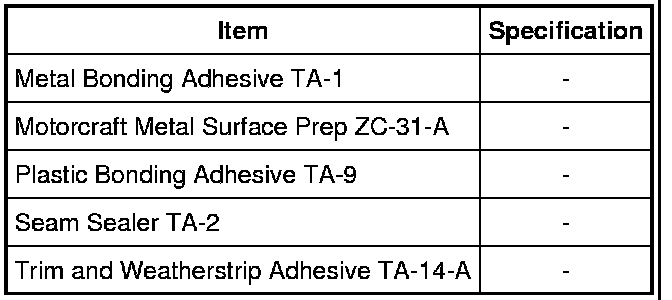
Adhesives are used in a variety of applications. Typical uses for adhesives include roof panels, door skins and quarter panels. Trim applications include body side mouldings, emblems, stationary glass and weatherstripping. Combination sealer/adhesives are also used. Surface preparation is critical to a high quality repair. Following the label instructions for the product is essential.
Work in a well-ventilated area and protect adjacent surfaces when working with adhesives. The use of eye protection and protective clothing is also recommended when working with adhesives. Carry out a trial fit, mark and align the surfaces before bonding the materials together.
Seam sealers and corrosion protection may be necessary once the adhesive(s) has cured, depending on the application. The following is a list of adhesives recommended for certain types of applications:
- Metal Bonding Adhesive - For bonding cold-rolled steel, galvanized steel, aluminum and correctly prepared E-coat. It is used for door skin and roof panel replacement and OEM structural adhesive replacement.
- Plastic Bonding Adhesive - For bonding a variety of plastics to plastics and plastics to primed, painted or E-coated metals. Also for general purpose bonding of trim components.
- Seam Sealer - Heavy-bodied, non-sag adhesive/sealer for use on standing cosmetic seams, truck bed seams, tooled door skin seams and floor pans.
- Trim and Weatherstrip Adhesive - For use on body side moulding, emblems, trim, bumper impact strips and carpeting.
- Clear Silicone Rubber - Used for sealing water leaks, noise concerns, remounting trim and repairing torn weatherstripping.
Structural Adhesive
NOTE: Corrosion protection needs to be restored whenever it is necessary to sand or grind through painted surfaces or E-coat, or when bare metal repairs are made.
NOTE: Factory spot welds may be substituted with either resistance spot welds or Metal Inert Gas (MIG) plug welds. Spot/plug welds should equal factory welds in both location and quantity. Do not place a new spot weld directly over an original weld location. Plug weld hole should equal 8 mm (0.31 in) diameter.
NOTE: Remove the outer body sheet metal from the affected area prior to carrying out any reinforcing panel replacement. Refer to Sectioning Guidelines .
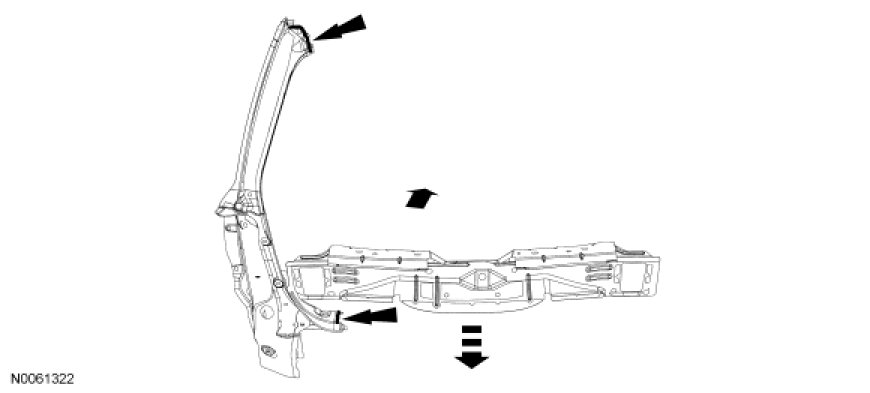
NOTE: The following illustrations identify structural adhesive locations.
Rear Corner Pillar-to-Rear Floor Crossmember
NOTE: Illustration view from rear of the vehicle, left rear side. Rear sill panel raised out of position for clarification of the structural adhesive application.
Factory Service Tools
Use the Manual With the Right Hardware
Pair factory procedures with proven DIY tools so the instructions are easier to execute.
Disclosure: Verified tool recommendations may earn an affiliate commission at no cost to you.
When to See a Mechanic
Stop DIY work and contact a certified mechanic immediately if any of the following apply:
- • You smell fuel, burning insulation, or see smoke.
- • Brakes feel soft, pull hard to one side, or make grinding noises.
- • The engine overheats, stalls repeatedly, or misfires under load.
- • You are missing required tools, torque specs, or safe lifting equipment.
- • You are not confident in the next step or safety outcome.
Rather have a pro handle this?
A certified mobile mechanic comes to your home or office. They bring the tools, you stay comfortable. No tow truck, no waiting room, no surprises.
Comes to youSame-day available12-month warranty
Get a Free QuoteNo obligation. See pricing before you book.