
Safety Warning
DIY auto repair can cause serious injury, fire, or vehicle damage. These guides are for informational purposes only. Always follow OEM torque specs, wear PPE, and consult a certified mechanic if you are unsure. You are solely responsible for your safety.
2008 Ford Explorer 2WD V8-4.6LFACTORY OEM SERVICE PROCEDURE
Spark Plug: Service and Repair
Spark Plugs
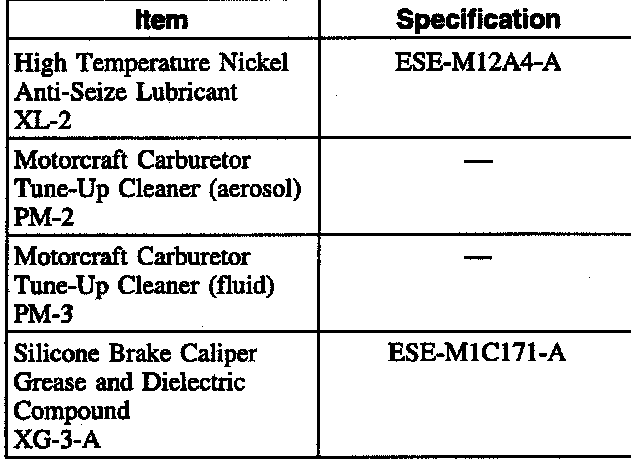
Materials
Removal
All vehicles
1. Disconnect the ignition coil electrical connector.
2. Remove the bolt and the ignition coil.
^ Use a twisting motion while pulling up on the ignition coil.
Early build vehicles (black coil boot)
3. CAUTION:
- Do not remove the spark plugs when the engine is hot or cold soaked. Spark plug thread or cylinder head damage can occur. Make sure the engine is warm (hand touch after cooling down) prior to spark plug removal.
- Only use hand tools when removing or installing the spark plugs or damage can occur to the cylinder head or spark plug.
NOTE:
- Use compressed air to remove any foreign material from the spark plug well before removing the spark plugs.
Remove the spark plug in the following sequence.
1. Loosen the spark plug no more than one-eighth to one-fourth of a turn.
2. NOTICE: Excessive use of carburetor tune-up cleaner can introduce enough liquid volume to hydro-lock the engine.
Using carburetor tune-up cleaner, fill the spark plug well until fluid has reached the park plug jamb nut. Follow the directions on the packaging.
3. NOTICE: Do not loosen or tighten the spark plug for a minimum of 15 minutes or damage to the cylinder head or spark plug may occur.
Let the carburetor tune-up cleaner soak for a minimum of 15 minutes.
4. NOTE: Some screeching and high effort may be noticed and is normal.
NOTE: The expected removal torque is around 45 Nm (33 lb-ft).
Tighten, and then loosen the spark plug, repeating until turning effort is reduced, and remove the spark plug.
Late build vehicles (brown coil boot)
4. CAUTION:
- Only use hand tools when removing or installing the spark plugs or damage can occur to the cylinder head or spark plug.
NOTE:
- Use compressed air to remove any foreign material from the spark plug well before removing the spark plugs.
- If an original spark plug is used, make sure it is installed in the same cylinder from which it was taken. New spark plugs can be used in any cylinder.
- Refer to the specifications for correct spark plug identification.
Remove the spark plugs.
All vehicles
5. Inspect the spark plugs. Install new spark plugs as necessary.
Installation
Early build vehicles (black coil boot)
1. NOTE: Refer to the specifications in this section for correct spark plug identification.
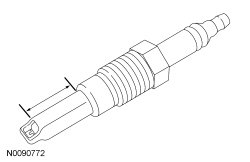
NOTE: Do not apply high temperature nickel anti-seize lubricant to the spark plug ground strap area.
Apply high temperature nickel anti-seize lubricant to only the spark plug ground electrode shield as shown.
2. NOTICE: Only use hand tools when removing or installing the sprak plugs or damage can occur to the cylinder head or spark plug.
Install the spark plug.
^ To install, tighten to 34 Nm (25 lb-ft).
Late build vehicles (brown coil boot)
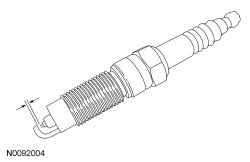
3. Adjust the spark plug gap as necessary. For the correct spark plug gap specification, refer to Specifications in this section.
4. NOTICE: Only use hand tools when removing or installing the sprak plugs or damage can occur to the cylinder head or spark plug.
Install the spark plug.
^ To install, tighten to 12 Nm (106 lb-in).
All vehicles
5. NOTE: Verify that the igition coil spring is correctly located inside the ignition coil-on plug boot and that there is no damage to the tip of the boot.
Install the ignition coil and the boot.
^ Apply a light coat of dielectric compound to the inside of the ignition coil boots.
^ To install tighten to 6 Nm (53 lb-in).
6. Connect the ignition coil electrical connector.
Factory Service Tools
Use the Manual With the Right Hardware
Pair factory procedures with proven DIY tools so the instructions are easier to execute.
Disclosure: Verified tool recommendations may earn an affiliate commission at no cost to you.
When to See a Mechanic
Stop DIY work and contact a certified mechanic immediately if any of the following apply:
- • You smell fuel, burning insulation, or see smoke.
- • Brakes feel soft, pull hard to one side, or make grinding noises.
- • The engine overheats, stalls repeatedly, or misfires under load.
- • You are missing required tools, torque specs, or safe lifting equipment.
- • You are not confident in the next step or safety outcome.
Rather have a pro handle this?
A certified mobile mechanic comes to your home or office. They bring the tools, you stay comfortable. No tow truck, no waiting room, no surprises.
Comes to youSame-day available12-month warranty
Get a Free QuoteNo obligation. See pricing before you book.