
Safety Warning
DIY auto repair can cause serious injury, fire, or vehicle damage. These guides are for informational purposes only. Always follow OEM torque specs, wear PPE, and consult a certified mechanic if you are unsure. You are solely responsible for your safety.
2012 Chrysler 200 L4-2.4LFACTORY OEM SERVICE PROCEDURE
Steering Column Control Module - Description
DESCRIPTION
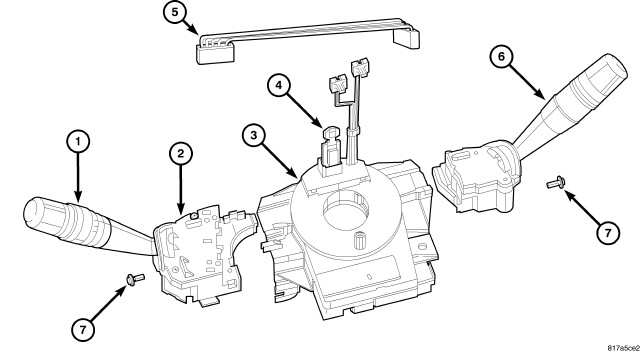
This vehicle is equipped with a Steering Column Control Module (SCCM). The SCCM is secured near the top of the steering column below the steering wheel and is completely concealed beneath the steering column shrouds. It is installed as a modular unit that supports the left (lighting) multi-function switch (1) and right (wiper) multi-function switch (6). The controls for each of these switches extend through appropriate clearance holes provided in the steering column shrouds.
The microprocessor-based Steering Control Module (SCM) (2) utilizes integrated circuitry and information carried on the Controller Area Network (CAN) data bus along with several hard wired analog and multiplexed inputs to monitor both the right and left multi-function switches. The SCCM uses a Local Interconnect Network (LIN) data bus for exterior lighting and wiper functions. The LIN data is sent to the Cab Compartment Node (CCN) and the CCN then sends it out on the CAN data bus Communication - Description. The SCCM is available for service replacement as a unit or each individual component:
- Clockspring (with integral Steering Angle Sensor if equipped)
- Left Multi-Function Switch (with integral Steering Control Module)
- Right Multi-Function Switch
Factory Service Tools
Use the Manual With the Right Hardware
Pair factory procedures with proven DIY tools so the instructions are easier to execute.
Disclosure: Verified tool recommendations may earn an affiliate commission at no cost to you.
When to See a Mechanic
Stop DIY work and contact a certified mechanic immediately if any of the following apply:
- • You smell fuel, burning insulation, or see smoke.
- • Brakes feel soft, pull hard to one side, or make grinding noises.
- • The engine overheats, stalls repeatedly, or misfires under load.
- • You are missing required tools, torque specs, or safe lifting equipment.
- • You are not confident in the next step or safety outcome.