
Safety Warning
DIY auto repair can cause serious injury, fire, or vehicle damage. These guides are for informational purposes only. Always follow OEM torque specs, wear PPE, and consult a certified mechanic if you are unsure. You are solely responsible for your safety.
2008 Chrysler Crossfire V6-3.2LFACTORY OEM SERVICE PROCEDURE
Refrigerant Oil: Service and Repair
STANDARD PROCEDURE - REFRIGERANT OIL LEVEL
When an Air Conditioning System is assembled at the factory, all components except the Compressor are refrigerant oil free. After the refrigerant system has been charged and operated, the refrigerant oil in the Compressor is dispersed throughout the refrigerant system. The Accumulator, Evaporator, Condenser, and Compressor will each retain a significant amount of the needed refrigerant oil.
It is important to have the correct amount of oil in the refrigerant system. This ensures proper lubrication of the Compressor. Too little oil will result in damage to the Compressor. Too much oil will reduce the cooling capacity of the Air Conditioning System.
It will not be necessary to check the oil level in the Compressor or to add oil, unless there has been an oil loss. An oil loss may occur due to a rupture or leak from a refrigerant line, a connector fitting, a component, or a component seal. If a leak occurs, add 30 milliliters (1 fluid ounce) of refrigerant oil to the refrigerant system after the repair has been made. Refrigerant oil loss will be evident at the leak point by the presence of a wet, shiny surface around the leak.
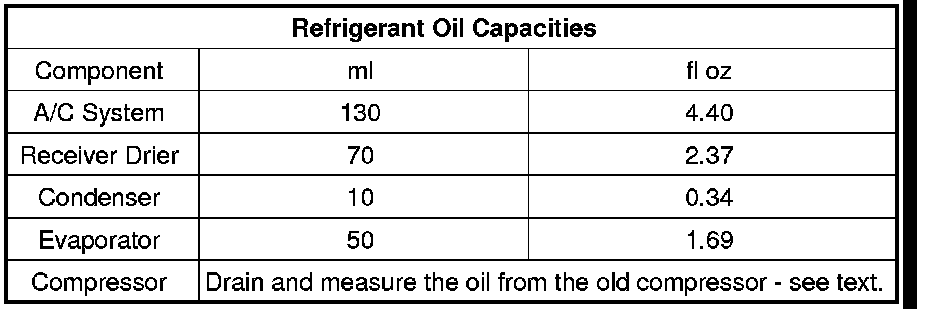
Refrigerant oil must be added when an Accumulator, Evaporator Coil, or Condenser are replaced. See the Refrigerant Oil Capacities chart. When a Compressor is replaced, the refrigerant oil must be drained from the old Compressor and measured. Drain all of the refrigerant oil from the new Compressor, then fill the new Compressor with the same amount of refrigerant oil that was drained out of the old Compressor.
Factory Service Tools
Use the Manual With the Right Hardware
Pair factory procedures with proven DIY tools so the instructions are easier to execute.
Disclosure: Verified tool recommendations may earn an affiliate commission at no cost to you.
When to See a Mechanic
Stop DIY work and contact a certified mechanic immediately if any of the following apply:
- • You smell fuel, burning insulation, or see smoke.
- • Brakes feel soft, pull hard to one side, or make grinding noises.
- • The engine overheats, stalls repeatedly, or misfires under load.
- • You are missing required tools, torque specs, or safe lifting equipment.
- • You are not confident in the next step or safety outcome.