
Safety Warning
DIY auto repair can cause serious injury, fire, or vehicle damage. These guides are for informational purposes only. Always follow OEM torque specs, wear PPE, and consult a certified mechanic if you are unsure. You are solely responsible for your safety.
2003 Chevrolet Express 1/2 Ton Van V6-4.3L VIN XFACTORY OEM SERVICE PROCEDURE
I/M EVAP System Set Procedure
INSPECTION/MAINTENANCE (I/M) EVAPORATIVE EMISSION (EVAP) SYSTEM SET PROCEDURE
DESCRIPTION
The purpose of this test is to satisfy the enable criteria necessary to execute I/M readiness diagnostics for the evaporative emission (EVAP) system. The test may be used to set the I/M System Status indicators to YES. The I/M System Status Display on the scan tool provides an indication of when the control module has completed the required tests. The I/M System Status does not indicate that the tests have passed or failed. When all of the diagnostics for a specific system have run and passed, the I/M System Status will update to YES. If a test for a specific system has failed, the I/M System Status will update to YES, indicating a determination was made, even if all of the other tests for that system have not run. Performing a visual inspection prior to running the EVAP test may prevent having to repeat the test. A failed or aborted test will require the vehicle to cool down in order to meet the enable criteria to run another test.
CONDITIONS FOR RUNNING
- DTCs P0442, P0446, P0455, P0496 are not set.
- The barometric pressure (BARO) is more than 75 kPa.
- The fuel level is between 1/4 and 3/4.
- The battery voltage is between 10-18 volts.
- The test will initiate only after a cold start. The control module considers the engine to be cold if the following conditions are met:
- The engine coolant temperature (ECT) is between 3.75-30°C (39-86°F).
- The intake air temperature (IAT) is between 3.75-30°C (39-86°F).
- The difference between the ECT and the IAT is less than 8°C (14°F).
DIAGNOSTIC AIDS
If there is an impending failure, the system may require more time to run the diagnostic than was allotted in the set procedure. If the test does not run after numerous attempts and no DTC is set, review the appropriate scan tool data list and the service information for an indication of why the test does not complete. Some tests may abort due to changes in the conditions while the test is running. For example, changes in engine load, such as the cooling fan or an A/C compressor clutch turning ON, may cause the test to abort.
TEST
DESCRIPTION
The purpose of this test is to satisfy the enable criteria necessary to execute I/M readiness diagnostics for the evaporative emission (EVAP) system. The test may be used to set the I/M System Status indicators to YES. The I/M System Status Display on the scan tool provides an indication of when the control module has completed the required tests. The I/M System Status does not indicate that the tests have passed or failed. When all of the diagnostics for a specific system have run and passed, the I/M System Status will update to YES. If a test for a specific system has failed, the I/M System Status will update to YES, indicating a determination was made, even if all of the other tests for that system have not run. Performing a visual inspection prior to running the EVAP test may prevent having to repeat the test. A failed or aborted test will require the vehicle to cool down in order to meet the enable criteria to run another test.
CONDITIONS FOR RUNNING
- DTCs P0442, P0446, P0455, P0496 are not set.
- The barometric pressure (BARO) is more than 75 kPa.
- The fuel level is between 1/4 and 3/4.
- The battery voltage is between 10-18 volts.
- The test will initiate only after a cold start. The control module considers the engine to be cold if the following conditions are met:
- The engine coolant temperature (ECT) is between 3.75-30°C (39-86°F).
- The intake air temperature (IAT) is between 3.75-30°C (39-86°F).
- The difference between the ECT and the IAT is less than 8°C (14°F).
DIAGNOSTIC AIDS
If there is an impending failure, the system may require more time to run the diagnostic than was allotted in the set procedure. If the test does not run after numerous attempts and no DTC is set, review the appropriate scan tool data list and the service information for an indication of why the test does not complete. Some tests may abort due to changes in the conditions while the test is running. For example, changes in engine load, such as the cooling fan or an A/C compressor clutch turning ON, may cause the test to abort.
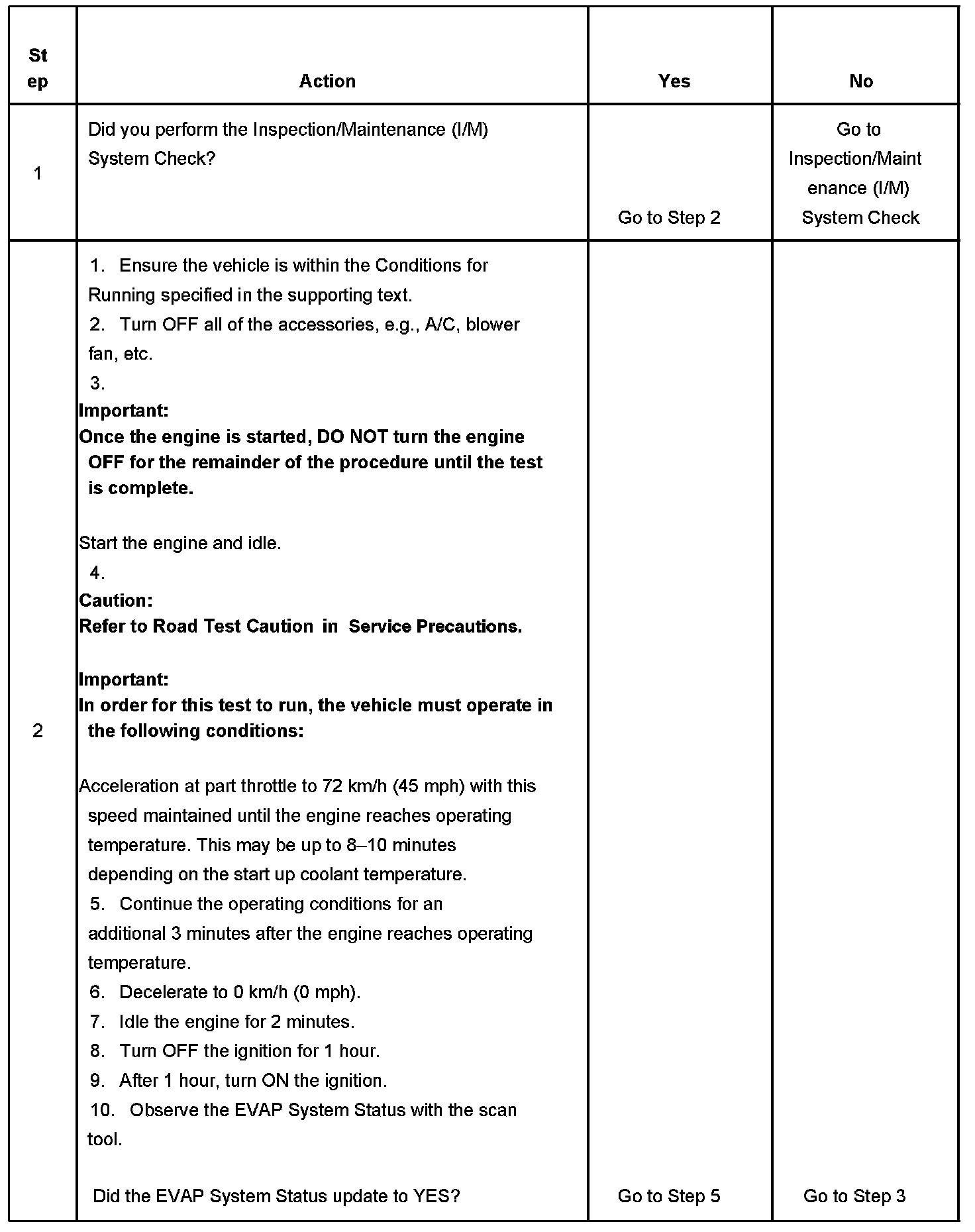
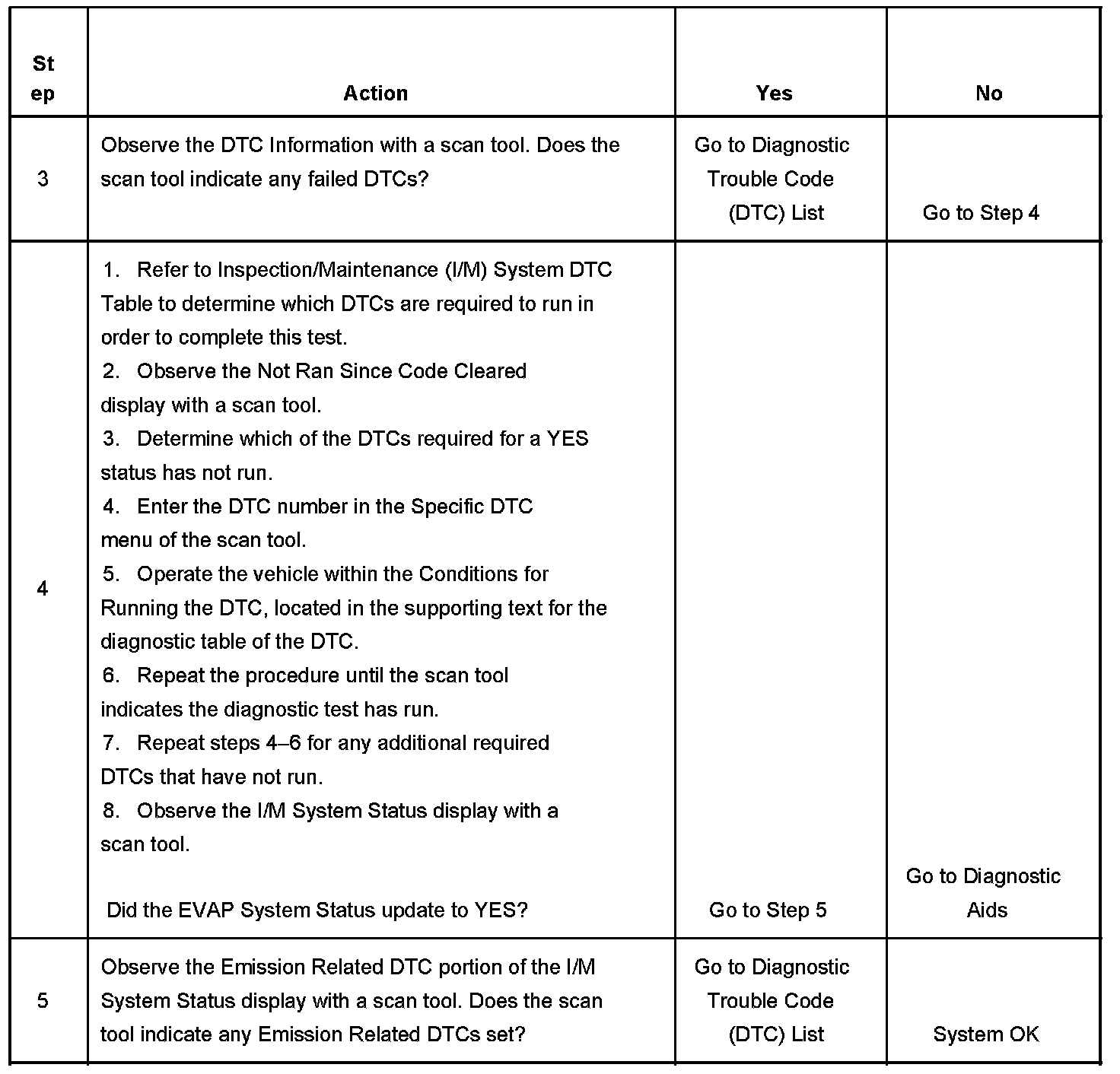
TEST
Steps 1-2:
Steps 3-5:
Factory Service Tools
Use the Manual With the Right Hardware
Pair factory procedures with proven DIY tools so the instructions are easier to execute.
Disclosure: Verified tool recommendations may earn an affiliate commission at no cost to you.
When to See a Mechanic
Stop DIY work and contact a certified mechanic immediately if any of the following apply:
- • You smell fuel, burning insulation, or see smoke.
- • Brakes feel soft, pull hard to one side, or make grinding noises.
- • The engine overheats, stalls repeatedly, or misfires under load.
- • You are missing required tools, torque specs, or safe lifting equipment.
- • You are not confident in the next step or safety outcome.
Rather have a pro handle this?
A certified mobile mechanic comes to your home or office. They bring the tools, you stay comfortable. No tow truck, no waiting room, no surprises.
Comes to youSame-day available12-month warranty
Get a Free QuoteNo obligation. See pricing before you book.