Safety Warning
DIY auto repair can cause serious injury, fire, or vehicle damage. These guides are for informational purposes only. Always follow OEM torque specs, wear PPE, and consult a certified mechanic if you are unsure. You are solely responsible for your safety.
SYS.OK|MANUAL.DB● LIVE
HOMESERVICE MANUALSCADILLAC1991SEVILLE V8-300 4.9LREPAIR AND DIAGNOSISPOWERTRAIN MANAGEMENTCOMPUTERS AND CONTROL SYSTEMSDESCRIPTION AND OPERATIONGENERAL SYSTEM DESCRIPTION
1991 Cadillac Seville V8-300 4.9L
General System Description
1991 Cadillac Seville V8-300 4.9LSECTION General System Description
PCM Inputs/Outputs:
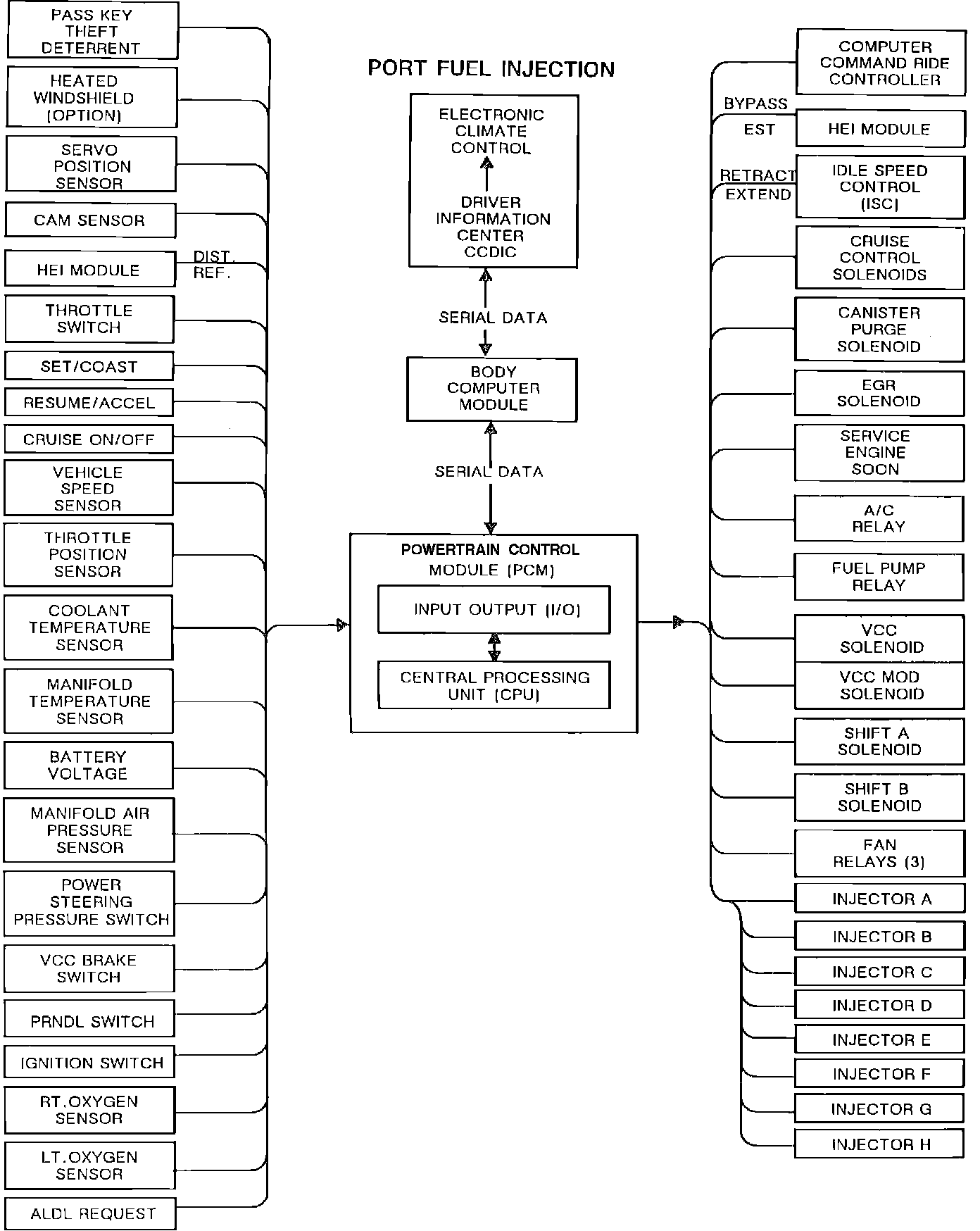
SYSTEM DESCRIPTION:
This vehicle uses several electronic components which form an electronic computer network, designed to control various engine and body sub-systems. The heart of the computer network is the Body Computer Module (BCM). The BCM has an internal microprocessor which is the center for communication with all the other components, and controls the on-board diagnostics of the vehicle. All system sensors and switches are monitored by the BCM or one of the five other major components that complete the computer system network. The other five components are the Climate Control Driver Information Center (CCDIC), Diagnostic Energy Reserve Module (DERM) Supplemental Inflatable Restraint (SIR) controller, Powertrain Control Module (PCM), Heating, Ventilation, and Air Conditioning (HVAC) Programmer, and the Instrument Panel Cluster (IPC).
The CCDIC is used by the driver to control the air conditioner and heating system, also used to retrieve diagnostic information (i.e. trouble codes, sensor parameters, etc.), or override certain output components. The DERM monitors, detects, and records the SIR system during operation when system components malfunction, stores the malfunction as a trouble code, and maintains a 36 volt loop reserve energy supply to provide deployment energy in the event the vehicle voltage is low or lost during an accident. The PCM controls the fuel and ignition systems to obtain good performance and low exhaust emissions. The IPC is used to display information to the driver such as vehicle speed, engine rpm, and fuel level. The HVAC Programmer receives information from the CCDIC and carries out the commands necessary to obtain the correct interior temperature.
All components in the system are always in continuous communication with each other to provide accurate control over the many sub-systems involved. When one or more of these sub-system circuits exceeds pre-programmed limits a malfunction is indicated by a service engine soon warning lamp, and a backup function may be activated until the malfunction is corrected.
RENDER: 1.0x
NO RELATED
Recommended Tools & Savings
Use the Manual With the Right Hardware
Pair factory procedures with proven DIY tools so the instructions are easier to execute.
Affiliate disclosure: We may earn a commission at no extra cost to you.
When to See a Mechanic
Stop DIY work and contact a certified mechanic immediately if any of the following apply:
- • You smell fuel, burning insulation, or see smoke.
- • Brakes feel soft, pull hard to one side, or make grinding noises.
- • The engine overheats, stalls repeatedly, or misfires under load.
- • You are missing required tools, torque specs, or safe lifting equipment.
- • You are not confident in the next step or safety outcome.