
Safety Warning
DIY auto repair can cause serious injury, fire, or vehicle damage. These guides are for informational purposes only. Always follow OEM torque specs, wear PPE, and consult a certified mechanic if you are unsure. You are solely responsible for your safety.
2012 Volkswagen CC (357) L4-2.0L Turbo (CCTA)FACTORY OEM SERVICE PROCEDURE
Coolant Temperature Sensor/Switch (For Computer): Testing and Inspection
Engine Coolant Temperature Sensor 1 or 2 Checking
• Cooling system is under pressure.
• Danger of scalding when opening!
• Use only gold-plated terminals when servicing terminals in the electrical harness connector of Engine Coolant Temperature (ECT) Sensor (G62).
Special tools, testers and auxiliary items required
• Multimeter.
• Jumper wire.
• Wiring diagram.
Test requirements
• The Engine Control Module (ECM) (J623) fuses OK.

• Battery voltage at least 12.5 volts.
• All electrical consumers such as, lights and rear window defroster, switched off.
• Vehicles with automatic transmission, shift selector lever into position "P" or "N".
• A/C switched off.
• Ground connections between engine/transmission/chassis OK.
• Ignition switched OFF.
• Engine cold.
Test procedure
- Perform a preliminary check to verify the customers complaint. Refer to => [ Preliminary Check ] Preliminary Check
Start diagnosis
- Connect the scan tool.
- Switch the ignition ON.
- Using the scan tool, check the coolant temperature:

If indication remains at approx. - 40.0 °C:
- Continue test according to the following table:

If the specified value was obtained:
- Start the engine and let it run at idle.
The temperature value must increase uniformly in increments of 1.0 °C.
If the engine shows problems in certain temperature ranges and if the temperature does not climb uniformly, the temperature signal is intermittent.
- Turn the ignition switch OFF.
- Replace the Engine Coolant Temperature (ECT) Sensor Refer to the repair information.
Checking internal resistance
- Disconnect the Engine Coolant Temperature (ECT) Sensor electrical harness connector - 1 -.

- Using a multimeter, check the Engine Coolant Temperature (ECT) Sensor terminals 1 to 2 for resistance.

Use the chart below for the specified values:
Specified values:
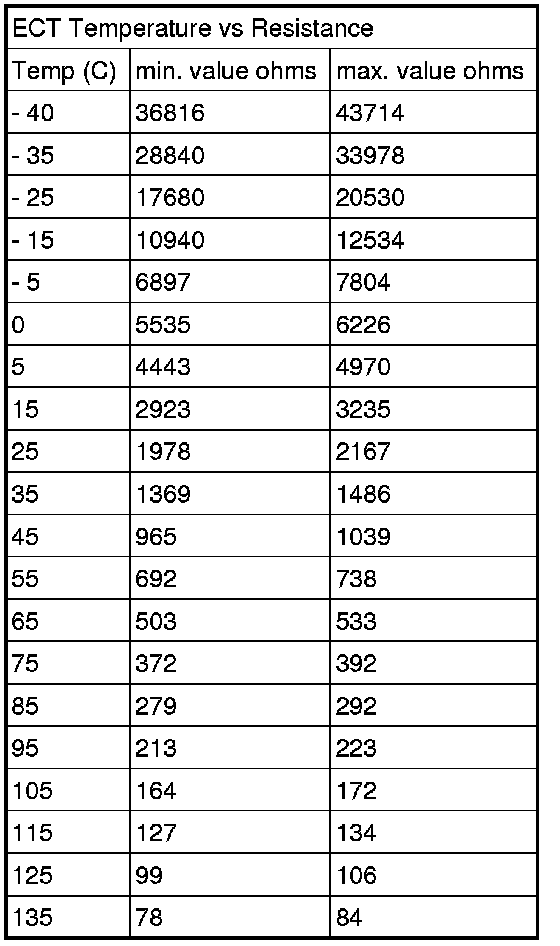
If the specified values were Not obtained:
- Replace the Engine Coolant Temperature (ECT) Sensor Refer to the repair information.
°Testing if display is approx. - 40.0 C
- Disconnect the Engine Coolant Temperature (ECT) Sensor electrical harness connector - 1 -.
- Using a jumper wire, connect the Engine Coolant Temperature (ECT) Sensor electrical harness connector terminals 1 to 2.
- Check the value indicated on the scan tool display.

If the value jumps to approx. 140.0° C
- Switch the ignition OFF.
- Replace the Engine Coolant Temperature (ECT) Sensor Refer to the repair information.
If indication remains at approx. - 40.0° C:
Checking wiring
- Remove the Engine Control Module (ECM) (J623). Refer to the repair information.
- Using a multimeter, check the Engine Coolant Temperature (ECT) Sensor electrical harness connector terminals to the Engine Control Module (ECM) (J623) electrical harness connector T60 terminals for an open circuit or a short to voltage, refer to the chart below.


Specified values: 1.5 ohms Max. and 0 volts with key on and ECM disconnected.
If the specified value was Not obtained:
- Check the wiring for an open or short circuit to Battery (+).
- Check the electrical harness connector for damage, corrosion, loose or broken terminals.
- If necessary, repair the faulty wiring connection.
If the specified value was obtained:
- Using a multimeter, check terminal 2 of the ECT sensor to engine ground.
Specified value: 1.5 ohms Max
If the specified value was Not obtained:
- Check the wiring for an open circuit or high resistance.
- Check the electrical harness connector for damage, corrosion, loose or broken terminals.
- If necessary, repair the faulty wiring connection.
If the specified value was obtained:
- Replace the Engine Control Module (ECM) (J623). Refer to the repair information.
°Testing if display approx. 140.0 C
- Disconnect the Engine Coolant Temperature (ECT) Sensor electrical harness connector - 1 -.
- Turn the ignition switch ON.
If indication jumps to approx. - 40.0 °C:
- Switch ignition OFF.
- Replace the Engine Coolant Temperature (ECT) Sensor Refer to the repair information.
If the value remains at approx. 140.0 °C
Checking wiring
- Remove the Engine Control Module (ECM) (J623) and disconnect the ECM connectors. Refer to the repair information.
- Disconnect the ECT harness connector at the sensor.
- Using a multimeter, check the signal circuit of the Engine Coolant Temperature (ECT) Sensor electrical harness connector terminal 1 to engine ground.
Specified value: OL or no continuity.
If the specified value was Not obtained:
- Check the wiring for a short circuit to Ground.
- Check the electrical harness connector for damage, corrosion, loose or broken terminals.
- If necessary, repair the faulty wiring connection.
If the specified value was obtained:
- Replace the Engine Control Module (ECM) (J623). Refer to the repair information.
Final procedures
After the repair work, the following work steps must be performed in the following sequence:
1. Check the DTC memory. Refer to => [ Diagnostic Mode 03 - Read DTC Memory ] Diagnostic Modes 01 - 09.
2. If necessary, erase the DTC memory. Refer to => [ Diagnostic Mode 04 - Erase DTC Memory ] Diagnostic Modes 01 - 09.
3. If the DTC memory was erased, generate readiness code. Refer to => [ Readiness Code ] Monitors, Trips, Drive Cycles and Readiness Codes.
Factory Service Tools
Use the Manual With the Right Hardware
Pair factory procedures with proven DIY tools so the instructions are easier to execute.
Disclosure: Verified tool recommendations may earn an affiliate commission at no cost to you.
When to See a Mechanic
Stop DIY work and contact a certified mechanic immediately if any of the following apply:
- • You smell fuel, burning insulation, or see smoke.
- • Brakes feel soft, pull hard to one side, or make grinding noises.
- • The engine overheats, stalls repeatedly, or misfires under load.
- • You are missing required tools, torque specs, or safe lifting equipment.
- • You are not confident in the next step or safety outcome.