
Safety Warning
DIY auto repair can cause serious injury, fire, or vehicle damage. These guides are for informational purposes only. Always follow OEM torque specs, wear PPE, and consult a certified mechanic if you are unsure. You are solely responsible for your safety.
2012 Toyota Corolla L4-1.8L (2ZR-FE)FACTORY OEM SERVICE PROCEDURE
Rear Wheel Alignment
ALIGNMENT / HANDLING DIAGNOSIS: REAR WHEEL ALIGNMENT: INSPECTION
NOTICE:
For vehicles equipped with VSC, if the wheel alignment has been adjusted, and if suspension or underbody components have been removed/installed or replaced, be sure to perform the following initialization procedure in order for the system to function normally:
(a) Disconnect the cable from the negative (-) battery terminal for more than 2 seconds.
(b) Reconnect the cable to the negative (-) battery terminal.
(c) Perform zero point calibration of the yaw rate and acceleration sensor and test mode inspection.
1. INSPECT TIRES Component Tests and General Diagnostics
2. MEASURE VEHICLE HEIGHT Front Wheel Alignment
3. INSPECT TOE-IN
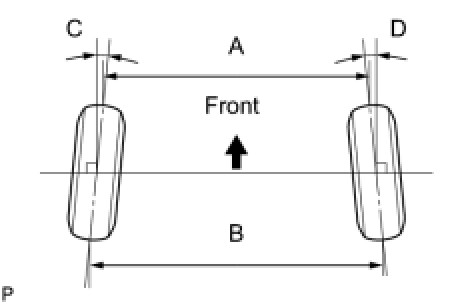
Toe-in (Unloaded Vehicle):
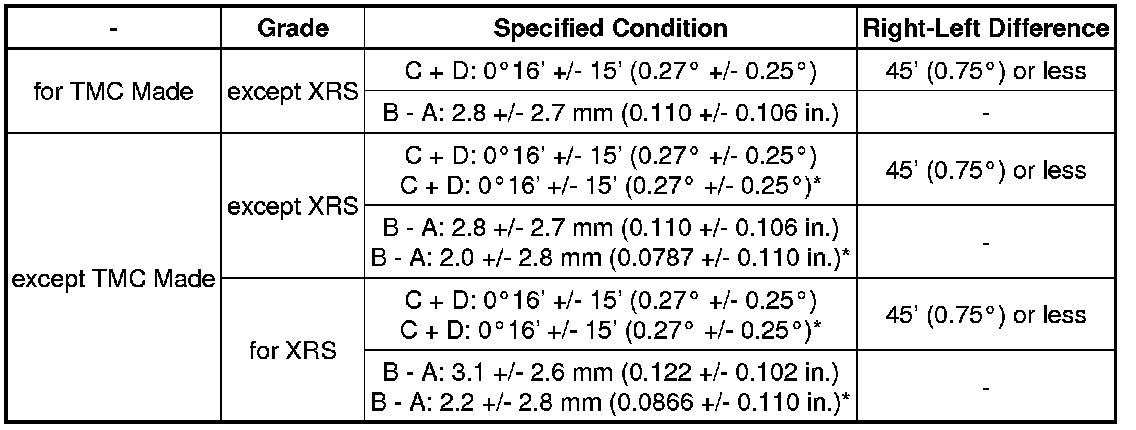
* For vehicle height for Mexico, add 15 mm (0.591 in.).
If the toe-in is not within the specified range, inspect the suspension parts and replace them if necessary.
HINT
* Measure "B - A" only when "C + D" cannot be measured.
4. INSPECT CAMBER
(a) Install the camber-caster-kingpin gauge or set the vehicle on the wheel alignment tester.
(b) Inspect the camber.
Camber (Unloaded Vehicle):

HINT
Camber is not adjustable. If the measurement is not within the specified range, inspect the suspension parts for damage and/or wear, and replace them if necessary.
Factory Service Tools
Use the Manual With the Right Hardware
Pair factory procedures with proven DIY tools so the instructions are easier to execute.
Disclosure: Verified tool recommendations may earn an affiliate commission at no cost to you.
When to See a Mechanic
Stop DIY work and contact a certified mechanic immediately if any of the following apply:
- • You smell fuel, burning insulation, or see smoke.
- • Brakes feel soft, pull hard to one side, or make grinding noises.
- • The engine overheats, stalls repeatedly, or misfires under load.
- • You are missing required tools, torque specs, or safe lifting equipment.
- • You are not confident in the next step or safety outcome.