
Safety Warning
DIY auto repair can cause serious injury, fire, or vehicle damage. These guides are for informational purposes only. Always follow OEM torque specs, wear PPE, and consult a certified mechanic if you are unsure. You are solely responsible for your safety.
2009 Toyota Matrix FWD L4-2.4L (2AZ-FE)FACTORY OEM SERVICE PROCEDURE
Compression Check: Testing and Inspection
2AZ-FE ENGINE MECHANICAL: ENGINE: ON-VEHICLE INSPECTION
ON-VEHICLE INSPECTION
1. INSPECT COMPRESSION
(a) Warm up and stop the engine.
(b) Remove the 4 ignition coils and spark plugs Removal.
(c) Disconnect the 4 fuel injector connectors.
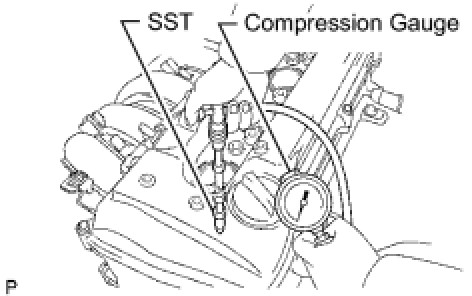
(d) Set SST and a compression gauge.
SST: 09992-00500
(e) Insert the compression gauge into the spark plug hole.
(f) Fully open the throttle.
(g) While cranking the engine, measure the compression pressure.
Standard compression pressure:
1300 kPa (13.3 kgf/cm2, 189 psi)
Minimum compression pressure:
1000 kPa (10.0 kgf/cm2, 145 psi)
Standard difference between each cylinder:
100 kPa (1.0 kgf/cm2, 15 psi) or less
NOTICE:
- Always use a fully-charged battery to obtain an engine speed of 250 rpm or more.
- Check the other cylinders in the same way.
- This measurement must be done as quickly as possible.
If the cylinder compression is low, pour a small amount of engine oil into the cylinder through the spark plug hole and inspect again.
HINT:
- If adding oil increases the compression, the piston rings and/or cylinder bore may be worn or damaged.
- If pressure stays low, a valve may be stuck or seated improperly, or there may be leakage in the gasket.
(h) Connect the 4 fuel injector connectors.
(i) Install the 4 spark plugs and ignition coils Installation.
Factory Service Tools
Use the Manual With the Right Hardware
Pair factory procedures with proven DIY tools so the instructions are easier to execute.
Disclosure: Verified tool recommendations may earn an affiliate commission at no cost to you.
When to See a Mechanic
Stop DIY work and contact a certified mechanic immediately if any of the following apply:
- • You smell fuel, burning insulation, or see smoke.
- • Brakes feel soft, pull hard to one side, or make grinding noises.
- • The engine overheats, stalls repeatedly, or misfires under load.
- • You are missing required tools, torque specs, or safe lifting equipment.
- • You are not confident in the next step or safety outcome.