
Safety Warning
DIY auto repair can cause serious injury, fire, or vehicle damage. These guides are for informational purposes only. Always follow OEM torque specs, wear PPE, and consult a certified mechanic if you are unsure. You are solely responsible for your safety.
2009 Toyota Matrix FWD L4-1.8L (2ZR-FE)FACTORY OEM SERVICE PROCEDURE
Compression Check: Testing and Inspection
2ZR-FE ENGINE MECHANICAL: ENGINE: ON-VEHICLE INSPECTION
ON-VEHICLE INSPECTION
1. INSPECT COMPRESSION
(a) Warm up and stop the engine.
(b) Remove the No. 2 cylinder head cover Removal.
(c) Remove the 4 ignition coils.
(d) Remove the 4 spark plugs Removal.
(e) Disconnect the 4 fuel injector connectors.
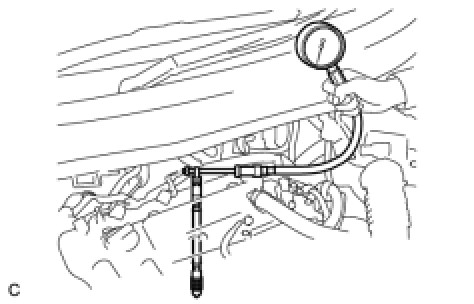
(f) Inspect the cylinder compression pressure.
(1) Insert a compression gauge into the spark plug hole.
(2) Fully open the throttle.
(3) While cranking the engine, measure the compression pressure.
Compression:
1373 kPa (14.0 kgf/cm2, 199 psi)
Minimum pressure:
1079 kPa (11.0 kgf/cm2, 157 psi)
Difference between each cylinder:
98 kPa (1.0 kgf/cm2, 14.2 psi) or less
NOTICE:
- Use a fully-charged battery so that the engine speed can be increased to 250 rpm or more.
- Inspect the other cylinders in the same way.
- Measure the compression in as a short time as possible.
(4) If the cylinder compression is low, pour a small amount of engine oil into the cylinder through the spark plug hole, then inspect it again.
HINT:
- If adding oil increases the compression, the piston rings and/or cylinder bore may be worn or damaged.
- If the pressure stays low, the valve may be stuck or seated improperly, or there may be leakage from the gasket.
(g) Connect the 4 fuel injector connectors.
(h) Install the 4 spark plugs Installation.
(i) Install the 4 ignition coils.
Torque: 10 Nm (102 kgf-cm, 7 ft-lbf)
(j) Install the No. 2 cylinder head cover Installation.
Factory Service Tools
Use the Manual With the Right Hardware
Pair factory procedures with proven DIY tools so the instructions are easier to execute.
Disclosure: Verified tool recommendations may earn an affiliate commission at no cost to you.
When to See a Mechanic
Stop DIY work and contact a certified mechanic immediately if any of the following apply:
- • You smell fuel, burning insulation, or see smoke.
- • Brakes feel soft, pull hard to one side, or make grinding noises.
- • The engine overheats, stalls repeatedly, or misfires under load.
- • You are missing required tools, torque specs, or safe lifting equipment.
- • You are not confident in the next step or safety outcome.