
Safety Warning
DIY auto repair can cause serious injury, fire, or vehicle damage. These guides are for informational purposes only. Always follow OEM torque specs, wear PPE, and consult a certified mechanic if you are unsure. You are solely responsible for your safety.
2004 Suzuki Forenza L4-2.0LFACTORY OEM SERVICE PROCEDURE
Using Maintenance Schedules
Explanation of Scheduled Maintenance Services
The services listed in the maintenance schedule are further explained below. When the following maintenance services are performed, make sure all the parts are replaced and all the necessary repairs are done before driving the vehicle. Always use the proper fluid and lubricants.
Drive Belt Inspection
When a separate belt drives the power steering pump, the air conditioning compressor and the generator, inspect it for cracks, fraying, wear and proper tension. Adjust or replace the belt as needed.
Engine Oil and Oil Filter Change
API Classifications of Engine Oil
The International Lubricant Standardization and Approval Committee (ILSAC) and American Petroleum Institute classifies engine oils according to their performance quality. Always use oil rated API-SL (ILSAC GF-III) or better.
Engine Oil Viscosity
Engine oil viscosity (thickness) has an effect on fuel economy and cold weather operation. Lower viscosity engine oils can provide better fuel economy and cold weather performance; however, higher temperature weather conditions require higher viscosity engine oils for satisfactory lubrication. Using oils of any viscosity other than those viscosities recommended could result in engine damage.
Cooling System Service
Drain, flush and refill the system with new coolant. Refer to Draining and Refilling the Cooling
Fuel Filter Replacement
Replace the engine fuel filter every 90,000 miles (144,000 km).
Air Cleaner Element Replacement
Replace the air cleaner element every 30,000 miles (48,000 km). Replace the air cleaner more often under dusty conditions.
Throttle Body Mounting Bolt Torque
Check the torque of the mounting bolts.
Tighten the throttle body mounting bolts to 15 Nm (11 ft. lbs.) if necessary.
Spark Plug Replacement
Replace spark plugs with the same type.
Spark Plug Wire Replacement
Clean wires and inspect them for burns, cracks or other damage. Check the wire boot fit at the DIS module and at the spark plugs. Replace the wires as needed.
Brake System Service
Check the disc brake pads and the drum brake linings every 7,500 miles (12,000 km) or 6 months. Check the pad and the lining thickness carefully. If the pads or the linings are not expected to last to the next scheduled maintenance service, replace the pads or the linings. Check the breather hole in the brake fluid reservoir cap to be sure it is free from dirt and the passage is open.
Transaxle Service
The manual transaxle fluid does not require changing. For automatic transaxles, refer to Scheduled Maintenance Service.
Tire and Wheel Inspection and Rotation
Check the tires for abnormal wear or damage. To equalize wear and obtain maximum tire life, rotate the tires. If irregular or premature wear exists, check the wheel alignment and check for damaged wheels. While the tires and wheels are removed, inspect the brakes. Refer to "Each Time The Oil Is Changed" in Owner Inspections and Services.
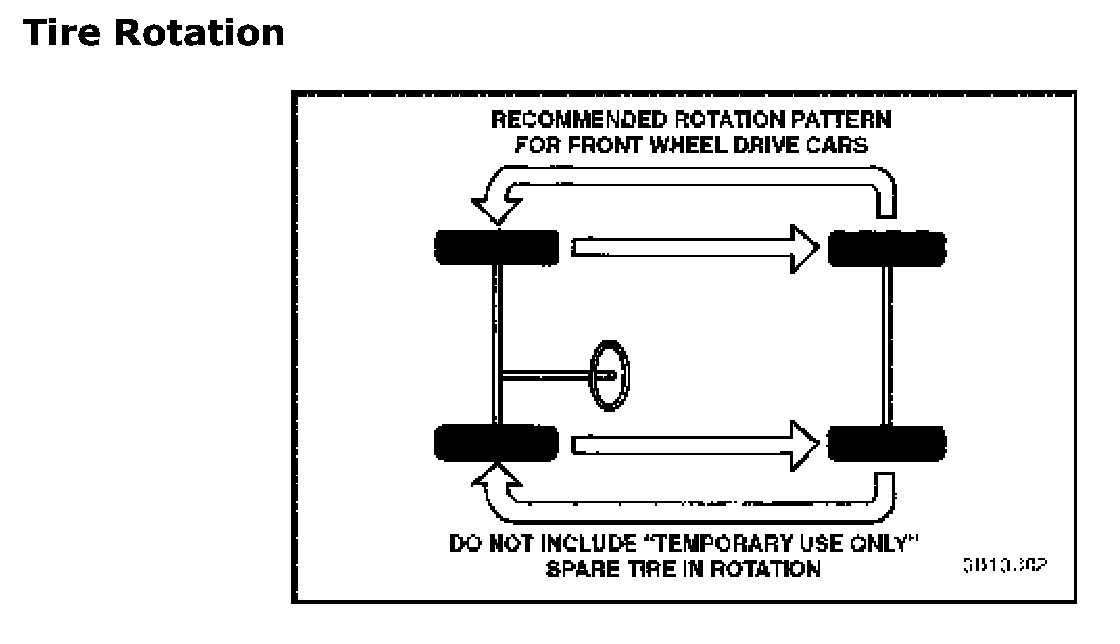
Tire Rotation
The services listed in the maintenance schedule are further explained below. When the following maintenance services are performed, make sure all the parts are replaced and all the necessary repairs are done before driving the vehicle. Always use the proper fluid and lubricants.
Drive Belt Inspection
When a separate belt drives the power steering pump, the air conditioning compressor and the generator, inspect it for cracks, fraying, wear and proper tension. Adjust or replace the belt as needed.
Engine Oil and Oil Filter Change
API Classifications of Engine Oil
The International Lubricant Standardization and Approval Committee (ILSAC) and American Petroleum Institute classifies engine oils according to their performance quality. Always use oil rated API-SL (ILSAC GF-III) or better.
Engine Oil Viscosity
Engine oil viscosity (thickness) has an effect on fuel economy and cold weather operation. Lower viscosity engine oils can provide better fuel economy and cold weather performance; however, higher temperature weather conditions require higher viscosity engine oils for satisfactory lubrication. Using oils of any viscosity other than those viscosities recommended could result in engine damage.
Cooling System Service
Drain, flush and refill the system with new coolant. Refer to Draining and Refilling the Cooling
Fuel Filter Replacement
Replace the engine fuel filter every 90,000 miles (144,000 km).
Air Cleaner Element Replacement
Replace the air cleaner element every 30,000 miles (48,000 km). Replace the air cleaner more often under dusty conditions.
Throttle Body Mounting Bolt Torque
Check the torque of the mounting bolts.
Tighten the throttle body mounting bolts to 15 Nm (11 ft. lbs.) if necessary.
Spark Plug Replacement
Replace spark plugs with the same type.
Spark Plug Wire Replacement
Clean wires and inspect them for burns, cracks or other damage. Check the wire boot fit at the DIS module and at the spark plugs. Replace the wires as needed.
Brake System Service
Check the disc brake pads and the drum brake linings every 7,500 miles (12,000 km) or 6 months. Check the pad and the lining thickness carefully. If the pads or the linings are not expected to last to the next scheduled maintenance service, replace the pads or the linings. Check the breather hole in the brake fluid reservoir cap to be sure it is free from dirt and the passage is open.
Transaxle Service
The manual transaxle fluid does not require changing. For automatic transaxles, refer to Scheduled Maintenance Service.
Tire and Wheel Inspection and Rotation
Check the tires for abnormal wear or damage. To equalize wear and obtain maximum tire life, rotate the tires. If irregular or premature wear exists, check the wheel alignment and check for damaged wheels. While the tires and wheels are removed, inspect the brakes. Refer to "Each Time The Oil Is Changed" in Owner Inspections and Services.
Tire Rotation
Factory Service Tools
Use the Manual With the Right Hardware
Pair factory procedures with proven DIY tools so the instructions are easier to execute.
Disclosure: Verified tool recommendations may earn an affiliate commission at no cost to you.
When to See a Mechanic
Stop DIY work and contact a certified mechanic immediately if any of the following apply:
- • You smell fuel, burning insulation, or see smoke.
- • Brakes feel soft, pull hard to one side, or make grinding noises.
- • The engine overheats, stalls repeatedly, or misfires under load.
- • You are missing required tools, torque specs, or safe lifting equipment.
- • You are not confident in the next step or safety outcome.