
Safety Warning
DIY auto repair can cause serious injury, fire, or vehicle damage. These guides are for informational purposes only. Always follow OEM torque specs, wear PPE, and consult a certified mechanic if you are unsure. You are solely responsible for your safety.
2002 Suzuki XL-7 Plus 2WD V6-2.7LFACTORY OEM SERVICE PROCEDURE
Ignition Timing: Testing and Inspection
Ignition Timing Check and Adjustment
NOTE: Before starting engine, place transmission gear shift lever in "Neutral" (shift selector lever to "P" range for A/T model), and set parking brake
1. Start engine and warm it up to normal operating temperature.
2. Make sure that all of electrical loads except ignition are switched OFF.
3. Check to be sure that idle speed is within specification referring to "Idle Air Control (IAC) System Inspection:"
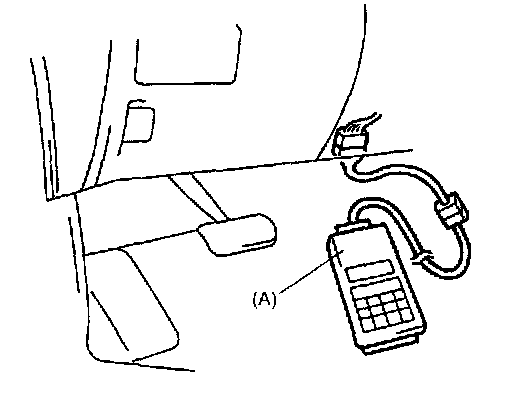
4. Connect SUZUKI scan tool to DLC with ignition switch OFF, restart engine and fix ignition timing by using fixed spark mode of SUZUKI scan tool.
Special tool
(A) : SUZUKI scan tool
5. Set timing light to ignition harness for No.1 cylinder.
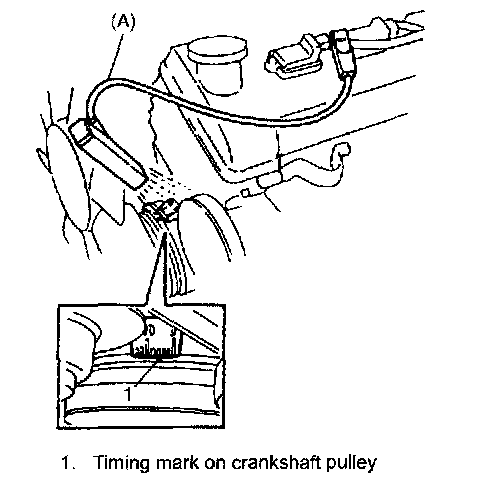
6. Using timing light, check that timing observed from viewpoint is within specification.
Initial ignition timing of viewpoint (when it is fixed by SUZUKI scan tool) 5 ± 1° BTDC
Ignition order
1 - 6 - 5 - 4 - 3 - 2
Special tool
(A) : 09930 - 76420
7. If ignition timing is out of specification, loosen flange bolt, adjust timing by turning CMP sensor (1) while engine is running, and then tighten bolt (2).
Tightening Torque
CMP sensor bolt (a): 15 N.m (1.5 kg.m, 11.0 lb.ft)
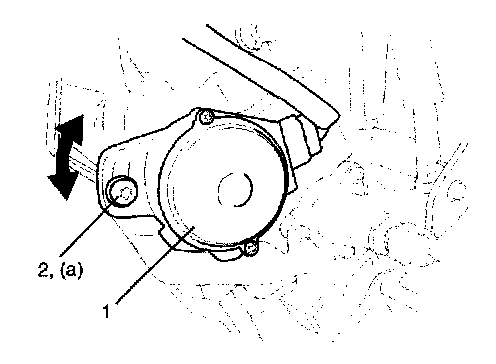
8. After tightening bolt (2), recheck that ignition timing is within specification.
9. After checking and/or adjusting, end fixed spark mode of SUZUKI scan tool.
NOTE: In this state, ignition timing may vary more or less of initial ignition timing but it is nothing abnormal.
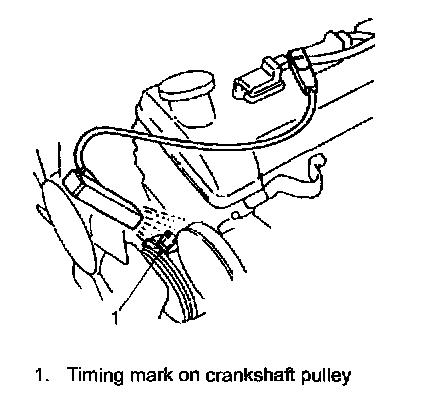
10. With engine idling (closed throttle position and vehicle stopped), check that ignition timing is about BTDC 12 - 16° (shown in the figure). Also, check that increasing engine speed advances ignition timing.
If above check results are not satisfactory, check input signals related to this system.
NOTE: Before starting engine, place transmission gear shift lever in "Neutral" (shift selector lever to "P" range for A/T model), and set parking brake
1. Start engine and warm it up to normal operating temperature.
2. Make sure that all of electrical loads except ignition are switched OFF.
3. Check to be sure that idle speed is within specification referring to "Idle Air Control (IAC) System Inspection:"
4. Connect SUZUKI scan tool to DLC with ignition switch OFF, restart engine and fix ignition timing by using fixed spark mode of SUZUKI scan tool.
Special tool
(A) : SUZUKI scan tool
5. Set timing light to ignition harness for No.1 cylinder.
6. Using timing light, check that timing observed from viewpoint is within specification.
Initial ignition timing of viewpoint (when it is fixed by SUZUKI scan tool) 5 ± 1° BTDC
Ignition order
1 - 6 - 5 - 4 - 3 - 2
Special tool
(A) : 09930 - 76420
7. If ignition timing is out of specification, loosen flange bolt, adjust timing by turning CMP sensor (1) while engine is running, and then tighten bolt (2).
Tightening Torque
CMP sensor bolt (a): 15 N.m (1.5 kg.m, 11.0 lb.ft)
8. After tightening bolt (2), recheck that ignition timing is within specification.
9. After checking and/or adjusting, end fixed spark mode of SUZUKI scan tool.
NOTE: In this state, ignition timing may vary more or less of initial ignition timing but it is nothing abnormal.
10. With engine idling (closed throttle position and vehicle stopped), check that ignition timing is about BTDC 12 - 16° (shown in the figure). Also, check that increasing engine speed advances ignition timing.
If above check results are not satisfactory, check input signals related to this system.
Factory Service Tools
Use the Manual With the Right Hardware
Pair factory procedures with proven DIY tools so the instructions are easier to execute.
Disclosure: Verified tool recommendations may earn an affiliate commission at no cost to you.
When to See a Mechanic
Stop DIY work and contact a certified mechanic immediately if any of the following apply:
- • You smell fuel, burning insulation, or see smoke.
- • Brakes feel soft, pull hard to one side, or make grinding noises.
- • The engine overheats, stalls repeatedly, or misfires under load.
- • You are missing required tools, torque specs, or safe lifting equipment.
- • You are not confident in the next step or safety outcome.