
Safety Warning
DIY auto repair can cause serious injury, fire, or vehicle damage. These guides are for informational purposes only. Always follow OEM torque specs, wear PPE, and consult a certified mechanic if you are unsure. You are solely responsible for your safety.
2003 Subaru Outback F6-3.0LFACTORY OEM SERVICE PROCEDURE
Battery: Testing and Inspection
INSPECTION
WARNING:
- Electrolyte has toxicity; be careful handling the fluid.
- Avoid contact with skin, eyes or clothing. Especially at contact with eyes, flush with water for 15 minutes and get prompt medical attention.
- Batteries produce explosive gases. Keep sparks, flame, cigarettes away.
- Ventilate when charging or using in enclosed space.
- For safety, in case an explosion does occur, wear eye protection or shield your eyes when working near any battery. Never lean over a battery.
- Do not let battery fluid contact eyes, skin, fabrics, or paint-work because battery fluid is corrosive acid.
- To lessen the risk of sparks, remove rings, metal watch-bands, and other metal jewelry. Never allow metal tools to contact the positive battery terminal and anything connected to it while you are at the same time in contact with any other metallic portion of the vehicle because a short circuit will be caused.
EXTERNAL PARTS:
Check for the existence of dirt or cracks on the battery case, top cover, vent plugs, and terminal posts. If necessary, clean with water and wipe with a dry cloth.
Apply a thin coat of grease on the terminal posts to prevent corrosion.
ELECTROLYTE LEVEL:
Check the electrolyte level in each cell. If the level is below MIN LEVEL, bring the level to MAX LEVEL by pouring distilled water into the battery cell. Do not fill beyond MAX LEVEL.
SPECIFIC GRAVITY OF ELECTROLYTE:
1. Measure specific gravity of electrolyte using a hydrometer and a thermometer. Specific gravity varies with temperature of electrolyte so that it must be corrected at 20 °C (68 °F) using the following equation:
S20 =St + 0.0007 x (t - 20)
S20: Specific gravity corrected at electrolyte temperature of 20 °C
St: Measured specific gravity
t: Measured temperature (°C)
Determine whether or not battery must be charged, according to corrected specific gravity.
Standard specific gravity: 1.220 - 1.290 [at 20 °C (68 °F)]
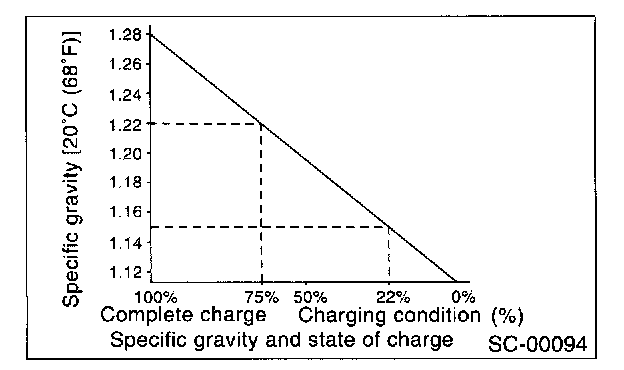
2. Measuring the specific gravity of the electrolyte in the battery will disclose the state of charge of the battery. The relation between the specific gravity and the state of charge is as shown in figure.
MEASUREMENT
WARNING: Do not bring an open flame close to the battery at this time.
CAUTION:
- Prior to charging, corroded terminals should be cleaned with a brush and common baking soda solution.
- Be careful since battery electrolyte overflows while charging the battery.
- Observe instructions when handling battery charger.
- Before charging the battery on vehicle, disconnect battery ground terminal. Failure to follow this rule may damage alternator's diodes or other electrical units.
JUDGMENT OF BATTERY IN CHARGED CONDITION
1. Specific gravity of electrolyte is held at a specific value in a range from 1.250 to 1.290 for more than one hour.
2. Voltage per battery cell is held at a specific value in a range from 2.5 to 2.8 volts for more than one hour.

CHECK HYDROMETER FOR STATE OF CHARGE
NORMAL CHARGING
Charge the battery at current value specified by manufacturer or at approximately 1/10 of battery's ampere-hour rating.
QUICK CHARGING
Quick charging is a method in which the battery is charged in a short period of time with a relatively large current by using a quick charger. Since a large current flow raises electrolyte temperature, the battery is subject to damage if the large current is used for prolonged time. For this reason, the quick charging must be carried out within a current range that will not increase the electrolyte temperature above 40 °C (104 °F). It should be also remembered that the quick charging is a temporary means to bring battery voltage up to a fair value and, as a rule, a battery should be charged slowly with a low current.
CAUTION:
- Observe the items in 3. NORMAL CHARGING.
- Never use more than 10 amperes when charging the battery because that will shorten battery life.
WARNING:
- Electrolyte has toxicity; be careful handling the fluid.
- Avoid contact with skin, eyes or clothing. Especially at contact with eyes, flush with water for 15 minutes and get prompt medical attention.
- Batteries produce explosive gases. Keep sparks, flame, cigarettes away.
- Ventilate when charging or using in enclosed space.
- For safety, in case an explosion does occur, wear eye protection or shield your eyes when working near any battery. Never lean over a battery.
- Do not let battery fluid contact eyes, skin, fabrics, or paint-work because battery fluid is corrosive acid.
- To lessen the risk of sparks, remove rings, metal watch-bands, and other metal jewelry. Never allow metal tools to contact the positive battery terminal and anything connected to it while you are at the same time in contact with any other metallic portion of the vehicle because a short circuit will be caused.
EXTERNAL PARTS:
Check for the existence of dirt or cracks on the battery case, top cover, vent plugs, and terminal posts. If necessary, clean with water and wipe with a dry cloth.
Apply a thin coat of grease on the terminal posts to prevent corrosion.
ELECTROLYTE LEVEL:
Check the electrolyte level in each cell. If the level is below MIN LEVEL, bring the level to MAX LEVEL by pouring distilled water into the battery cell. Do not fill beyond MAX LEVEL.
SPECIFIC GRAVITY OF ELECTROLYTE:
1. Measure specific gravity of electrolyte using a hydrometer and a thermometer. Specific gravity varies with temperature of electrolyte so that it must be corrected at 20 °C (68 °F) using the following equation:
S20 =St + 0.0007 x (t - 20)
S20: Specific gravity corrected at electrolyte temperature of 20 °C
St: Measured specific gravity
t: Measured temperature (°C)
Determine whether or not battery must be charged, according to corrected specific gravity.
Standard specific gravity: 1.220 - 1.290 [at 20 °C (68 °F)]
2. Measuring the specific gravity of the electrolyte in the battery will disclose the state of charge of the battery. The relation between the specific gravity and the state of charge is as shown in figure.
MEASUREMENT
WARNING: Do not bring an open flame close to the battery at this time.
CAUTION:
- Prior to charging, corroded terminals should be cleaned with a brush and common baking soda solution.
- Be careful since battery electrolyte overflows while charging the battery.
- Observe instructions when handling battery charger.
- Before charging the battery on vehicle, disconnect battery ground terminal. Failure to follow this rule may damage alternator's diodes or other electrical units.
JUDGMENT OF BATTERY IN CHARGED CONDITION
1. Specific gravity of electrolyte is held at a specific value in a range from 1.250 to 1.290 for more than one hour.
2. Voltage per battery cell is held at a specific value in a range from 2.5 to 2.8 volts for more than one hour.
CHECK HYDROMETER FOR STATE OF CHARGE
NORMAL CHARGING
Charge the battery at current value specified by manufacturer or at approximately 1/10 of battery's ampere-hour rating.
QUICK CHARGING
Quick charging is a method in which the battery is charged in a short period of time with a relatively large current by using a quick charger. Since a large current flow raises electrolyte temperature, the battery is subject to damage if the large current is used for prolonged time. For this reason, the quick charging must be carried out within a current range that will not increase the electrolyte temperature above 40 °C (104 °F). It should be also remembered that the quick charging is a temporary means to bring battery voltage up to a fair value and, as a rule, a battery should be charged slowly with a low current.
CAUTION:
- Observe the items in 3. NORMAL CHARGING.
- Never use more than 10 amperes when charging the battery because that will shorten battery life.
Factory Service Tools
Use the Manual With the Right Hardware
Pair factory procedures with proven DIY tools so the instructions are easier to execute.
Disclosure: Verified tool recommendations may earn an affiliate commission at no cost to you.
When to See a Mechanic
Stop DIY work and contact a certified mechanic immediately if any of the following apply:
- • You smell fuel, burning insulation, or see smoke.
- • Brakes feel soft, pull hard to one side, or make grinding noises.
- • The engine overheats, stalls repeatedly, or misfires under load.
- • You are missing required tools, torque specs, or safe lifting equipment.
- • You are not confident in the next step or safety outcome.