
Safety Warning
DIY auto repair can cause serious injury, fire, or vehicle damage. These guides are for informational purposes only. Always follow OEM torque specs, wear PPE, and consult a certified mechanic if you are unsure. You are solely responsible for your safety.
2003 Subaru Forester F4-2.5L SOHCFACTORY OEM SERVICE PROCEDURE
Engine Oil: Service and Repair
REPLACEMENT
1. Open the engine oil filler cap for quick draining of the engine oil.
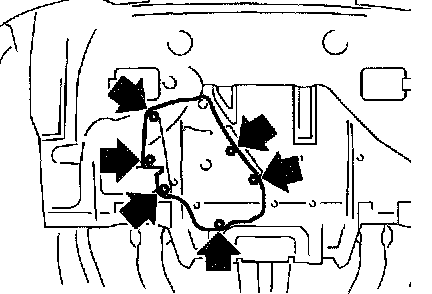
2. Remove six clips.
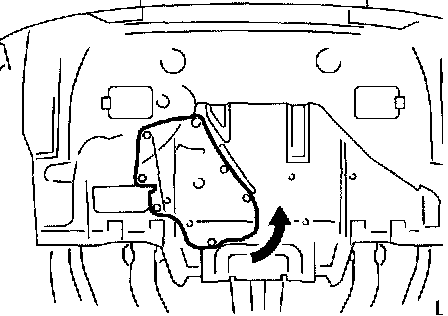
3. Turn the service hole cover counterclockwise.

4. Drain the engine oil by loosening the engine oil drain plug.
5. Replace the drain plug gasket.

6. Tighten the engine oil drain plug after draining engine oil.
Tightening torque: 44 Nm (4.5 kgf-m, 32.5 ft. lbs.)
7. Install the service hole cover.
8. Fill engine oil through the filler pipe up to upper point on level gauge. Make sure that the vehicle is placed level when checking oil level. Use the engine oil of proper quality and viscosity, selected in accordance with the table in figure.
Recommended oil: API classification SL or SJ or SH with the words "Energy Conserving or Energy conserving II", CCMC specification G4 or G5, ACEA specification A1, A2 or A3, or New API mark displayed on the container (If it is impossible to get SL or SJ or SH grade, you may use SG grade.)

Engine oil capacity:
Upper level 4.0 L (4.2 US qt. 3.5 Imp qt)
Lower level 3.0 L (3.2 US qt. 2.6 Imp qt)
The proper viscosity helps vehicle get good cold and hot starting by reducing viscous friction and thus increasing cranking speed.
CAUTION: When replenishing oil, it does not matter if the oil to be added is a different brand from that in the engine; however, use oil having the API classification and SAE viscosity No. designated by SUBARU.
NOTE: If the vehicle is used in areas with very high temperatures or for other heavy duty applications, the following viscosity oils may be used: API classification: SL or SJ or SH SAE Viscosity No.: 30, 40, 1 0W-50, 20W-40, 20W 50.
9. Close the engine oil filler cap.
10. Start the engine and warm it up for a time.
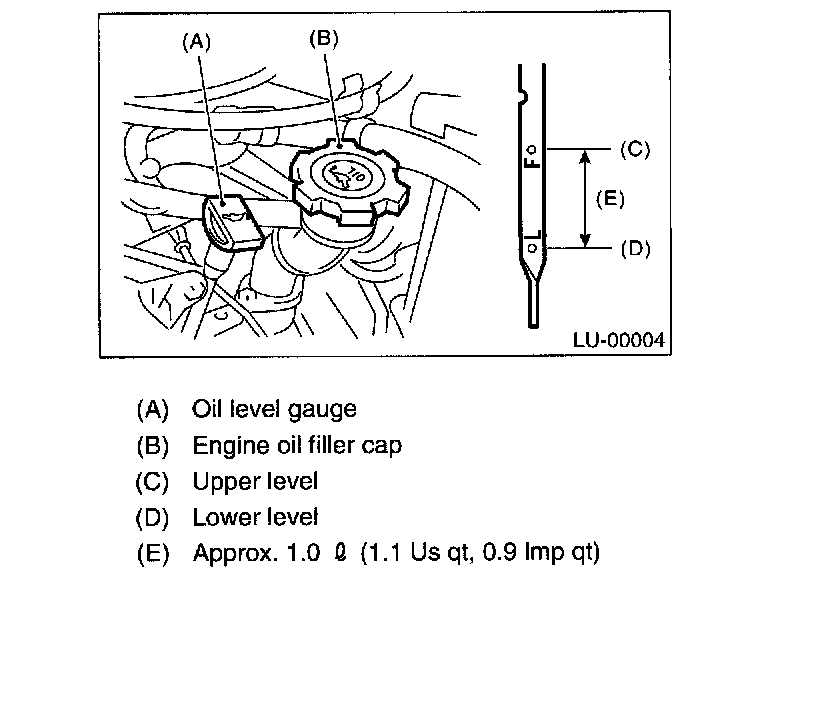
11. After the engine stops, recheck the oil level. If necessary, add engine oil up to the upper level on level gauge.
1. Open the engine oil filler cap for quick draining of the engine oil.
2. Remove six clips.
3. Turn the service hole cover counterclockwise.
4. Drain the engine oil by loosening the engine oil drain plug.
5. Replace the drain plug gasket.
6. Tighten the engine oil drain plug after draining engine oil.
Tightening torque: 44 Nm (4.5 kgf-m, 32.5 ft. lbs.)
7. Install the service hole cover.
8. Fill engine oil through the filler pipe up to upper point on level gauge. Make sure that the vehicle is placed level when checking oil level. Use the engine oil of proper quality and viscosity, selected in accordance with the table in figure.
Recommended oil: API classification SL or SJ or SH with the words "Energy Conserving or Energy conserving II", CCMC specification G4 or G5, ACEA specification A1, A2 or A3, or New API mark displayed on the container (If it is impossible to get SL or SJ or SH grade, you may use SG grade.)
Engine oil capacity:
Upper level 4.0 L (4.2 US qt. 3.5 Imp qt)
Lower level 3.0 L (3.2 US qt. 2.6 Imp qt)
The proper viscosity helps vehicle get good cold and hot starting by reducing viscous friction and thus increasing cranking speed.
CAUTION: When replenishing oil, it does not matter if the oil to be added is a different brand from that in the engine; however, use oil having the API classification and SAE viscosity No. designated by SUBARU.
NOTE: If the vehicle is used in areas with very high temperatures or for other heavy duty applications, the following viscosity oils may be used: API classification: SL or SJ or SH SAE Viscosity No.: 30, 40, 1 0W-50, 20W-40, 20W 50.
9. Close the engine oil filler cap.
10. Start the engine and warm it up for a time.
11. After the engine stops, recheck the oil level. If necessary, add engine oil up to the upper level on level gauge.
Factory Service Tools
Use the Manual With the Right Hardware
Pair factory procedures with proven DIY tools so the instructions are easier to execute.
Disclosure: Verified tool recommendations may earn an affiliate commission at no cost to you.
When to See a Mechanic
Stop DIY work and contact a certified mechanic immediately if any of the following apply:
- • You smell fuel, burning insulation, or see smoke.
- • Brakes feel soft, pull hard to one side, or make grinding noises.
- • The engine overheats, stalls repeatedly, or misfires under load.
- • You are missing required tools, torque specs, or safe lifting equipment.
- • You are not confident in the next step or safety outcome.