
Safety Warning
DIY auto repair can cause serious injury, fire, or vehicle damage. These guides are for informational purposes only. Always follow OEM torque specs, wear PPE, and consult a certified mechanic if you are unsure. You are solely responsible for your safety.
2000 Saturn LS L4-2.2L VIN FFACTORY OEM SERVICE PROCEDURE
Coolant Temperature Sensor/Switch (For Computer): Description and Operation
The engine coolant temperature sensor is a thermistor-type sensor. A thermistor resists the flow of electricity similar to a resistor. However, the resistance of a thermistor increases as the temperature drops. For example, at a low air temperature a thermistor produces a high resistance of 53 k ohms at -30°C (-22°F), while a high temperature causes low resistance of 177 ohms at 100°C (212°F). The engine coolant temperature sensor is a two-wire sensor that receives a reference signal voltage from the PCM to sensor pin B and a sensor reference ground from the PCM to sensor pin A.
The PCM supplies the five-volt reference signal to the engine coolant temperature sensor through a current-limiting resistor located inside the PCM. The signal received by the PCM indicates the temperature of the engine coolant, which is an indication of engine operating temperature. This sensor input is used by the PCM for fuel control, cooling fan control, ignition timing, EVAP canister purge control, idle speed control, and closed loop fuel control. The PCM also sends the coolant temperature information to the I/P cluster over serial data to indicate coolant temperature on the gage.
Engine Cooling Fan Control - The PCM controls operation of the engine cooling fan based on coolant temperature, air conditioning request, A/C pressure sensor input. Refer to Cooling System for a detailed description and operating criteria.
Hot Light Telltale - The hot coolant light telltale is used to indicate if there is a cooling system over-temperature condition. The light will illuminate on solid if the ECT senses engine coolant above 118°C (244°F).
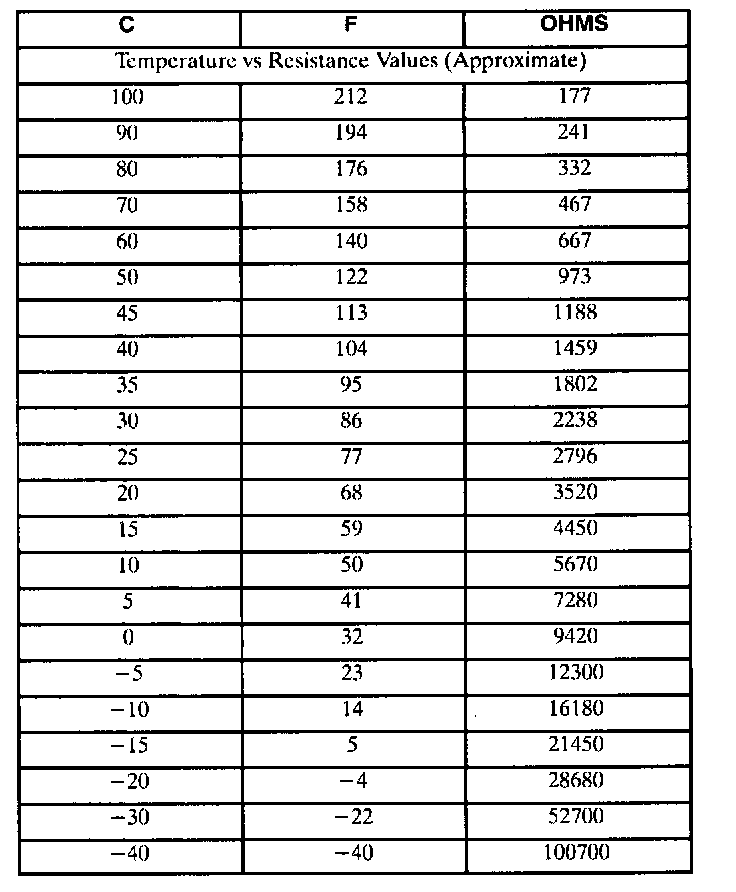
The following chart lists the resistances of engine coolant temperature sensor as compared to temperature.
The PCM supplies the five-volt reference signal to the engine coolant temperature sensor through a current-limiting resistor located inside the PCM. The signal received by the PCM indicates the temperature of the engine coolant, which is an indication of engine operating temperature. This sensor input is used by the PCM for fuel control, cooling fan control, ignition timing, EVAP canister purge control, idle speed control, and closed loop fuel control. The PCM also sends the coolant temperature information to the I/P cluster over serial data to indicate coolant temperature on the gage.
Engine Cooling Fan Control - The PCM controls operation of the engine cooling fan based on coolant temperature, air conditioning request, A/C pressure sensor input. Refer to Cooling System for a detailed description and operating criteria.
Hot Light Telltale - The hot coolant light telltale is used to indicate if there is a cooling system over-temperature condition. The light will illuminate on solid if the ECT senses engine coolant above 118°C (244°F).
Temperature Vs Resistance:
The following chart lists the resistances of engine coolant temperature sensor as compared to temperature.
Factory Service Tools
Use the Manual With the Right Hardware
Pair factory procedures with proven DIY tools so the instructions are easier to execute.
Disclosure: Verified tool recommendations may earn an affiliate commission at no cost to you.
When to See a Mechanic
Stop DIY work and contact a certified mechanic immediately if any of the following apply:
- • You smell fuel, burning insulation, or see smoke.
- • Brakes feel soft, pull hard to one side, or make grinding noises.
- • The engine overheats, stalls repeatedly, or misfires under load.
- • You are missing required tools, torque specs, or safe lifting equipment.
- • You are not confident in the next step or safety outcome.
Rather have a pro handle this?
A certified mobile mechanic comes to your home or office. They bring the tools, you stay comfortable. No tow truck, no waiting room, no surprises.
Comes to youSame-day available12-month warranty
Get a Free QuoteNo obligation. See pricing before you book.