
Safety Warning
DIY auto repair can cause serious injury, fire, or vehicle damage. These guides are for informational purposes only. Always follow OEM torque specs, wear PPE, and consult a certified mechanic if you are unsure. You are solely responsible for your safety.
2005 Porsche Boxster (987) F6-2.7LFACTORY OEM SERVICE PROCEDURE
Starting System: Service and Repair
276019 Removing And Installing Starter
Preliminary work
Preliminary work - starter
Remove the engine-compartment lid.
Disconnect battery.
Remove rear wall cover.
Remove centre intake-air distributor with throttle valve.
Installing the starter
WARNING: If the battery has not been disconnected, battery voltage will be present at the leads during removal and installation.
- Risk of injury from burns and electric shock.
- Damage to electrical leads, control units and components due to accidental contact of leads with ground.
- Disconnect both battery terminals and cover the + terminal.
1. Insert starter into the bracket from above and install with the upper fastening screw -3-. Tightening torque 33 ftlb.
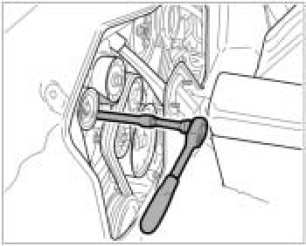
2. Screw down the lower fastening screw -4- through the tailgate. Tightening torque 33 ftlb.
Installing Starter:
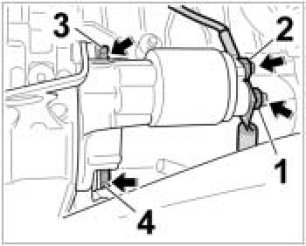
3. Position electrical leads on the starter and tighten with fastening nuts -1, 2-. Tightening torque 13 ftlb. Tightening torque 5 ftlb.
Screwing Down Lower Fastening Screw:
Subsequent work
Subsequent work - starter
Install centre intake-air distributor with throttle valve.
Install rear wall cover.
Connect the battery and carry out "Work instructions after disconnecting the battery".
Install the engine-compartment lid.
Factory Service Tools
Use the Manual With the Right Hardware
Pair factory procedures with proven DIY tools so the instructions are easier to execute.
Disclosure: Verified tool recommendations may earn an affiliate commission at no cost to you.
When to See a Mechanic
Stop DIY work and contact a certified mechanic immediately if any of the following apply:
- • You smell fuel, burning insulation, or see smoke.
- • Brakes feel soft, pull hard to one side, or make grinding noises.
- • The engine overheats, stalls repeatedly, or misfires under load.
- • You are missing required tools, torque specs, or safe lifting equipment.
- • You are not confident in the next step or safety outcome.