
Safety Warning
DIY auto repair can cause serious injury, fire, or vehicle damage. These guides are for informational purposes only. Always follow OEM torque specs, wear PPE, and consult a certified mechanic if you are unsure. You are solely responsible for your safety.
2005 Porsche Boxster (987) F6-2.7LFACTORY OEM SERVICE PROCEDURE
Motronic Power Supply System
Power Supply in the Area of the Motronic System
Similar to the previous Boxster, the Motronic control unit is mounted in the rear luggage compartment, at the partitioning panel separating the luggage compartment from the engine.
NOTE: The fuse carrier fuse assignments have changed from the previous Boxster (986) model.
Important fuses for the area of the Motronic system can be found at the following locations:
Fuse carrier in left footwell, relay carrier (slot 6) at left of rear luggage compartment and in current distributor.
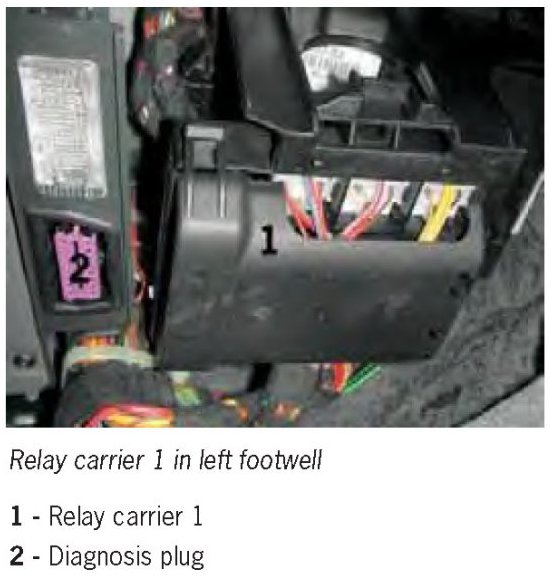
Important relays for the area of the Motronic system can be found at the following locations:
Relay carrier 1 in left footwell,
Relay carrier 2 at left of rear luggage compartment.
Starting The Engine
In order to start the engine it is necessary, after the ignition key has been identified, to also actuate the clutch pedal (vehicles with manual transmission) or the brake pedal (Tiptronic vehicles). In Tiptronic vehicles, the selector lever must also be set to either "P" or "N".
CAN Networking
NOTE: The relay carrier relay assignments have changed from the previous Boxster (986) model.
The electronic networking facilitates the exchange of data and electronic information between the various control modules throughout the vehicle with the internal high-speed network, CAN bus (Controller Area Network).
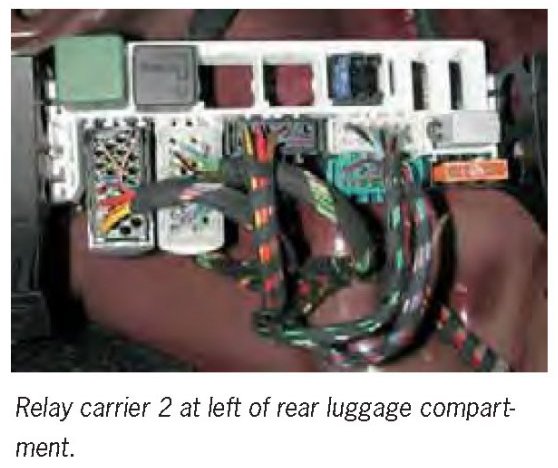
Relay carrier 2 at left of rear luggage compartment.
Via the CAN, the Motronic control module communicates with the following control modules:
- Gateway control module
- Driver authorization controller
- Tiptronic control unit
- PSM control unit
- Steering angle sensor
- Yaw velocity sensor
- Airbag control module
- Air conditioning control module
Factory Service Tools
Use the Manual With the Right Hardware
Pair factory procedures with proven DIY tools so the instructions are easier to execute.
Disclosure: Verified tool recommendations may earn an affiliate commission at no cost to you.
When to See a Mechanic
Stop DIY work and contact a certified mechanic immediately if any of the following apply:
- • You smell fuel, burning insulation, or see smoke.
- • Brakes feel soft, pull hard to one side, or make grinding noises.
- • The engine overheats, stalls repeatedly, or misfires under load.
- • You are missing required tools, torque specs, or safe lifting equipment.
- • You are not confident in the next step or safety outcome.