
Safety Warning
DIY auto repair can cause serious injury, fire, or vehicle damage. These guides are for informational purposes only. Always follow OEM torque specs, wear PPE, and consult a certified mechanic if you are unsure. You are solely responsible for your safety.
1996 Pontiac Firefly (CANADA) L4-1.3LFACTORY OEM SERVICE PROCEDURE
Spark Plug: Testing and Inspection
Spark Plug Diagnosis:
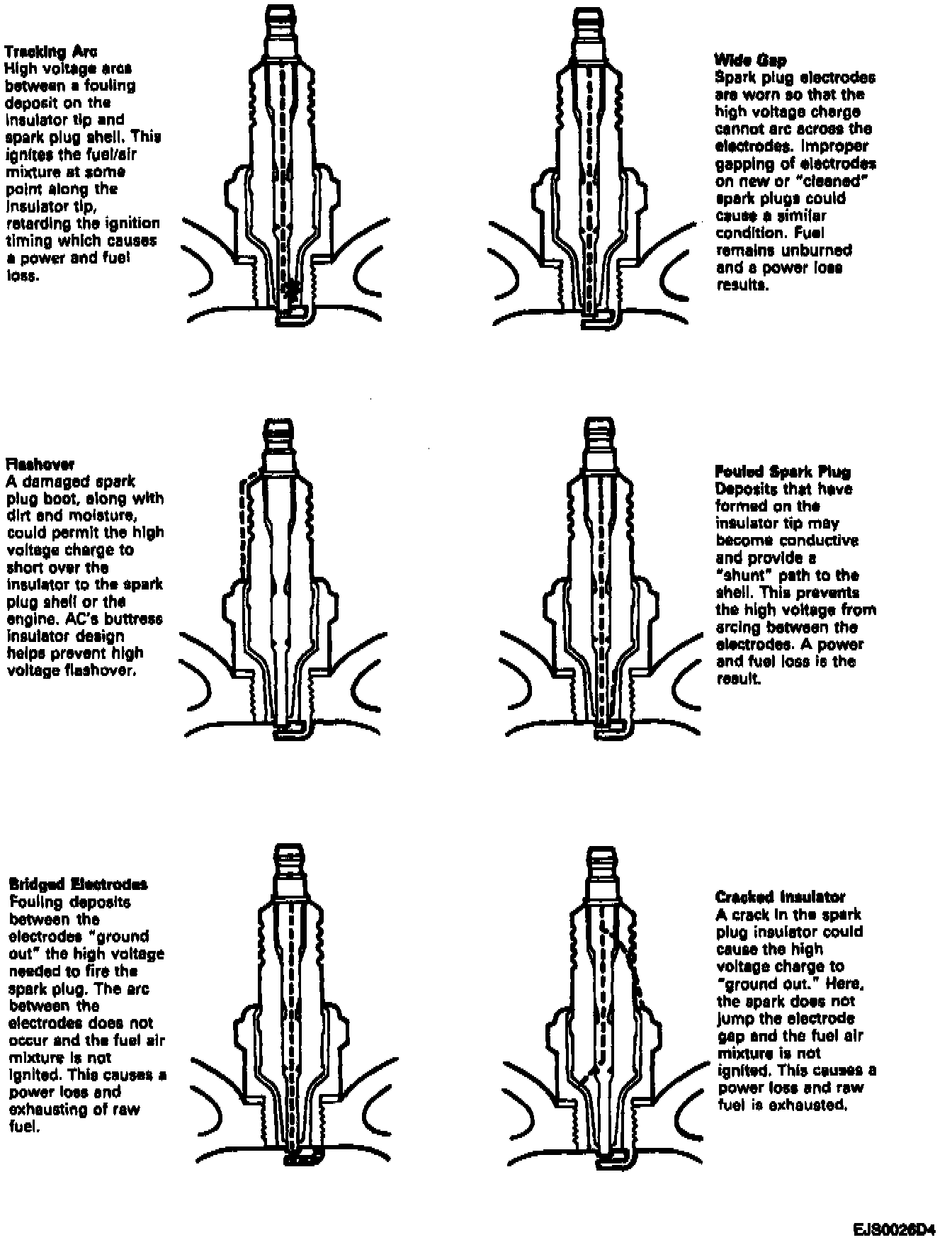
SPARK PLUG FAILURE MODES
Worn or Dirty Spark Plugs
Worn or dirty spark plugs provide satisfactory Performance at idle speed, but under more demanding operating conditions, they will frequently misfire. Conditions such as poor fuel economy, power loss, loss of speed, hard starting and generally poor engine performance may he the result of misfiring spark plugs. Spark plugs may misfire due to carbon fouling, an excessive air gap, a broken insulator, bridged electrodes or a damaged spark plug wire and/or boot.
Fouled Spark Plug
Fouled spark plugs are indicated by black carbon deposits on electrodes. These black deposits are usually the result of slow-speed driving and short runs in which sufficient operating temperature is seldom achieved. Carbon deposits will also result because of worn pistons, rings, faulty ignition, over-rich air/fuel mixture and the incorrect spark plug heat range.
Carbon Deposits
Carbon deposits on the spark plug insulator tip may become conductive and cause the high-voltage arc to track along the tip to some point where it arcs to join the spark plug shell. This arc ignites the air/fuel mixture later than normal which, in effect, retards ignition timing. Heavy carbon deposits may he conductive to the extent that the arc path now becomes a shunt path to the spark plug shell, which prevents the high voltage from arcing and igniting the air/fuel mixture. Once arc tracking occurs, the spark plug may be permanently damaged and must be replaced.
Excessive Gap
Excessive gap wear, on plugs of low mileage, usually indicates the engine is operating at higher speeds than those for which the engine was designed or that the spark plug's heat range is too high. Electrode wear may also he the result of spark plug overheating caused by combustion gases leaking past the threads. Electrode wear can become excessive to the point that the high voltage no longer arcs across the electrodes.
Broken Spark Plug Insulators
Broken or cracked insulators are usually the result of improper installation. Broken lower insulators often result from improper gapping and are usually visible immediately. When gapping a spark plug, always make the gap adjustment by bending the ground (side) electrode. Spark plugs with broken insulators must always be replaced.
High Voltage Arc
Damaged spark plug wires and/or boots cause a similar condition to that of a cracked insulator. The high-voltage arc flashes through the wire or boot and grounds on the spark plug shell or the engine.
Corona Discharge
Corona discharge, a steady blue light, may repel dust particles and leave a clear ring on the insulator just above the shell. It is important not to mistake corona discharge as evidence that combustion gases have blown between the shell and the insulator. Corona discharge has no effect on ignition system performance.
Factory Service Tools
Use the Manual With the Right Hardware
Pair factory procedures with proven DIY tools so the instructions are easier to execute.
Disclosure: Verified tool recommendations may earn an affiliate commission at no cost to you.
When to See a Mechanic
Stop DIY work and contact a certified mechanic immediately if any of the following apply:
- • You smell fuel, burning insulation, or see smoke.
- • Brakes feel soft, pull hard to one side, or make grinding noises.
- • The engine overheats, stalls repeatedly, or misfires under load.
- • You are missing required tools, torque specs, or safe lifting equipment.
- • You are not confident in the next step or safety outcome.