
Safety Warning
DIY auto repair can cause serious injury, fire, or vehicle damage. These guides are for informational purposes only. Always follow OEM torque specs, wear PPE, and consult a certified mechanic if you are unsure. You are solely responsible for your safety.
1998 Oldsmobile Aurora V8-4.0L VIN CFACTORY OEM SERVICE PROCEDURE
Modes of Operation
IC MODULE MODE
There are two modes of ignition system operation: PCM mode and Ignition Control Module (IC Module) mode. In IC Module mode, the ignition system operates independently from the PCM. The ignition control module maintains a base ignition timing of 10 BTDC and is able to change this ignition timing slightly with increased engine speed. IC Module mode is in effect whenever an ignition control fault is detected while the engine is running and it will have a noticeable effect on driveability. In PCM mode, the PCM controls the ignition timing. The PCM calculates the desired ignition timing based on information it receives from the input sensors.
PCM TIMING MODE
The Powertrain Control Module (PCM) controls spark advance and fuel injection for all driving conditions. The PCM monitors input signals from the following components as part of its ignition control function to determine the required ignition timing:
^ Ignition Control Module (IC Module).
^ Engine Coolant Temperature (ECT) sensor.
^ Manifold Absolute Pressure (MAP) sensor.
^ Transaxle Range (TR) switch.
^ Throttle Position (TP) sensor.
^ Vehicle Speed Sensor (VSS).
^ Knock Sensor (KS).
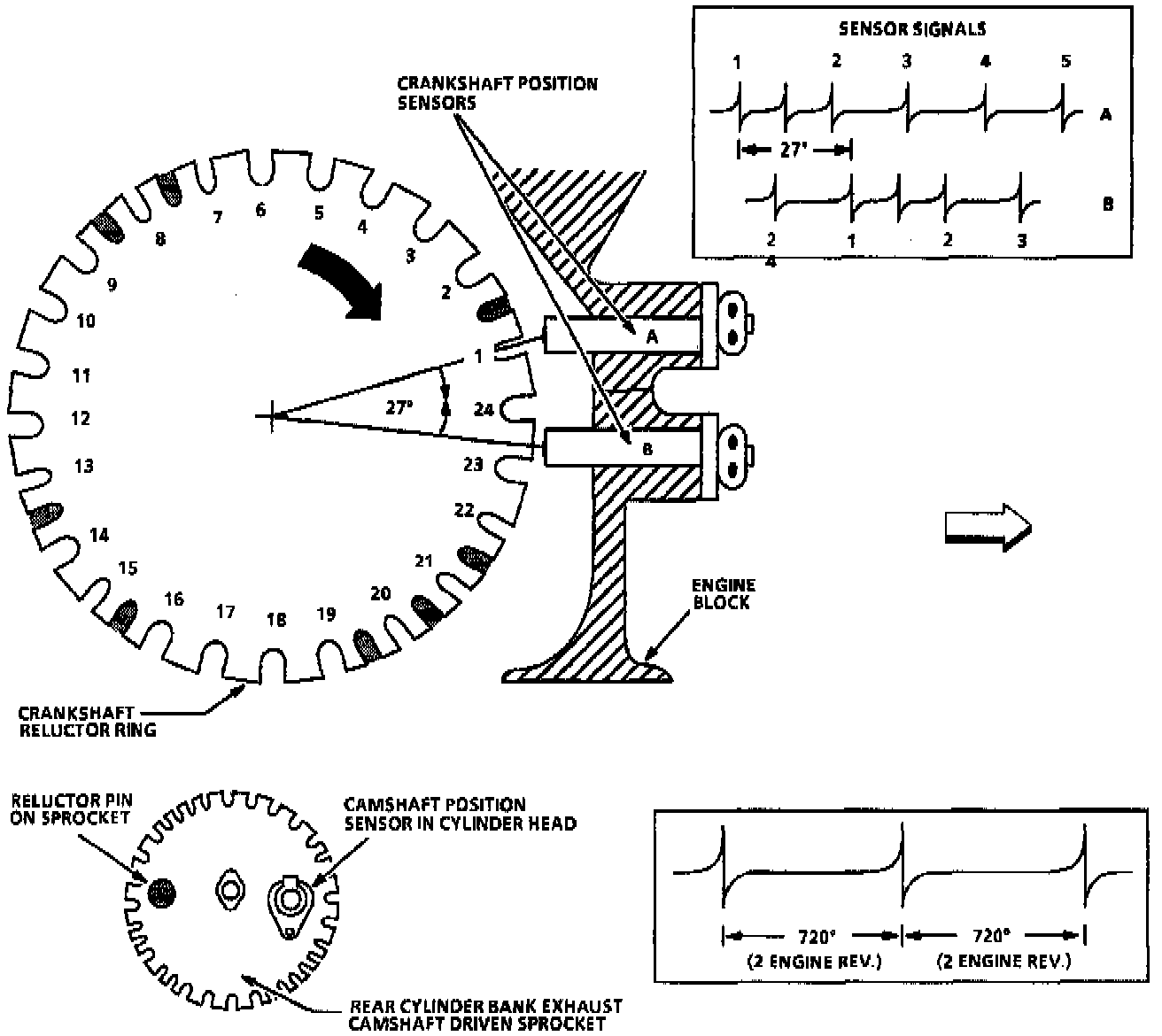
^ The Crankshaft Reluctor Ring has 24 evenly spaced notches plus S additional notches (shaded) used for synchronization.
^ As the crankshaft rotates, the notches pass the position sensors and create a voltage pulse signal in the sensor that is an input for the Ignition Control (IC) module.
^ Because of the physical location of the two crankshaft position sensors, the signal of "B" lags the signal of "A" by 27 degrees of crankshaft revolution.
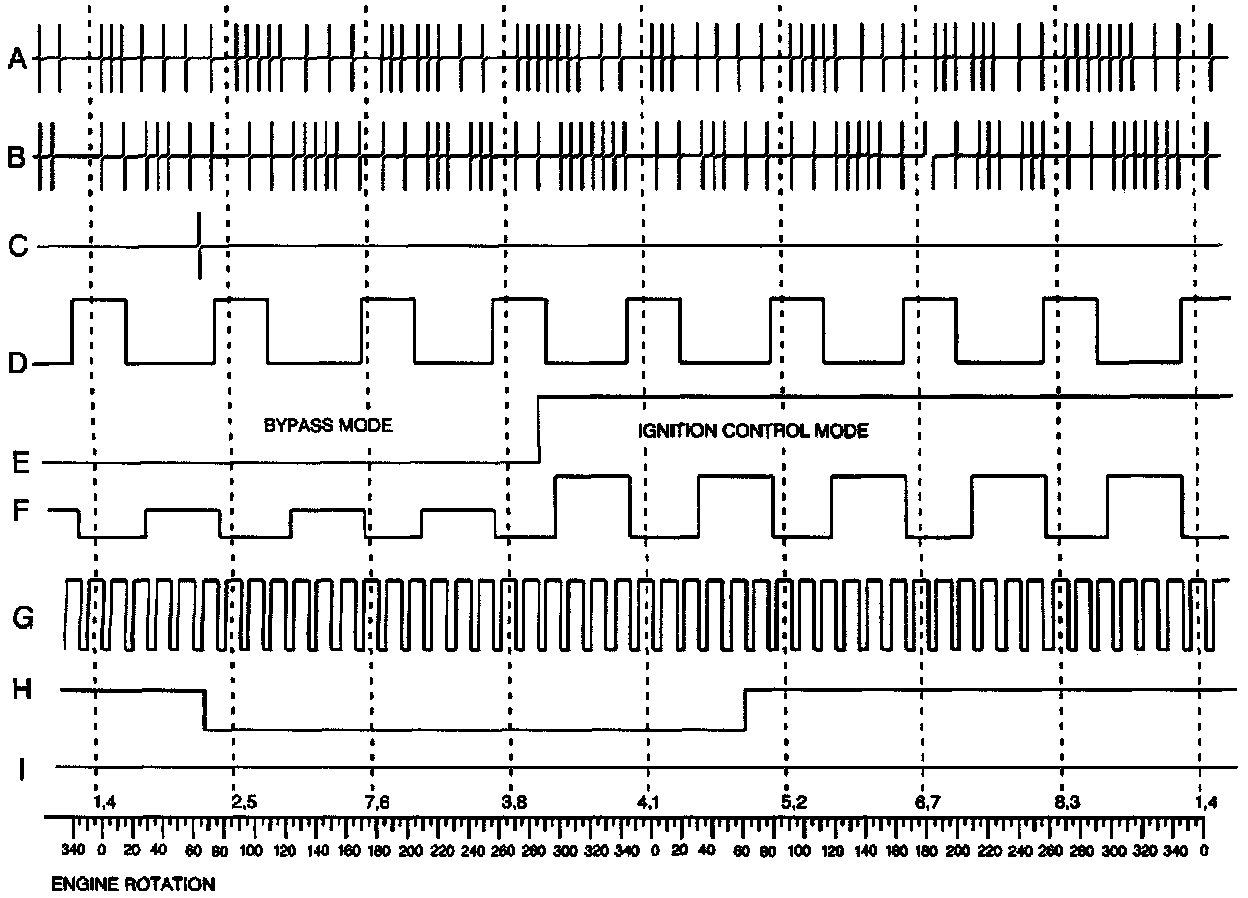
^ To synchronize the ignition, the IC module first counts the number of "B" pulses between every 2 "A" pulses. There can be 0,1 or 2 "B" pulses between "A" pulses.
^ When the IC module sees 0 "B" pulses between "A" pulses, it starts counting "B" pulses between "A" pulses. When the IC module counts exactly 4, it synchronizes the ignition on the very next "A" pulse. If the IC module counts over 4 (jumps from 3 to 5), it waits for another "B" pulse between "A" pulse to start counting again.
^ This process allows the ignition to synchronize and fire the 1st spark plug within 180 degrees (1/2 engine revolution).
^ The camshaft position sensor provides the IC module with cylinder #1 firing order information, which the PCM uses for sequential fuel injection.
^ Using 3 sensors allows the IC module to maintain ignition synchronization even if one of the 3 sensors fails
There are two modes of ignition system operation: PCM mode and Ignition Control Module (IC Module) mode. In IC Module mode, the ignition system operates independently from the PCM. The ignition control module maintains a base ignition timing of 10 BTDC and is able to change this ignition timing slightly with increased engine speed. IC Module mode is in effect whenever an ignition control fault is detected while the engine is running and it will have a noticeable effect on driveability. In PCM mode, the PCM controls the ignition timing. The PCM calculates the desired ignition timing based on information it receives from the input sensors.
PCM TIMING MODE
The Powertrain Control Module (PCM) controls spark advance and fuel injection for all driving conditions. The PCM monitors input signals from the following components as part of its ignition control function to determine the required ignition timing:
^ Ignition Control Module (IC Module).
^ Engine Coolant Temperature (ECT) sensor.
^ Manifold Absolute Pressure (MAP) sensor.
^ Transaxle Range (TR) switch.
^ Throttle Position (TP) sensor.
^ Vehicle Speed Sensor (VSS).
^ Knock Sensor (KS).
Position Sensor Signals:
Description:
^ The Crankshaft Reluctor Ring has 24 evenly spaced notches plus S additional notches (shaded) used for synchronization.
^ As the crankshaft rotates, the notches pass the position sensors and create a voltage pulse signal in the sensor that is an input for the Ignition Control (IC) module.
^ Because of the physical location of the two crankshaft position sensors, the signal of "B" lags the signal of "A" by 27 degrees of crankshaft revolution.
^ To synchronize the ignition, the IC module first counts the number of "B" pulses between every 2 "A" pulses. There can be 0,1 or 2 "B" pulses between "A" pulses.
^ When the IC module sees 0 "B" pulses between "A" pulses, it starts counting "B" pulses between "A" pulses. When the IC module counts exactly 4, it synchronizes the ignition on the very next "A" pulse. If the IC module counts over 4 (jumps from 3 to 5), it waits for another "B" pulse between "A" pulse to start counting again.
^ This process allows the ignition to synchronize and fire the 1st spark plug within 180 degrees (1/2 engine revolution).
^ The camshaft position sensor provides the IC module with cylinder #1 firing order information, which the PCM uses for sequential fuel injection.
^ Using 3 sensors allows the IC module to maintain ignition synchronization even if one of the 3 sensors fails
Factory Service Tools
Use the Manual With the Right Hardware
Pair factory procedures with proven DIY tools so the instructions are easier to execute.
Disclosure: Verified tool recommendations may earn an affiliate commission at no cost to you.
When to See a Mechanic
Stop DIY work and contact a certified mechanic immediately if any of the following apply:
- • You smell fuel, burning insulation, or see smoke.
- • Brakes feel soft, pull hard to one side, or make grinding noises.
- • The engine overheats, stalls repeatedly, or misfires under load.
- • You are missing required tools, torque specs, or safe lifting equipment.
- • You are not confident in the next step or safety outcome.
Rather have a pro handle this?
A certified mobile mechanic comes to your home or office. They bring the tools, you stay comfortable. No tow truck, no waiting room, no surprises.
Comes to youSame-day available12-month warranty
Get a Free QuoteNo obligation. See pricing before you book.