
Safety Warning
DIY auto repair can cause serious injury, fire, or vehicle damage. These guides are for informational purposes only. Always follow OEM torque specs, wear PPE, and consult a certified mechanic if you are unsure. You are solely responsible for your safety.
1991 Oldsmobile Toronado V6-3800 3.8LFACTORY OEM SERVICE PROCEDURE
Engine Control Module: Description and Operation
Powertrain Control Module (PCM):
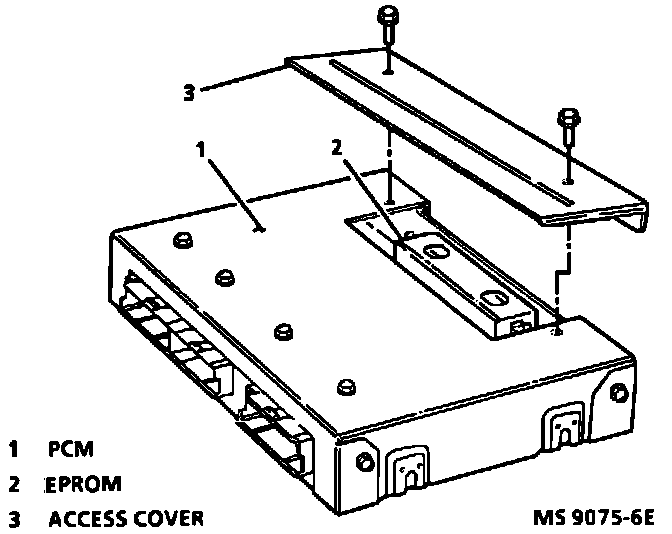
The Powertrain Control Module (PCM) is the control center for the Sequential Fuel Injection (SFI) system, ignition system, cruise control operation, and transaxle shifting. The PCM constantly monitors information from various data sensors and controls output devices that affect vehicle performance. The computer can control these devices through the use of Quad Driver Modules (QDM). When the PCM is commanding a device or a component "ON," the voltage potential of the output is low or near zero volts. When the PCM is commanding a device or component "OFF," the voltage potential of the circuit will be "HIGH," or near 12.0 volts. The primary function of the QDM is to supply the ground for the component being controlled.
The input information has an interrelation between sensor output. If one of the input devices fails, such as the oxygen sensor, this could affect more than one of the systems controlled by the computer. To allow one type of PCM to be used for many different vehicles, a device called a Memory-Calibration (MEM-CAL) unit is used. The MEM-CAL is located inside the PCM and has system calibration information based upon the vehicle's axle ratio, engine, transmission, weight, and other specific configurations of the vehicle. Since the MEM-CAL unit is unique to specific vehicles, it is important to install the MEM-CAL unit into the new PCM when servicing. The PCM also has self-diagnostic functions which stores trouble codes and alerts the driver through a warning lamp on the instrument panel.
Factory Service Tools
Use the Manual With the Right Hardware
Pair factory procedures with proven DIY tools so the instructions are easier to execute.
Disclosure: Verified tool recommendations may earn an affiliate commission at no cost to you.
When to See a Mechanic
Stop DIY work and contact a certified mechanic immediately if any of the following apply:
- • You smell fuel, burning insulation, or see smoke.
- • Brakes feel soft, pull hard to one side, or make grinding noises.
- • The engine overheats, stalls repeatedly, or misfires under load.
- • You are missing required tools, torque specs, or safe lifting equipment.
- • You are not confident in the next step or safety outcome.