
Safety Warning
DIY auto repair can cause serious injury, fire, or vehicle damage. These guides are for informational purposes only. Always follow OEM torque specs, wear PPE, and consult a certified mechanic if you are unsure. You are solely responsible for your safety.
2002 Nissan-Datsun Sentra SE-R L4-2.5L (QR25DE)FACTORY OEM SERVICE PROCEDURE
Compression Check: Testing and Inspection
CHECKING COMPRESSION PRESSURE
1. Warm up the engine to full operating temperature.
2. Release the fuel pressure. Refer to Powertrain Management; Fuel Delivery and Air Induction.
3. Remove the ignition coil and spark plug from each cylinder.
4. Connect engine tachometer (not required in use of CONSULT-II).
5. Disconnect the fuel injector harness connector to avoid any residual fuel injection during the measurement.
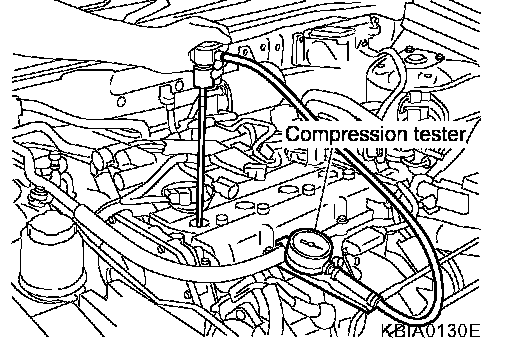
6. Install the compression tester with the adapter into the spark plug hole.

^ Use compression gauge whose picking up end inserted to spark plug hole is smaller then 20 mm (0.79 inch) in diameter. Otherwise, it may be caught by cylinder head during removal.

7. With the accelerator pedal fully depressed, turn the ignition switch to the "START" position to crank over the engine. When the gauge pointer stabilizes, read the compression pressure and engine rpm. Perform these steps to check each cylinder.
CAUTION: Always use a fully charged battery to obtain specified engine cranking speed.
^ If the engine speed is out of specified rpm range, check the battery. Check engine speed again with a fully charged battery.
^ If compression pressure is below minimum value, check valve clearances and parts associated with combustion chamber (valve, valve seat, piston, piston ring, cylinder bore, cylinder head, cylinder head gasket). After the checking, measure compression pressure again.
^ If some cylinders have low compression pressure, pour small amount of engine oil into the spark plug hole of the cylinder to re-check it for compression. If the added engine oil improves the compression, the piston rings may be worn or damaged. Check the piston rings and replace if necessary.
- If the compression pressure remains at low level despite the addition of engine oil, the valves may be malfunctioning. Check the valves for damage. Replace the valve or valve seat accordingly.
^ If two adjacent cylinders have respectively low compression pressure and their compression remains low even after the addition of engine oil, the head gasket is leaking. In such a case, replace the cylinder head gasket.
8. Install spark plug, ignition coil and harness connectors.
1. Warm up the engine to full operating temperature.
2. Release the fuel pressure. Refer to Powertrain Management; Fuel Delivery and Air Induction.
3. Remove the ignition coil and spark plug from each cylinder.
4. Connect engine tachometer (not required in use of CONSULT-II).
5. Disconnect the fuel injector harness connector to avoid any residual fuel injection during the measurement.
6. Install the compression tester with the adapter into the spark plug hole.
^ Use compression gauge whose picking up end inserted to spark plug hole is smaller then 20 mm (0.79 inch) in diameter. Otherwise, it may be caught by cylinder head during removal.
7. With the accelerator pedal fully depressed, turn the ignition switch to the "START" position to crank over the engine. When the gauge pointer stabilizes, read the compression pressure and engine rpm. Perform these steps to check each cylinder.
CAUTION: Always use a fully charged battery to obtain specified engine cranking speed.
^ If the engine speed is out of specified rpm range, check the battery. Check engine speed again with a fully charged battery.
^ If compression pressure is below minimum value, check valve clearances and parts associated with combustion chamber (valve, valve seat, piston, piston ring, cylinder bore, cylinder head, cylinder head gasket). After the checking, measure compression pressure again.
^ If some cylinders have low compression pressure, pour small amount of engine oil into the spark plug hole of the cylinder to re-check it for compression. If the added engine oil improves the compression, the piston rings may be worn or damaged. Check the piston rings and replace if necessary.
- If the compression pressure remains at low level despite the addition of engine oil, the valves may be malfunctioning. Check the valves for damage. Replace the valve or valve seat accordingly.
^ If two adjacent cylinders have respectively low compression pressure and their compression remains low even after the addition of engine oil, the head gasket is leaking. In such a case, replace the cylinder head gasket.
8. Install spark plug, ignition coil and harness connectors.
Factory Service Tools
Use the Manual With the Right Hardware
Pair factory procedures with proven DIY tools so the instructions are easier to execute.
Disclosure: Verified tool recommendations may earn an affiliate commission at no cost to you.
When to See a Mechanic
Stop DIY work and contact a certified mechanic immediately if any of the following apply:
- • You smell fuel, burning insulation, or see smoke.
- • Brakes feel soft, pull hard to one side, or make grinding noises.
- • The engine overheats, stalls repeatedly, or misfires under load.
- • You are missing required tools, torque specs, or safe lifting equipment.
- • You are not confident in the next step or safety outcome.