
Safety Warning
DIY auto repair can cause serious injury, fire, or vehicle damage. These guides are for informational purposes only. Always follow OEM torque specs, wear PPE, and consult a certified mechanic if you are unsure. You are solely responsible for your safety.
2012 Mazda 3 L4-2.0L (SKYACTIV-G)FACTORY OEM SERVICE PROCEDURE
Compression Check: Testing and Inspection
COMPRESSION INSPECTION [SKYACTIV-G 2.0]
WARNING:
- Hot engines and oil can cause severe burns. Be careful not to burn yourself during removal/installation of each component.
- Fuel vapor is hazardous. It can very easily ignite, causing serious injury and damage. Always keep sparks and flames away from fuel.
- Fuel line spills and leakage are dangerous. Fuel can ignite and cause serious injuries or death and damage. Fuel can also irritate skin and eyes. To prevent this, always complete the "Fuel Line Safety Procedure". Before Service Precaution
1. Verify that the battery is fully charged. Testing and Inspection
- Recharge it if necessary. Procedures
2. Warm up the engine to the normal operating temperature.
3. Perform "Fuel Line Safety Procedures". Before Service Precaution
4. Remove the following parts.
a. Plug hole plate. Plug Hole Plate Removal/Installation
b. Ignition coil/ion sensors. (See Ignition Coil/Ion Sensor Removal/Installation.)
c. Spark plugs. Service and Repair
d. Fuel pump relay
e. Fuel injector relay
5. Measure the compression pressure using the following procedure.
a. Press a compression gauge into the spark plug hole.
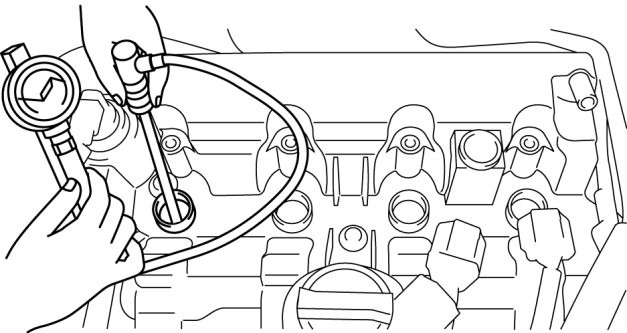
b. Fully depress the accelerator pedal.
c. Crank the engine and measure the compression pressure.
Compression
- Standard: 827 kPa {8.43 kgf/cm2, 120 psi} [300 rpm]
- Minimum: 661 kPa {6.74 kgf/cm2, 95.9 psi} [300 rpm]
- Maximum difference between cylinders: 140 kPa {1.43 kgf/cm2, 20.3 psi}
NOTE:
- Because the SKYACTIV-G 2.0 retards the intake valve closing timing, compression pressure is low.
d. Perform Steps (1) to (3) for all cylinders.
e. If the measured value is less than the minimum value, or there is a cylinder whose compression value varies from that of other cylinders by 140 kPa {1.43 kgf/cm2, 20.3 psi} or more, add a small amount of engine oil through the spark plug hole. Then measure the compression pressure and perform the respective operations for the following cases.
- If the pressure increases by adding the engine oil, the piston ring or the cylinder surface is worn, or they are damaged. Perform overhaul servicing.
- If the pressure does not increase, valve seizure, valve attachment malfunction, or pressure leakage from the cylinder head gasket might be occurring. Perform overhaul servicing.
f. If the measured value is high, it is possible that there is an error in the electric variable valve timing system.
6. Remove the compression gauge.
7. Install the following parts.
a. Fuel injector relay
b. Fuel pump relay
c. Spark plugs. Service and Repair
d. Ignition coil/ion sensors. Ignition Coil/Ion Sensor Removal/Installation
e. Plug hole plate. Plug Hole Plate Removal/Installation
Factory Service Tools
Use the Manual With the Right Hardware
Pair factory procedures with proven DIY tools so the instructions are easier to execute.
Disclosure: Verified tool recommendations may earn an affiliate commission at no cost to you.
When to See a Mechanic
Stop DIY work and contact a certified mechanic immediately if any of the following apply:
- • You smell fuel, burning insulation, or see smoke.
- • Brakes feel soft, pull hard to one side, or make grinding noises.
- • The engine overheats, stalls repeatedly, or misfires under load.
- • You are missing required tools, torque specs, or safe lifting equipment.
- • You are not confident in the next step or safety outcome.