
Safety Warning
DIY auto repair can cause serious injury, fire, or vehicle damage. These guides are for informational purposes only. Always follow OEM torque specs, wear PPE, and consult a certified mechanic if you are unsure. You are solely responsible for your safety.
2007 Mazda Mazdaspeed6 L4-2.3L TurboFACTORY OEM SERVICE PROCEDURE
Throttle Position Sensor: Testing and Inspection
THROTTLE POSITION (TP) SENSOR INSPECTION[L3 WITH TC]
NOTE: Perform the following inspection only when directed.
Voltage Inspection
1. Verity that no DTC related to APP sensor has been detected.
- If any DTCs related to APP sensor have been detected, perform the DTC inspection. (See DTC TABLE[L3 WITH TC].) Diagnostic Trouble Code Descriptions
2. Start the engine and warm it up (ECT: more than 80°C {176 °F)).
3. Turn the ignition switch to the ON position (Engine off).
4. Verity that the PCM terminal 3J and 3M change smoothly while throttle valve is gradually opened.
- If as verified, go to next step.
- If not as verified, perform the 'Circuit Open/Short Inspection".
- If there is no open circuit, replace the throttle body.

5. Verify that the PCM terminal 3J and 3M voltages are as shown in the following table.
- If voltage is not as following table, perform the "Circuit Open/Short Inspection".
- If there is no open or short circuit, replace the throttle body.

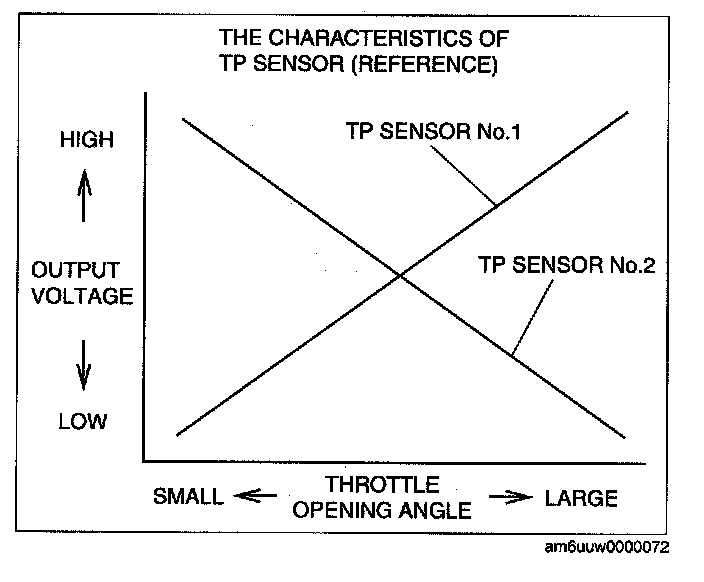
TP sensor output voltage
Circuit Open/Short Inspection

1. Disconnect the PCM connector.
2. Inspect the following wiring harnesses or an open or short circuit. (Continuity check)
Open circuit
- If there is no continuity, there is an open circuit. Repair or replace the wiring harness.
- Throttle body terminal A and PCM terminal 3M
- Throttle body terminal B and PCM terminal 3P
- Throttle body terminal C and PCM terminal 3J
- Throttle body terminal D and PCM terminal 3Q
Short circuit
- If there is continuity, there is a short circuit. Repair or replace the wiring harness.
- Throttle body terminal A and power supply
- Throttle body terminal A and body ground
- Throttle body terminal B and power supply
- Throttle body terminal B and body ground
- Throttle body terminal C and power supply
- Throttle body terminal C and body ground
- Throttle body terminal D and power supply
NOTE: Perform the following inspection only when directed.
Voltage Inspection
1. Verity that no DTC related to APP sensor has been detected.
- If any DTCs related to APP sensor have been detected, perform the DTC inspection. (See DTC TABLE[L3 WITH TC].) Diagnostic Trouble Code Descriptions
2. Start the engine and warm it up (ECT: more than 80°C {176 °F)).
3. Turn the ignition switch to the ON position (Engine off).
4. Verity that the PCM terminal 3J and 3M change smoothly while throttle valve is gradually opened.
- If as verified, go to next step.
- If not as verified, perform the 'Circuit Open/Short Inspection".
- If there is no open circuit, replace the throttle body.
5. Verify that the PCM terminal 3J and 3M voltages are as shown in the following table.
- If voltage is not as following table, perform the "Circuit Open/Short Inspection".
- If there is no open or short circuit, replace the throttle body.
TP sensor output voltage
Circuit Open/Short Inspection
1. Disconnect the PCM connector.
2. Inspect the following wiring harnesses or an open or short circuit. (Continuity check)
Open circuit
- If there is no continuity, there is an open circuit. Repair or replace the wiring harness.
- Throttle body terminal A and PCM terminal 3M
- Throttle body terminal B and PCM terminal 3P
- Throttle body terminal C and PCM terminal 3J
- Throttle body terminal D and PCM terminal 3Q
Short circuit
- If there is continuity, there is a short circuit. Repair or replace the wiring harness.
- Throttle body terminal A and power supply
- Throttle body terminal A and body ground
- Throttle body terminal B and power supply
- Throttle body terminal B and body ground
- Throttle body terminal C and power supply
- Throttle body terminal C and body ground
- Throttle body terminal D and power supply
Factory Service Tools
Use the Manual With the Right Hardware
Pair factory procedures with proven DIY tools so the instructions are easier to execute.
Disclosure: Verified tool recommendations may earn an affiliate commission at no cost to you.
When to See a Mechanic
Stop DIY work and contact a certified mechanic immediately if any of the following apply:
- • You smell fuel, burning insulation, or see smoke.
- • Brakes feel soft, pull hard to one side, or make grinding noises.
- • The engine overheats, stalls repeatedly, or misfires under load.
- • You are missing required tools, torque specs, or safe lifting equipment.
- • You are not confident in the next step or safety outcome.