
Safety Warning
DIY auto repair can cause serious injury, fire, or vehicle damage. These guides are for informational purposes only. Always follow OEM torque specs, wear PPE, and consult a certified mechanic if you are unsure. You are solely responsible for your safety.
2007 Mazda CX-9 V6-3.5LFACTORY OEM SERVICE PROCEDURE
Remote Start System - Blows A/C and Ign. Fuses: Overview
Bulletin No.: 01-046/08
Last Issued: 10/1/2008
Subject:
REMOTE START CAUSES HVAC1 OR IGN1 FUSE TO BLOW - INSTALL LOAD REDUCTION RELAY SERVICE HARNESS
APPLICABLE MODEL(S)/VINS
2007-2008 CX-7
2007-2008 CX-9
DESCRIPTION
Some vehicles equipped with accessory remote start may experience an inoperative wiper/washers and/or the HVAC system after starting the vehicle using the remote start feature. After the customer enters the vehicle and manually turns the ignition switch to the ON position, the wiper/washers and the HVAC system will be operational.
The cause may be the wipers were left in the ON or AUTO position during an overnight freeze. The wipers will freeze to the windshield and cause an electrical overload as the wipers attempt to operate after starting the vehicle using the remote start feature. The HVAC1 fuse and/or the IGN1 fuse located in the remote start module will blow to protect the system during the electrical overload causing the wiper/washers and/or the HVAC system to be inoperative.
IMPORTANT:
^ Once the customer enters the vehicle and manually turns the ignition switch to the ON position, the wiper/washers and the HVAC system will be operational. The fault is contained in the remote start module and does not effect normal operation of the wiper/washers and the HVAC system once the ignition is turned on. After the ignition is turned on, the wiper/washers and the HVAC system are powered as designed through the vehicles electrical system. Customers having this concern should have their vehicle repaired using the following repair procedure.

PART(S) INFORMATION
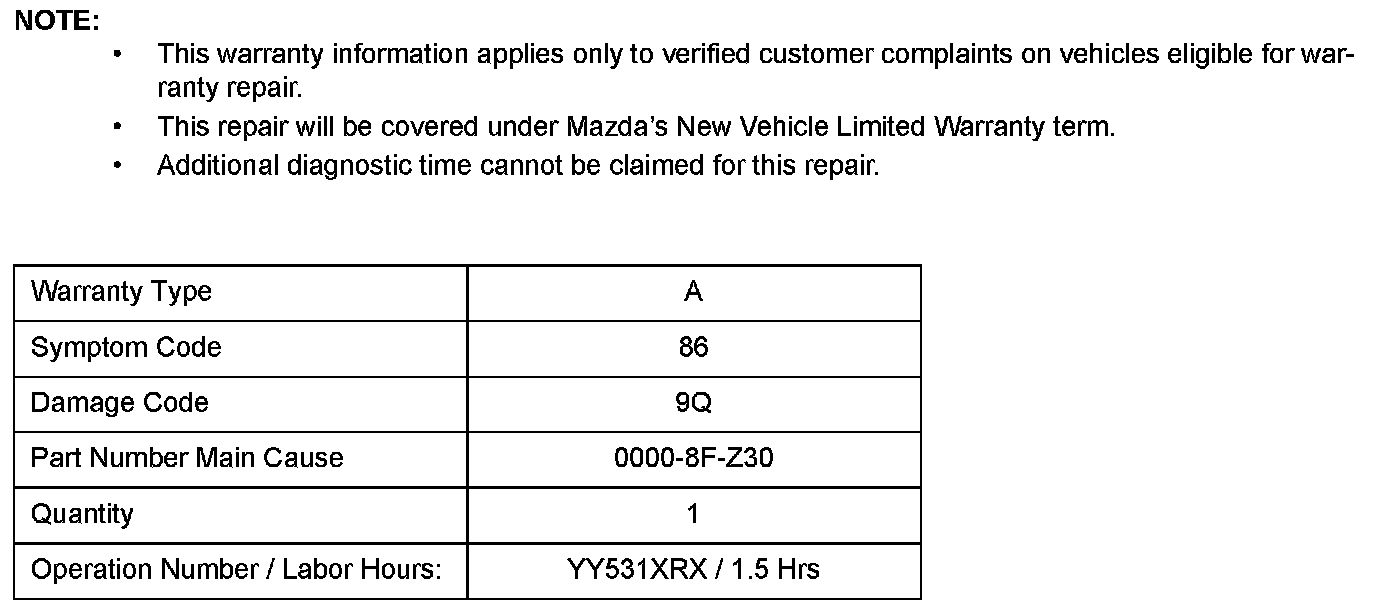
WARRANTY INFORMATION

Disclaimer
Last Issued: 10/1/2008
Subject:
REMOTE START CAUSES HVAC1 OR IGN1 FUSE TO BLOW - INSTALL LOAD REDUCTION RELAY SERVICE HARNESS
APPLICABLE MODEL(S)/VINS
2007-2008 CX-7
2007-2008 CX-9
DESCRIPTION
Some vehicles equipped with accessory remote start may experience an inoperative wiper/washers and/or the HVAC system after starting the vehicle using the remote start feature. After the customer enters the vehicle and manually turns the ignition switch to the ON position, the wiper/washers and the HVAC system will be operational.
The cause may be the wipers were left in the ON or AUTO position during an overnight freeze. The wipers will freeze to the windshield and cause an electrical overload as the wipers attempt to operate after starting the vehicle using the remote start feature. The HVAC1 fuse and/or the IGN1 fuse located in the remote start module will blow to protect the system during the electrical overload causing the wiper/washers and/or the HVAC system to be inoperative.
IMPORTANT:
^ Once the customer enters the vehicle and manually turns the ignition switch to the ON position, the wiper/washers and the HVAC system will be operational. The fault is contained in the remote start module and does not effect normal operation of the wiper/washers and the HVAC system once the ignition is turned on. After the ignition is turned on, the wiper/washers and the HVAC system are powered as designed through the vehicles electrical system. Customers having this concern should have their vehicle repaired using the following repair procedure.
PART(S) INFORMATION
WARRANTY INFORMATION
Disclaimer
Factory Service Tools
Use the Manual With the Right Hardware
Pair factory procedures with proven DIY tools so the instructions are easier to execute.
Disclosure: Verified tool recommendations may earn an affiliate commission at no cost to you.
When to See a Mechanic
Stop DIY work and contact a certified mechanic immediately if any of the following apply:
- • You smell fuel, burning insulation, or see smoke.
- • Brakes feel soft, pull hard to one side, or make grinding noises.
- • The engine overheats, stalls repeatedly, or misfires under load.
- • You are missing required tools, torque specs, or safe lifting equipment.
- • You are not confident in the next step or safety outcome.