
Safety Warning
DIY auto repair can cause serious injury, fire, or vehicle damage. These guides are for informational purposes only. Always follow OEM torque specs, wear PPE, and consult a certified mechanic if you are unsure. You are solely responsible for your safety.
2004 Mazda 6 L4-2.3LFACTORY OEM SERVICE PROCEDURE
Manifold Pressure/Vacuum Sensor: Testing and Inspection
MANIFOLD ABSOLUTE PRESSURE (MAP) SENSOR INSPECTION
NOTE:
- Perform the following inspection only when directed
- The following vacuum values are indicated by relative pressure from the MAP sensor
1. Connect the WDS or equivalent to the DLC-2
2. Turn the ignition switch to ON (Engine OFF)
3. Select MAP PID on the WDS or equivalent
4. Verify that the MAP PID (pressure) and barometric pressure are practically equal
- If not as verified, perform the "Circuit Open/Short Inspection"
- If there is no open or short circuit, replace the MAP sensor
- If as verified, go to next step
5. Apply vacuum of -25.0 kPa {-187 mmHg, -7.38 inHg} to the MAP sensor, and verify that the MAP variation from that of Step 4 is approx 25.0 kPa {187 mmHg, 7.38 inHg}.
- If not as verified, perform the "Circuit Open/Short inspection"
- If there is no open or short circuit replace the barometric pressure sensor.
Circuit Open/Short Inspection
1. Disconnect the PCM connector (See PCM REMOVAL/INSTALLATION.)
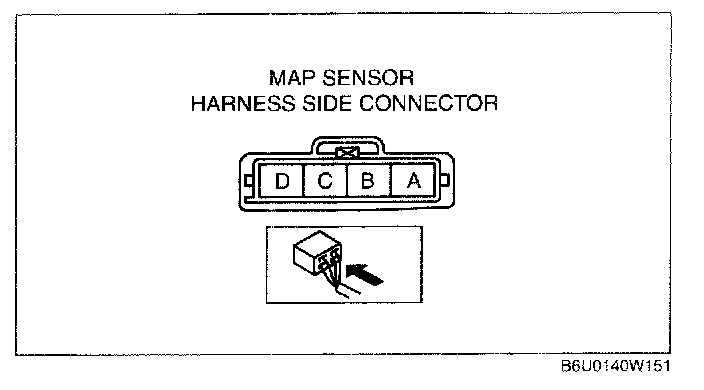
2. Inspect the following wiring harnesses for open or short circuit (Continuity check).
Open circuit
- If there is no continuity, there is an open circuit. Repair or replace the wiring harness
- MAP sensor terminal A (harness-side) and PCM terminal 2H
- MAP sensor terminal D (harness-side) and PCM terminal 1J
- MAP sensor terminal C (harness-side) and PCM terminal 2K
Short circuit
- If there is continuity, there is a short circuit Repair or replace the wiring harness
- MAP sensor terminal C (harness-side) and power supply.
- MAP sensor terminal C (harness-side) and body GND.
- MAP sensor terminal D (harness-side) and power supply.
- MAP sensor terminal D (harness-side) and body GND.
NOTE:
- Perform the following inspection only when directed
- The following vacuum values are indicated by relative pressure from the MAP sensor
1. Connect the WDS or equivalent to the DLC-2
2. Turn the ignition switch to ON (Engine OFF)
3. Select MAP PID on the WDS or equivalent
4. Verify that the MAP PID (pressure) and barometric pressure are practically equal
- If not as verified, perform the "Circuit Open/Short Inspection"
- If there is no open or short circuit, replace the MAP sensor
- If as verified, go to next step
5. Apply vacuum of -25.0 kPa {-187 mmHg, -7.38 inHg} to the MAP sensor, and verify that the MAP variation from that of Step 4 is approx 25.0 kPa {187 mmHg, 7.38 inHg}.
- If not as verified, perform the "Circuit Open/Short inspection"
- If there is no open or short circuit replace the barometric pressure sensor.
Circuit Open/Short Inspection
1. Disconnect the PCM connector (See PCM REMOVAL/INSTALLATION.)
2. Inspect the following wiring harnesses for open or short circuit (Continuity check).
Open circuit
- If there is no continuity, there is an open circuit. Repair or replace the wiring harness
- MAP sensor terminal A (harness-side) and PCM terminal 2H
- MAP sensor terminal D (harness-side) and PCM terminal 1J
- MAP sensor terminal C (harness-side) and PCM terminal 2K
Short circuit
- If there is continuity, there is a short circuit Repair or replace the wiring harness
- MAP sensor terminal C (harness-side) and power supply.
- MAP sensor terminal C (harness-side) and body GND.
- MAP sensor terminal D (harness-side) and power supply.
- MAP sensor terminal D (harness-side) and body GND.
Factory Service Tools
Use the Manual With the Right Hardware
Pair factory procedures with proven DIY tools so the instructions are easier to execute.
Disclosure: Verified tool recommendations may earn an affiliate commission at no cost to you.
When to See a Mechanic
Stop DIY work and contact a certified mechanic immediately if any of the following apply:
- • You smell fuel, burning insulation, or see smoke.
- • Brakes feel soft, pull hard to one side, or make grinding noises.
- • The engine overheats, stalls repeatedly, or misfires under load.
- • You are missing required tools, torque specs, or safe lifting equipment.
- • You are not confident in the next step or safety outcome.