
Safety Warning
DIY auto repair can cause serious injury, fire, or vehicle damage. These guides are for informational purposes only. Always follow OEM torque specs, wear PPE, and consult a certified mechanic if you are unsure. You are solely responsible for your safety.
2003 Lexus SC 430 V8-4.3L (3UZ-FE)FACTORY OEM SERVICE PROCEDURE
Engine Controls - ECU Programming Procedure: Overview
SPECIAL SERVICE TOOLS
SS001-01
REVISED
March 9, 2001
Title:
ECU FLASH REPROGRAMMING PROCESS
Models:
Applicable Models
TSIB REVISION NOTICE:
^ September 22, 2003: 2003 (and later) models added; Operation Procedures updated for CAN Interface Module with the latest Diagnostic Tester software (v. 10.1a and 10.2a), Calibration Update Wizard (v.6.0), and calibration files.
^ The previous TSIB should be discarded.
Introduction
Electronic Control Unit (ECU) is a Lexus term used to describe integrated computerized devices responsible for managing the operation of a system or sub-system. For the purposes of this bulletin, the term "ECU" is used as a generic label for the following SAE J1930 standard references:
^ Powertrain Control Module (PCM)
^ Engine Control Module (ECM)
^ Transmission Control Module (TCM)
^ or any other Lexus specific control unit
Flash reprogramming allows the ECU software to be updated for changes in vehicle calibrations without removing the ECU from the vehicle. Flash calibration updates for specific vehicle models/ECUs will be released as field fix procedures described in individual service bulletins. This bulletin details the ECU flash reprogramming process and the applications within the Technical Information System (TIS) and the Lexus Diagnostic Tester used for reprogramming.
Flash calibration updates can only be applied to the vehicle/ECU combination for which they are intended. ECUs have internal security that will not allow them to be programmed with another ECU's information.
Applicable Vehicles
^ 2001 (and later) model year GS 430/300, IS 300, LS 430 and LX 470 vehicles.
^ 2002 (and later) model year SC 430 vehicles.
^ All 2003 (and later) model year Lexus vehicles.

Parts Information
NOTE:
Authorized Modifications Labels may be ordered in packages of 25 from the Materials Distribution Center (MDC) through the TDN Dealer Support Materials System, or by calling the MDC at 1-800-622-2033.

Warranty Information
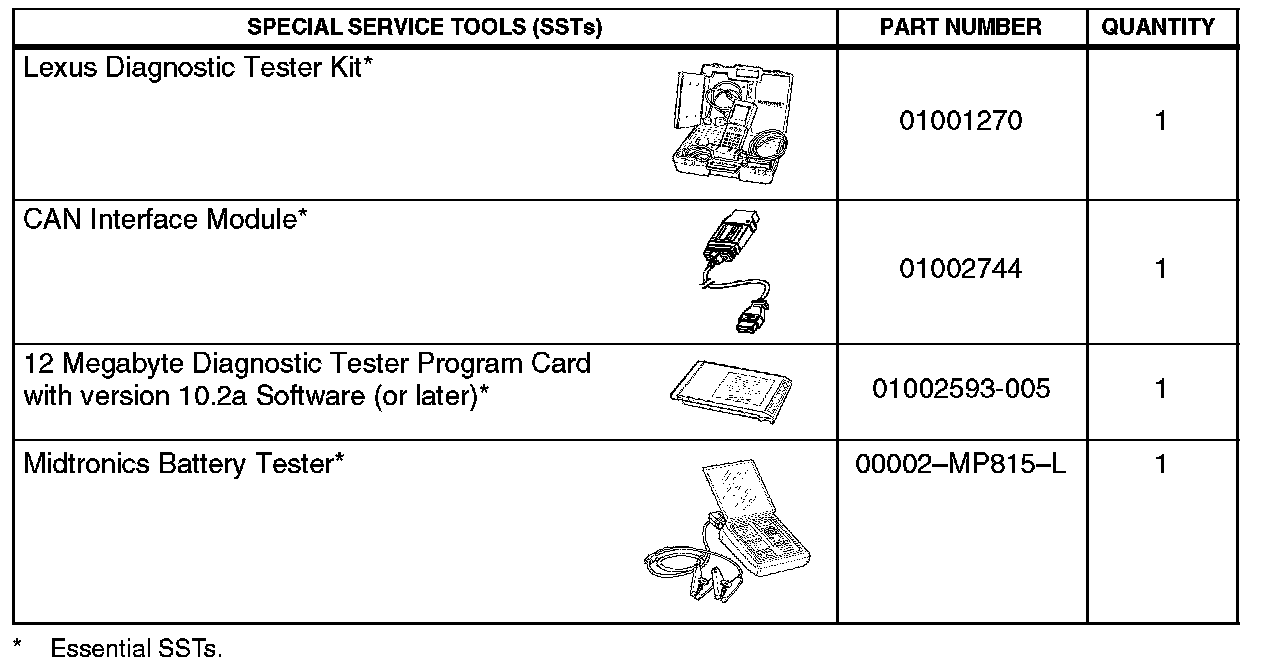
Required SSTs
NOTE:
Additional Diagnostic Tester Kits, CAN Interface Modules, Program Cards or SSTs may be ordered by calling SPX/OTC at 1-800-933-8335.
Process Overview
ECU Flash Reprogramming is a 4-step process:
1. Locate the desired calibration file on TIS (Technical Information System).
Calibration files may be found in two areas:
a. Search by model and year for a Technical Service Information Bulletin addressing a specific product issue.
b. Search by model under the ECU Flash Reprogramming section.
2. Download the calibration file from TIS to the Diagnostic Tester.
The Calibration Update Wizard (CUW) is an application on TIS which downloads calibration files from TIS to the Diagnostic Tester Program Card. This step is only required when the calibration file is not currently stored on the Diagnostic Tester Program Card.
3. Reprogram the vehicle ECU with the Diagnostic Tester.
Diagnostic Tester Software now incorporates a function to update a vehicle's ECU calibration through flash reprogramming.
4. Confirm successful flash update and affix calibration update sticker.
Modifications to ECU calibration files must be recorded and properly displayed on the vehicle using the calibration update sticker.
NOTE:
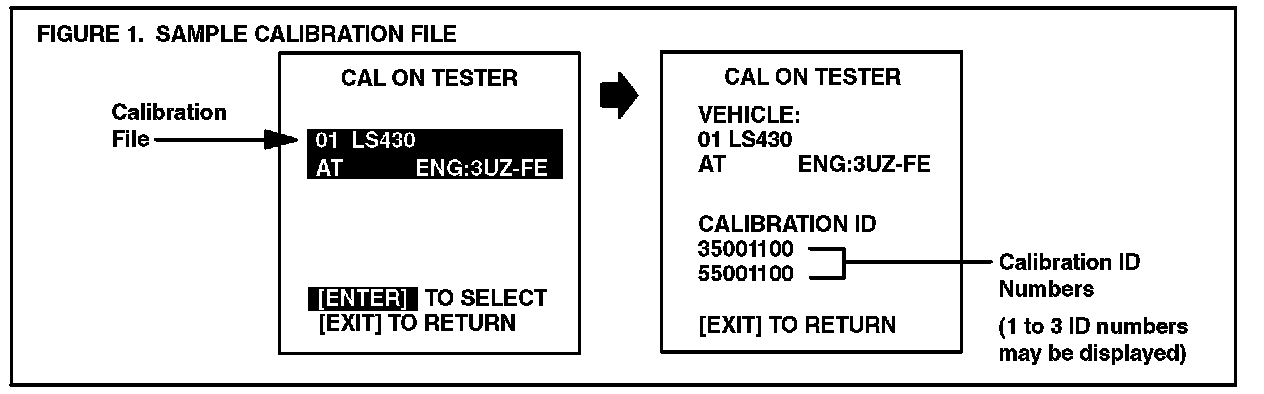
The calibration file contains the Calibration ID number(s) for a specific vehicle ECU (see Figure 1).
NOTE:
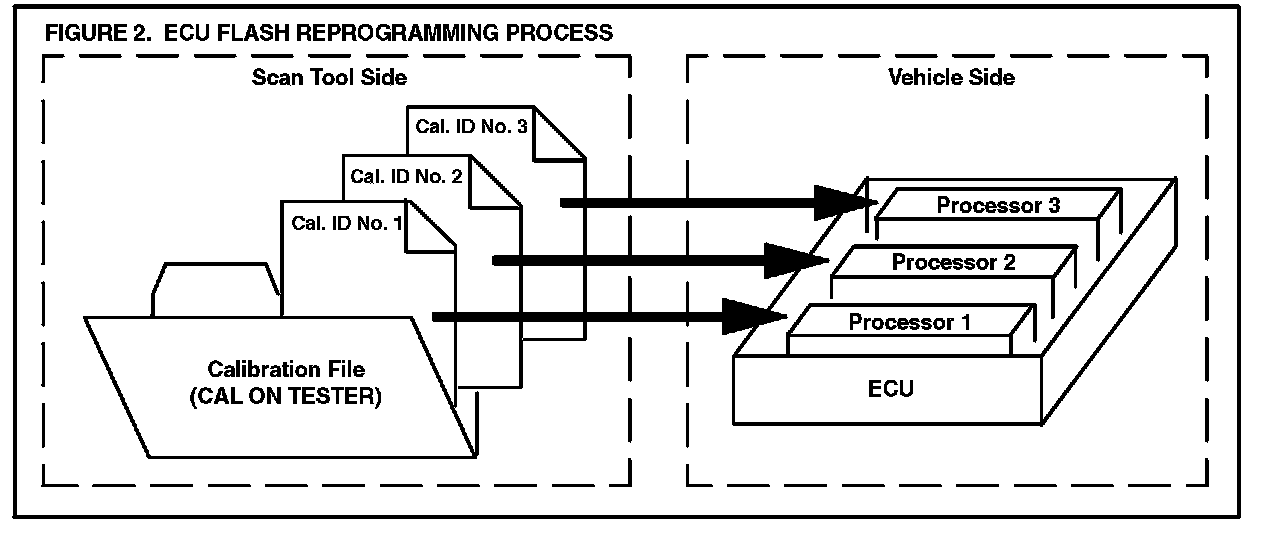
The total number of Calibration ID numbers corresponds to the number of reprogrammable processors in the ECU (see Figure 2).
SS001-01
REVISED
March 9, 2001
Title:
ECU FLASH REPROGRAMMING PROCESS
Models:
Applicable Models
TSIB REVISION NOTICE:
^ September 22, 2003: 2003 (and later) models added; Operation Procedures updated for CAN Interface Module with the latest Diagnostic Tester software (v. 10.1a and 10.2a), Calibration Update Wizard (v.6.0), and calibration files.
^ The previous TSIB should be discarded.
Introduction
Electronic Control Unit (ECU) is a Lexus term used to describe integrated computerized devices responsible for managing the operation of a system or sub-system. For the purposes of this bulletin, the term "ECU" is used as a generic label for the following SAE J1930 standard references:
^ Powertrain Control Module (PCM)
^ Engine Control Module (ECM)
^ Transmission Control Module (TCM)
^ or any other Lexus specific control unit
Flash reprogramming allows the ECU software to be updated for changes in vehicle calibrations without removing the ECU from the vehicle. Flash calibration updates for specific vehicle models/ECUs will be released as field fix procedures described in individual service bulletins. This bulletin details the ECU flash reprogramming process and the applications within the Technical Information System (TIS) and the Lexus Diagnostic Tester used for reprogramming.
Flash calibration updates can only be applied to the vehicle/ECU combination for which they are intended. ECUs have internal security that will not allow them to be programmed with another ECU's information.
Applicable Vehicles
^ 2001 (and later) model year GS 430/300, IS 300, LS 430 and LX 470 vehicles.
^ 2002 (and later) model year SC 430 vehicles.
^ All 2003 (and later) model year Lexus vehicles.
Parts Information
NOTE:
Authorized Modifications Labels may be ordered in packages of 25 from the Materials Distribution Center (MDC) through the TDN Dealer Support Materials System, or by calling the MDC at 1-800-622-2033.
Warranty Information
Required SSTs
NOTE:
Additional Diagnostic Tester Kits, CAN Interface Modules, Program Cards or SSTs may be ordered by calling SPX/OTC at 1-800-933-8335.
Process Overview
ECU Flash Reprogramming is a 4-step process:
1. Locate the desired calibration file on TIS (Technical Information System).
Calibration files may be found in two areas:
a. Search by model and year for a Technical Service Information Bulletin addressing a specific product issue.
b. Search by model under the ECU Flash Reprogramming section.
2. Download the calibration file from TIS to the Diagnostic Tester.
The Calibration Update Wizard (CUW) is an application on TIS which downloads calibration files from TIS to the Diagnostic Tester Program Card. This step is only required when the calibration file is not currently stored on the Diagnostic Tester Program Card.
3. Reprogram the vehicle ECU with the Diagnostic Tester.
Diagnostic Tester Software now incorporates a function to update a vehicle's ECU calibration through flash reprogramming.
4. Confirm successful flash update and affix calibration update sticker.
Modifications to ECU calibration files must be recorded and properly displayed on the vehicle using the calibration update sticker.
NOTE:
The calibration file contains the Calibration ID number(s) for a specific vehicle ECU (see Figure 1).
NOTE:
The total number of Calibration ID numbers corresponds to the number of reprogrammable processors in the ECU (see Figure 2).
Factory Service Tools
Use the Manual With the Right Hardware
Pair factory procedures with proven DIY tools so the instructions are easier to execute.
Disclosure: Verified tool recommendations may earn an affiliate commission at no cost to you.
When to See a Mechanic
Stop DIY work and contact a certified mechanic immediately if any of the following apply:
- • You smell fuel, burning insulation, or see smoke.
- • Brakes feel soft, pull hard to one side, or make grinding noises.
- • The engine overheats, stalls repeatedly, or misfires under load.
- • You are missing required tools, torque specs, or safe lifting equipment.
- • You are not confident in the next step or safety outcome.