
Safety Warning
DIY auto repair can cause serious injury, fire, or vehicle damage. These guides are for informational purposes only. Always follow OEM torque specs, wear PPE, and consult a certified mechanic if you are unsure. You are solely responsible for your safety.
2000 Lexus LS 400 V8-4.0L (1UZ-FE)FACTORY OEM SERVICE PROCEDURE
Rear Wheel Alignment
INSPECTION
1. MEASURE VEHICLE HEIGHT
2. INSTALL CAMBER-CASTER-KINGPIN GAUGE ONTO WHEEL ALIGNMENT TESTER
Follow the specific instructions of the equipment manufacturer.

3. INSPECT CAMBER
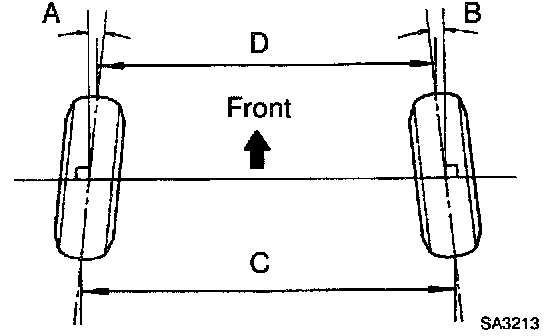
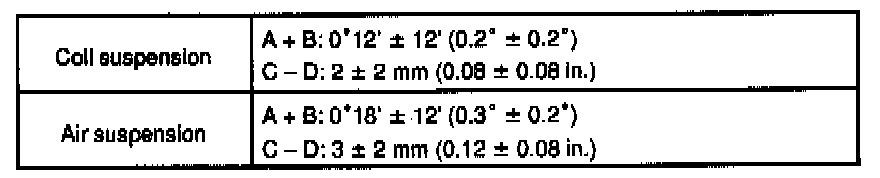
4. INSPECT TOE-IN
5. ADJUST CAMBER AND TOE-IN
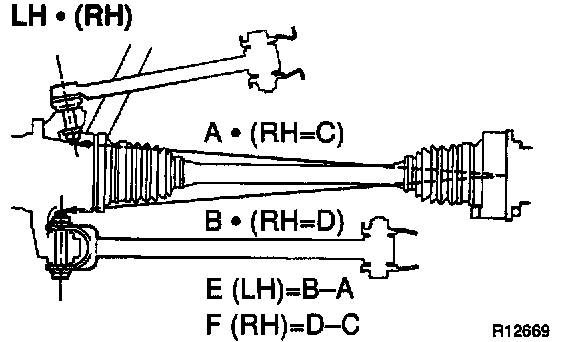
a. Measure the length of the lower suspension arm No.1 and No.2, as shown in the illustration.
Length: (E-F) or (F-E) should be less 4.0 mm (0.16 inch).
If it is not within the specification, adjust the length of the arms by turning the adjusting cam, as shown, until (E-F) or (F-E) is less than 4.0 mm (0.16 inch).
b. Measure the camber and toe-in.
If the camber and toe-in are still not within the specification, adjust the camber and toe-in with the adjusting cam. (See step 6.)
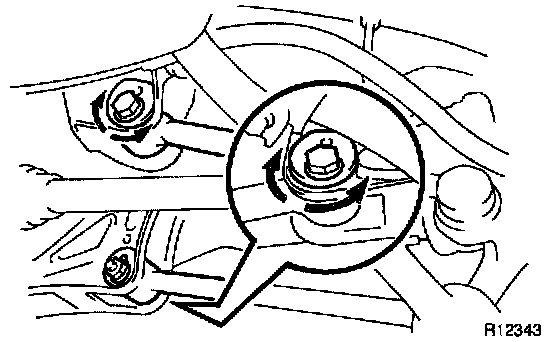
c. Loosen the front and/or rear cams.
d. Adjust camber and toe-in by turning the front and/or rear cams.
e. Torque the front and/or rear cam nuts.
Torque: 78 Nm (790 kgf-cm, 57 ft. lbs.)
6. HOW TO READ ADJUSTMENT CHART
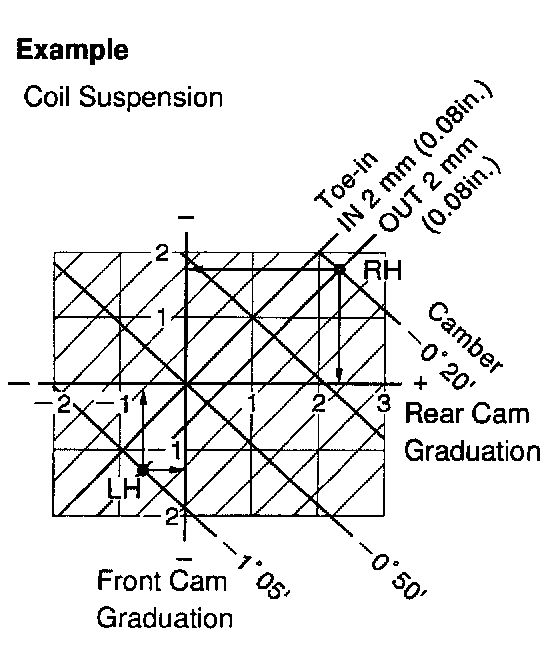
a. Mark on the graph the measurements taken from the vehicle.
Example (Coil suspension):
Camber (LH): -1°05' (-1.08°)
Camber (RH): -0°20' (-0.33°)
Toxin (total): OUT 2 mm (0.08 inch)
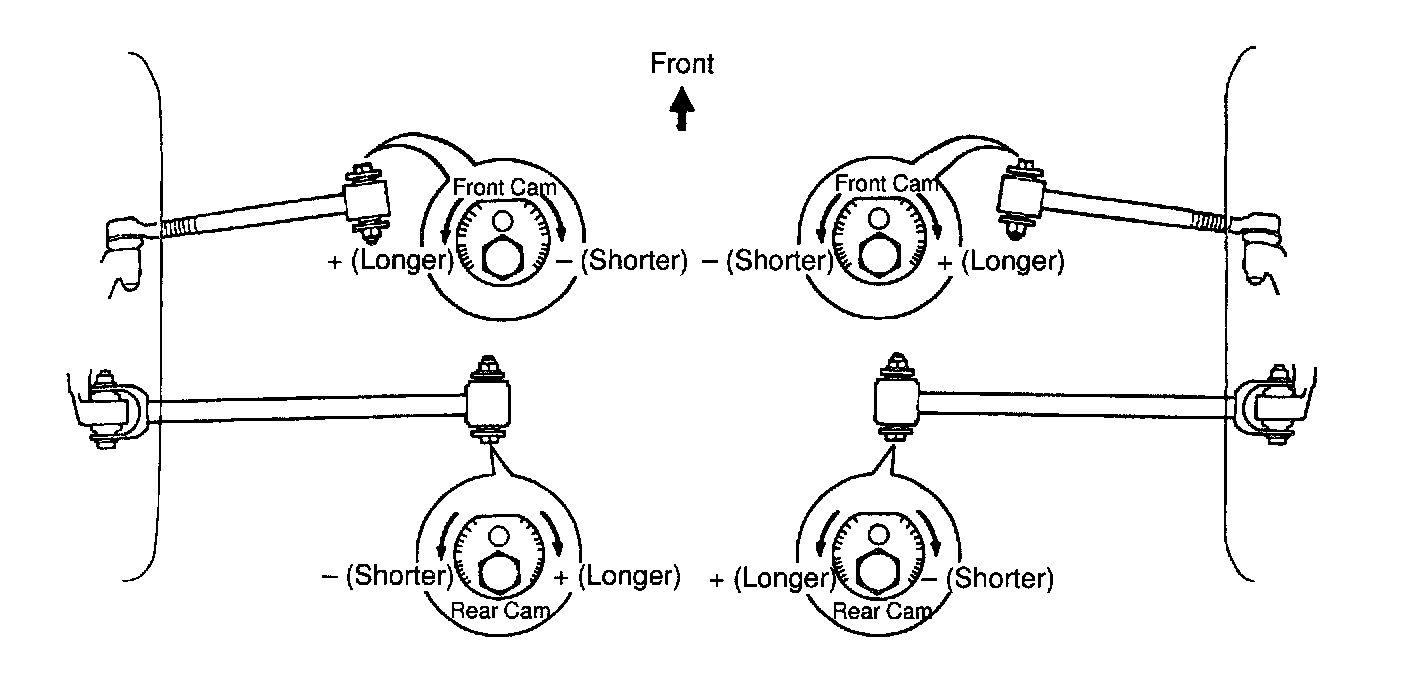
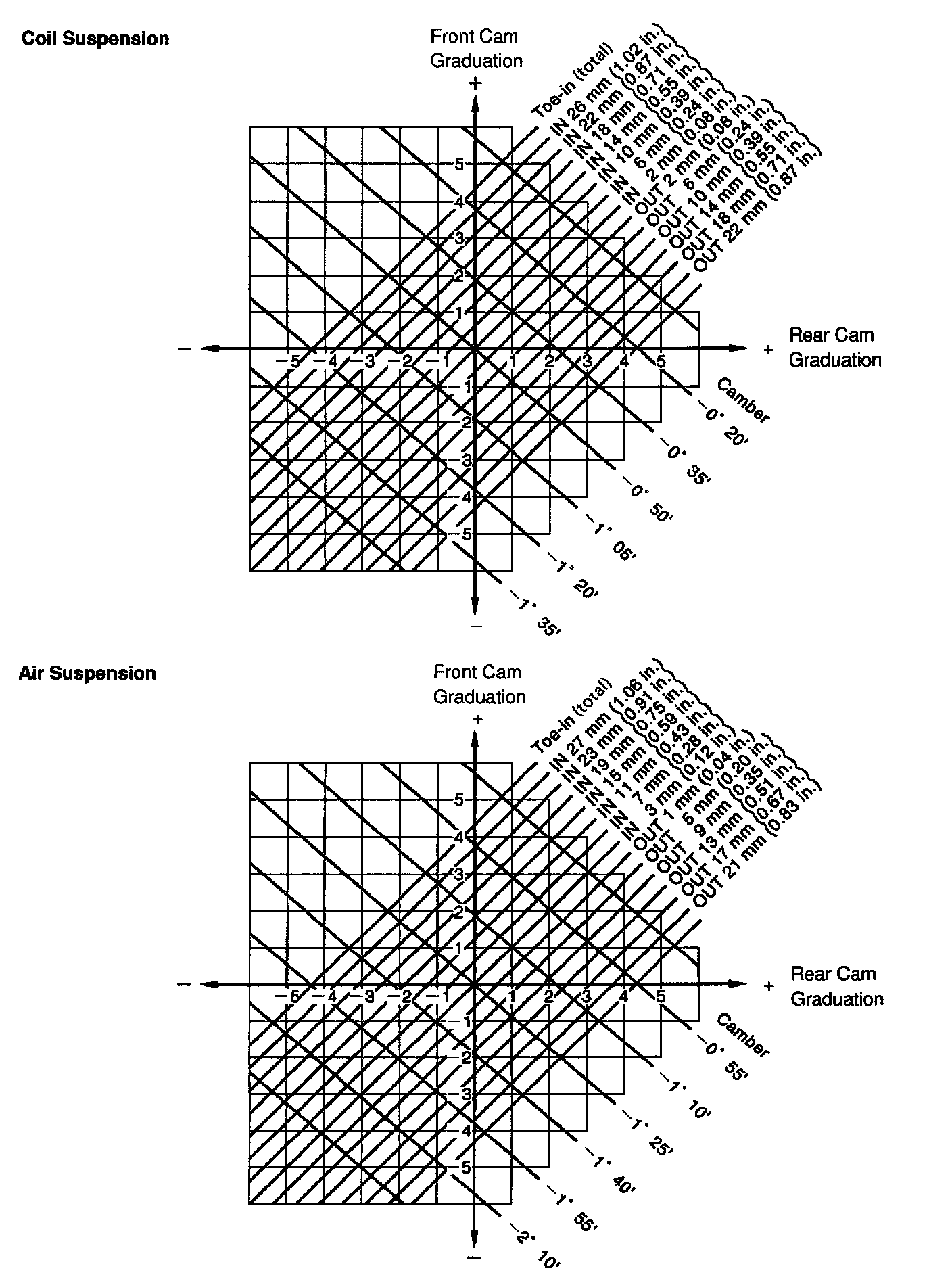
b. As shown in the illustration, from the graph the amounts by which the front and/or rear cam are to be adjusted.
Amount to turn adjusting cam (by graduation):
LH Front cam: -(Shorter) 1.2
LH Rear cam: -(Shorter) 0.7
RH Front cam: +(Longer) 1.8
LH Rear cam: +(Longer) 2.3
1. MEASURE VEHICLE HEIGHT
2. INSTALL CAMBER-CASTER-KINGPIN GAUGE ONTO WHEEL ALIGNMENT TESTER
Follow the specific instructions of the equipment manufacturer.
3. INSPECT CAMBER
Measuring Point Reference:
4. INSPECT TOE-IN
5. ADJUST CAMBER AND TOE-IN
a. Measure the length of the lower suspension arm No.1 and No.2, as shown in the illustration.
Length: (E-F) or (F-E) should be less 4.0 mm (0.16 inch).
If it is not within the specification, adjust the length of the arms by turning the adjusting cam, as shown, until (E-F) or (F-E) is less than 4.0 mm (0.16 inch).
b. Measure the camber and toe-in.
If the camber and toe-in are still not within the specification, adjust the camber and toe-in with the adjusting cam. (See step 6.)
c. Loosen the front and/or rear cams.
d. Adjust camber and toe-in by turning the front and/or rear cams.
e. Torque the front and/or rear cam nuts.
Torque: 78 Nm (790 kgf-cm, 57 ft. lbs.)
6. HOW TO READ ADJUSTMENT CHART
a. Mark on the graph the measurements taken from the vehicle.
Example (Coil suspension):
Camber (LH): -1°05' (-1.08°)
Camber (RH): -0°20' (-0.33°)
Toxin (total): OUT 2 mm (0.08 inch)
b. As shown in the illustration, from the graph the amounts by which the front and/or rear cam are to be adjusted.
Amount to turn adjusting cam (by graduation):
LH Front cam: -(Shorter) 1.2
LH Rear cam: -(Shorter) 0.7
RH Front cam: +(Longer) 1.8
LH Rear cam: +(Longer) 2.3
Factory Service Tools
Use the Manual With the Right Hardware
Pair factory procedures with proven DIY tools so the instructions are easier to execute.
Disclosure: Verified tool recommendations may earn an affiliate commission at no cost to you.
When to See a Mechanic
Stop DIY work and contact a certified mechanic immediately if any of the following apply:
- • You smell fuel, burning insulation, or see smoke.
- • Brakes feel soft, pull hard to one side, or make grinding noises.
- • The engine overheats, stalls repeatedly, or misfires under load.
- • You are missing required tools, torque specs, or safe lifting equipment.
- • You are not confident in the next step or safety outcome.