
Safety Warning
DIY auto repair can cause serious injury, fire, or vehicle damage. These guides are for informational purposes only. Always follow OEM torque specs, wear PPE, and consult a certified mechanic if you are unsure. You are solely responsible for your safety.
2012 Kia Soul L4-2.0LFACTORY OEM SERVICE PROCEDURE
Camshaft Position Sensor: Service and Repair
Inspection
1. Check the signal waveform of the CMPS and CKPS using the GDS.
Specification:Refer to "Wave Form" Testing and Inspection
Removal
WARNING:
- DON'T remove the camshaft position sensor during engine running or right after engine stops, or a scald by the flowed out engine oil may occur.
[Bank 1 / Intake]
1. Turn the ignition switch OFF and disconnect the battery negative (-) cable.
2. Disconnect the camshaft position sensor connector (B) after removing the clip (A).
3. Remove the installation bolt (C), and then remove the sensor.
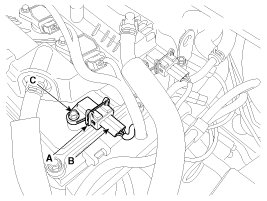
[Bank 1 / Exhaust]
1. Turn the ignition switch OFF and disconnect the battery negative (-) cable.
2. Disconnect the camshaft position sensor connector (B) after removing the clip (A).
3. Remove the installation bolt (C), and then remove the sensor.

Installation
CAUTION:
- Install the component with the specified torques.
- Note that internal damage may occur when the component is dropped. In this case, use it after inspecting.
CAUTION:
- Apply the engine oil to the O-ring.
CAUTION:
- Insert the sensor in the installation hole and be careful not to damage when installation.
CAUTION:
- Be careful not to damage the sensor housing and the connector.
- Be careful not to damage the O-ring.
1. Installation is reverse of removal.
Camshaft position sensor installation bolt:
9.8 - 11.8 N.m (1.0 - 1.2 kgf.m, 7.2 - 8.7 lb-ft)
Factory Service Tools
Use the Manual With the Right Hardware
Pair factory procedures with proven DIY tools so the instructions are easier to execute.
Disclosure: Verified tool recommendations may earn an affiliate commission at no cost to you.
When to See a Mechanic
Stop DIY work and contact a certified mechanic immediately if any of the following apply:
- • You smell fuel, burning insulation, or see smoke.
- • Brakes feel soft, pull hard to one side, or make grinding noises.
- • The engine overheats, stalls repeatedly, or misfires under load.
- • You are missing required tools, torque specs, or safe lifting equipment.
- • You are not confident in the next step or safety outcome.