
Safety Warning
DIY auto repair can cause serious injury, fire, or vehicle damage. These guides are for informational purposes only. Always follow OEM torque specs, wear PPE, and consult a certified mechanic if you are unsure. You are solely responsible for your safety.
2012 Kia Optima L4-2.4LFACTORY OEM SERVICE PROCEDURE
Repair Procedures
Fuse Inspection
1. Be sure there is no play in the fuse holders, and that the fuses are held securely.
2. Are the fuse capacities for each circuit correct?
3. Are there any blown fuses?
If a fuse is to be replaced, be sure to use a new fuse of the same capacity. Always determine why the fuse blew first and completely eliminate the problem before installing a new fuse.
Inspection
1. The SJB can be diagnosed by using the GDS. The SJB communicates with the GDS which then displays inputs and outputs along with codes.
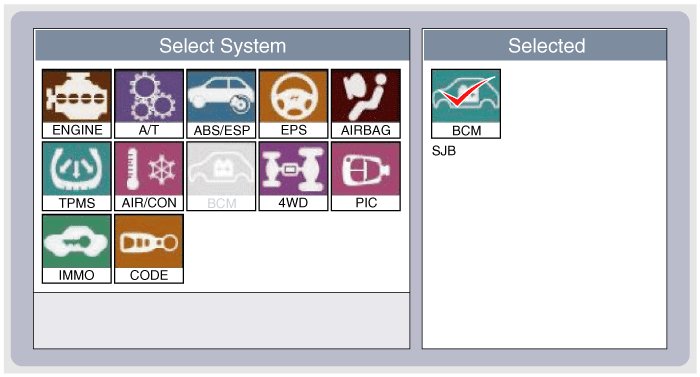
2. To diagnose the SJB function, select the vehicle model, BCM and SJB.
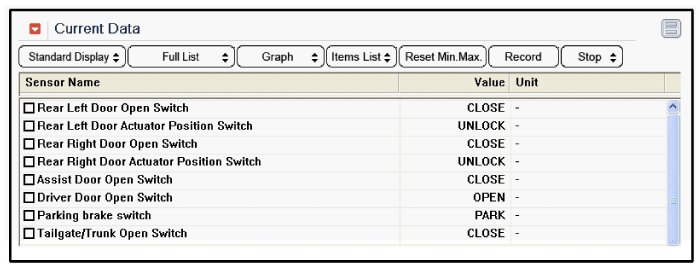
3. To consult the present input/out value of SJB, "Current DATA". It provides information of SJB input/output conditions.
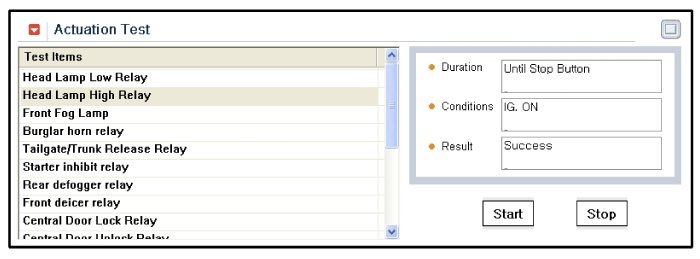
4. To perform functional test on SJB outputs, select "Actuation Test"
Removal
Passenger Compartment Junction Box (SJB)
1. Disconnect the negative(-) battery terminal.
2. Remove the crash pad lower panel (A).
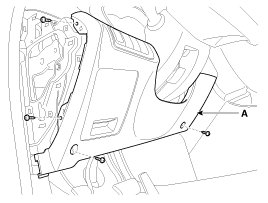
3. Disconnect the connectors (A) from the fuse side of the smart junction box.
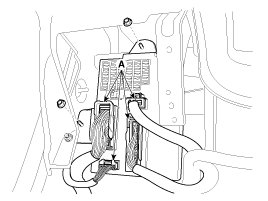
4. Remove the smart junction box after loosening the mounting nuts (2EA).
5. Disconnect the connectors from the back side of the smart junction box.
Installation
1. Install the smart junction box.
2. Install the crash pad lower panel.
3. Check that all system operates normally.
Factory Service Tools
Use the Manual With the Right Hardware
Pair factory procedures with proven DIY tools so the instructions are easier to execute.
Disclosure: Verified tool recommendations may earn an affiliate commission at no cost to you.
When to See a Mechanic
Stop DIY work and contact a certified mechanic immediately if any of the following apply:
- • You smell fuel, burning insulation, or see smoke.
- • Brakes feel soft, pull hard to one side, or make grinding noises.
- • The engine overheats, stalls repeatedly, or misfires under load.
- • You are missing required tools, torque specs, or safe lifting equipment.
- • You are not confident in the next step or safety outcome.