
Safety Warning
DIY auto repair can cause serious injury, fire, or vehicle damage. These guides are for informational purposes only. Always follow OEM torque specs, wear PPE, and consult a certified mechanic if you are unsure. You are solely responsible for your safety.
2009 Kia Rio L4-1.6LFACTORY OEM SERVICE PROCEDURE
Front Wheel Alignment
FRONT WHEEL ALIGNMENT
TOE
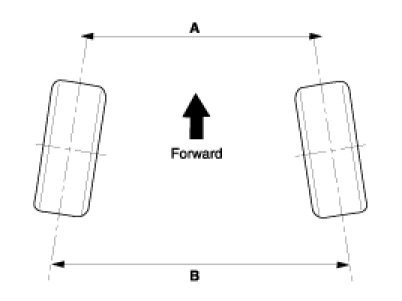

Standard value
Toe-in (B-A) mm (in) : -2 - 2 mm (-0.078 - 0.078 in)
NOTE:
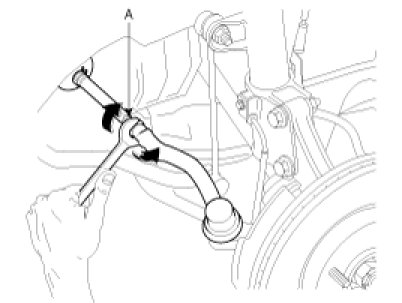
- Toe-in adjustment should be made by turning the right and left tie rods at the same amount.
- When adjusting toe-in, loosen the outer bellows clip to prevent twisting the bellows.
- After the adjustment, tighten the tie rod end lock nuts firmly and reinstall the bellows clip.
- Adjust each toe-in to be the range of ±1mm.
Tie rod end lock nuts(A) tightening torque :
50 - 55 Nm (5 - 5.5 Kgf-m, 36 - 39 lb-ft)
CAMBER
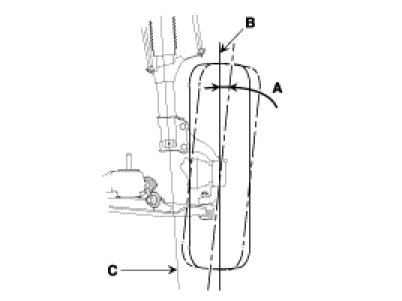

When the wheel tilts out at the top, then the camber is positive (+).
When the wheel tilts in at the top, then the camber is negative (-).
The steering knuckle which is installed with the strut assembly is pre-set to the specified camber at the factory and doesn't need to be adjusted.
Camber : 0°±30'
CASTER
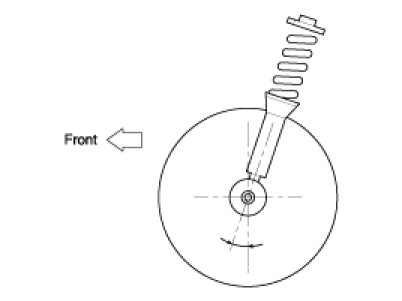
Caster :
to ground ; 4°00' ± 30'
to body ; 4°30'
NOTE:
- The worn loose or damaged parts of the front suspension assembly must be replaced prior to measuring front wheel alignment.
- Camber and caster are pre-set to the specified value at the factory and don't need to be adjusted.
- If the camber and caster are not within specifications, replace bent or damaged parts.
- The difference of left and right wheels about the camber and the caster must be within the range of 0° ± 30'.
Factory Service Tools
Use the Manual With the Right Hardware
Pair factory procedures with proven DIY tools so the instructions are easier to execute.
Disclosure: Verified tool recommendations may earn an affiliate commission at no cost to you.
When to See a Mechanic
Stop DIY work and contact a certified mechanic immediately if any of the following apply:
- • You smell fuel, burning insulation, or see smoke.
- • Brakes feel soft, pull hard to one side, or make grinding noises.
- • The engine overheats, stalls repeatedly, or misfires under load.
- • You are missing required tools, torque specs, or safe lifting equipment.
- • You are not confident in the next step or safety outcome.