
Safety Warning
DIY auto repair can cause serious injury, fire, or vehicle damage. These guides are for informational purposes only. Always follow OEM torque specs, wear PPE, and consult a certified mechanic if you are unsure. You are solely responsible for your safety.
2000 Kia Spectra GSX L4-1.8LFACTORY OEM SERVICE PROCEDURE
Brake Bleeding: Service and Repair
PRECAUTIONS
After finishing repair on a hydraulic line (removing brake pipe), bleed air out of the line using the following precautions and procedures.
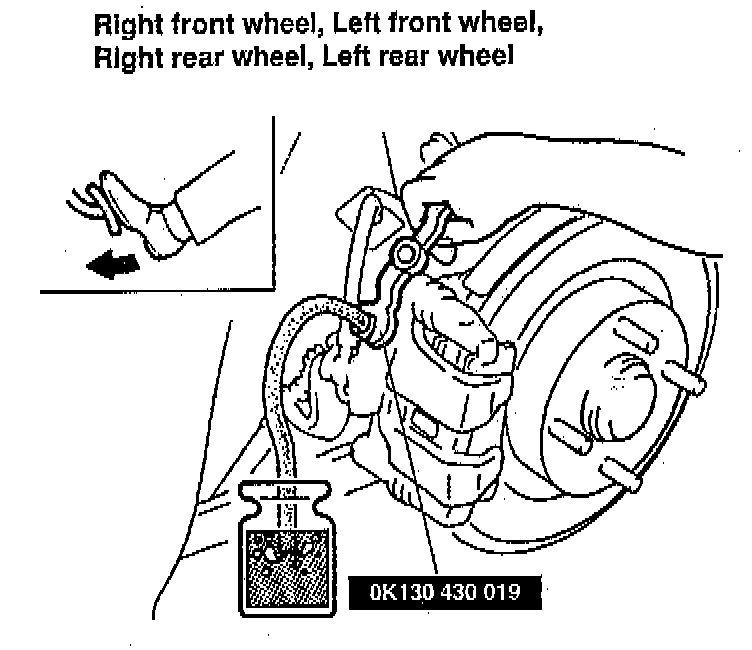
1. When bleeding air from lines, keep fluid level in reservoir to Max position.
2. Bleed air in the following order:
- Right front wheel
- Left front wheel
- Right rear wheel
- Left rear wheel
3. During air bleeding, depress brake pedal at least ten times. Keep the pedal depressed for three seconds to fill the master cylinder.
4. To avoid brake fluids from spouting, install the cap of the reserve tank prior to air bleeding.
5. Keep vehicle level.
PROCEDURES
1. Jack up vehicle and support it with safety stands.
CAUTION: Brake fluid reservoir must be 3/4 full during air bleeding.
2. Remove bleeder cap and attach a vinyl hose to bleeder plug.
3. Place other end of vinyl tube in a clear container.
4. Depress brake pedal a few times, and then hold it in depressed position.
5. Have a second person loosen the bleeder screw, drain out fluid, and retighten screw with Special Service Tool (SST) 0K130 430 019 or equivalent.
Tightening torque: 4.3 - 6.5 ft. lbs.(5.9 Nm)
CAUTION:
a) Both people should stay in voice contact with each other.
b) Be sure pedal remains depressed until air bleed screw is tightened.
6. Repeat steps 4 and 5 until no air bubbles are seen.
7. Check for correct brake operation.
8. Verify that there is no fluid leakage. Clean away any spilled fluid with rags.
9. After air bleeding, add brake fluid to reservoir to specified level.
NOTICE: Air bleeding must be done from bleeder screw that is farthest from the master cylinder.
Factory Service Tools
Use the Manual With the Right Hardware
Pair factory procedures with proven DIY tools so the instructions are easier to execute.
Disclosure: Verified tool recommendations may earn an affiliate commission at no cost to you.
When to See a Mechanic
Stop DIY work and contact a certified mechanic immediately if any of the following apply:
- • You smell fuel, burning insulation, or see smoke.
- • Brakes feel soft, pull hard to one side, or make grinding noises.
- • The engine overheats, stalls repeatedly, or misfires under load.
- • You are missing required tools, torque specs, or safe lifting equipment.
- • You are not confident in the next step or safety outcome.