
Safety Warning
DIY auto repair can cause serious injury, fire, or vehicle damage. These guides are for informational purposes only. Always follow OEM torque specs, wear PPE, and consult a certified mechanic if you are unsure. You are solely responsible for your safety.
2008 Jeep Commander 4WD V8-4.7LFACTORY OEM SERVICE PROCEDURE
Checking the Exhaust System For Leaks
*CHECKING THE EXHAUST SYSTEM FOR LEAKS
1. CHECKING THE EXHAUST SYSTEM FOR LEAKS
Turn the ignition off.
Raise the vehicle.
WARNING: The normal operating temperature of the exhaust system is very high. Never work around or attempt to service any part of the exhaust system until it has cooled. Special care should be taken when working near the catalytic converter. The temperature of the converter rises to a high level after a short period of engine operating time
Connect Exhaust Cone #8404-EC or #8404-EC to Air Pressure Regulator (with hose) #W-18-MIL-1146AS.
CAUTION: The air pressure must not exceed 27.6 kPa (4 psi), otherwise engine damage can occur.
Attach shop air to the air pressure regulator.
Adjust the Air Pressure Regulator to 27.6 kPa (4 psi)
Insert the exhaust cone into the vehicle tail pipe.
If the vehicle is equipped with dual exhaust. Use the #8404-ECT with equipped attached plug, plug one side of the dual exhaust pipe. Pressurize the other as described above.
Apply Mopar(R) Air Leak Detector PN# 05191804AA (or an equivalent leak finder liquid) to the following areas:
- All welded joints from the exhaust manifold to 152.4 mm (6 inches) behind the downstream O2 sensor
- O2 sensor seal points
- O2 sensor boss welds
- Flange/joint connection(s)
- Exhaust manifold to cylinder head connection(s)
- EGR solenoid gasket base and tube seal points (if equipped)
Watch for the Mopar(R) Air Leak Detector PN# 05191804AA (or the equivalent leak finder liquid) to bubble.
Use the following definitions to help determine if system or component repair/replacement is necessary:
Type 1 Leak is defined as a leak where very small foam like bubbles 1 mm (0.04 of an inch) or less appear.
Any Type 1 or greater leaks found in welded joints, O2 sensor seal points or O2 sensor boss welds must be repaired or the component must be replaced.
Type 2 Leak is defined as a leak where larger bubbles pea size, 8 mm (0.3 of an inch) or greater appear.
Any Type 2 or greater leaks found in flange or joint connections, exhaust manifold to cylinder head connections, or EGR gasket and tube seal points must be repaired or the components must be replaced
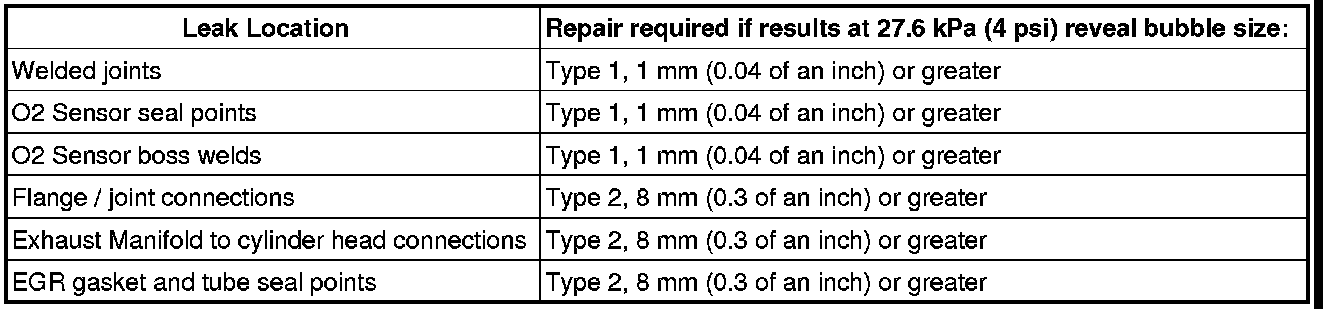
If a leak is found that matches the above definition, repair or replace the component as necessary.
Once the repair is complete, repeat the procedure to verify that all leaks have been repaired.
Were any exhaust leaks found?
Yes
- Repair or replace the leaking exhaust parts as necessary.
- Perform the POWERTRAIN VERIFICATION TEST.Powertrain Verification Test
No
- Test complete.
Factory Service Tools
Use the Manual With the Right Hardware
Pair factory procedures with proven DIY tools so the instructions are easier to execute.
Disclosure: Verified tool recommendations may earn an affiliate commission at no cost to you.
When to See a Mechanic
Stop DIY work and contact a certified mechanic immediately if any of the following apply:
- • You smell fuel, burning insulation, or see smoke.
- • Brakes feel soft, pull hard to one side, or make grinding noises.
- • The engine overheats, stalls repeatedly, or misfires under load.
- • You are missing required tools, torque specs, or safe lifting equipment.
- • You are not confident in the next step or safety outcome.
Rather have a pro handle this?
A certified mobile mechanic comes to your home or office. They bring the tools, you stay comfortable. No tow truck, no waiting room, no surprises.
Comes to youSame-day available12-month warranty
Get a Free QuoteNo obligation. See pricing before you book.