
Safety Warning
DIY auto repair can cause serious injury, fire, or vehicle damage. These guides are for informational purposes only. Always follow OEM torque specs, wear PPE, and consult a certified mechanic if you are unsure. You are solely responsible for your safety.
2006 Jeep Commander 2WD V8-5.7L VIN 2FACTORY OEM SERVICE PROCEDURE
Control Module HVAC: Description and Operation
MODULE-POWER-BLOWER MOTOR
DESCRIPTION
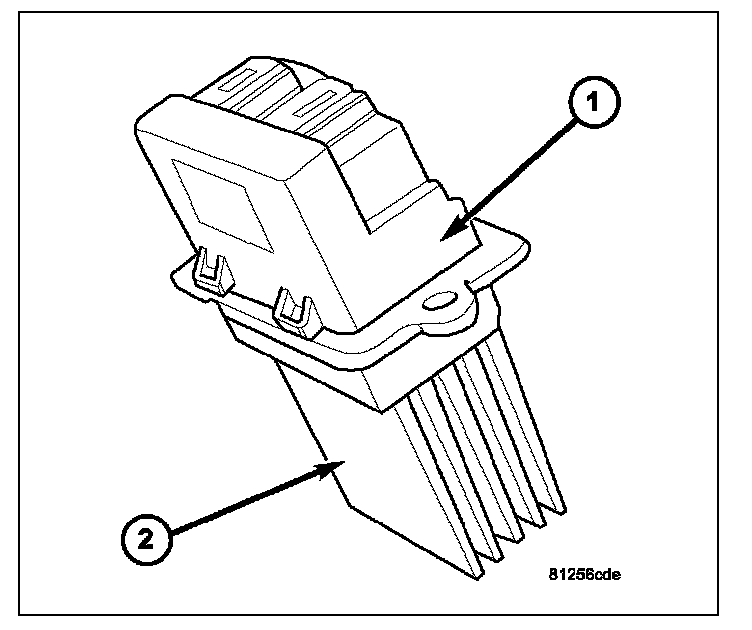
A blower motor power module is used on this model when it is equipped with the automatic temperature control (ATC) heating-A/C system. Models equipped with the manual temperature control (MTC) heating-A/C system use a blower motor resistor, instead of the blower motor power module.
The blower motor power module is mounted to the rear of the HVAC housing, directly behind the glove box. The blower motor power module consists of a molded plastic mounting plate with two integral connector receptacles (1). Concealed behind the mounting plate is the power module electronic circuitry and a large finned heat sink (2).
The blower motor power module is accessed for service by removing the glove box.
OPERATION
The blower motor power module is connected to the vehicle electrical system through a dedicated lead and connector of the HVAC wire harness. A second connector receptacle receives the wire harness connector from the blower motor. The blower motor power module allows the microprocessor-based automatic temperature control (ATC) A/C-heater control to calculate and provide infinitely variable blower motor speeds based upon either manual blower switch input or the ATC programming using a pulse width modulated (PWM) circuit strategy.
The PWM voltage is applied to a comparator circuit which compares the PWM signal voltage to the blower motor feedback voltage. The resulting output drives the power module circuitry, which provides a linear output voltage to change or maintain the desired blower speed.
The blower motor power module can be diagnosed using a scan tool.
The blower motor power module cannot be adjusted or repaired and, if faulty or damaged, it must be replaced.
DESCRIPTION
A blower motor power module is used on this model when it is equipped with the automatic temperature control (ATC) heating-A/C system. Models equipped with the manual temperature control (MTC) heating-A/C system use a blower motor resistor, instead of the blower motor power module.
The blower motor power module is mounted to the rear of the HVAC housing, directly behind the glove box. The blower motor power module consists of a molded plastic mounting plate with two integral connector receptacles (1). Concealed behind the mounting plate is the power module electronic circuitry and a large finned heat sink (2).
The blower motor power module is accessed for service by removing the glove box.
OPERATION
The blower motor power module is connected to the vehicle electrical system through a dedicated lead and connector of the HVAC wire harness. A second connector receptacle receives the wire harness connector from the blower motor. The blower motor power module allows the microprocessor-based automatic temperature control (ATC) A/C-heater control to calculate and provide infinitely variable blower motor speeds based upon either manual blower switch input or the ATC programming using a pulse width modulated (PWM) circuit strategy.
The PWM voltage is applied to a comparator circuit which compares the PWM signal voltage to the blower motor feedback voltage. The resulting output drives the power module circuitry, which provides a linear output voltage to change or maintain the desired blower speed.
The blower motor power module can be diagnosed using a scan tool.
The blower motor power module cannot be adjusted or repaired and, if faulty or damaged, it must be replaced.
Factory Service Tools
Use the Manual With the Right Hardware
Pair factory procedures with proven DIY tools so the instructions are easier to execute.
Disclosure: Verified tool recommendations may earn an affiliate commission at no cost to you.
When to See a Mechanic
Stop DIY work and contact a certified mechanic immediately if any of the following apply:
- • You smell fuel, burning insulation, or see smoke.
- • Brakes feel soft, pull hard to one side, or make grinding noises.
- • The engine overheats, stalls repeatedly, or misfires under load.
- • You are missing required tools, torque specs, or safe lifting equipment.
- • You are not confident in the next step or safety outcome.