
Safety Warning
DIY auto repair can cause serious injury, fire, or vehicle damage. These guides are for informational purposes only. Always follow OEM torque specs, wear PPE, and consult a certified mechanic if you are unsure. You are solely responsible for your safety.
2000 Isuzu Rodeo LS 2WD V6-3.2LFACTORY OEM SERVICE PROCEDURE
Air Flow Meter/Sensor: Description and Operation
Mass Air Flow (MAF) Sensor
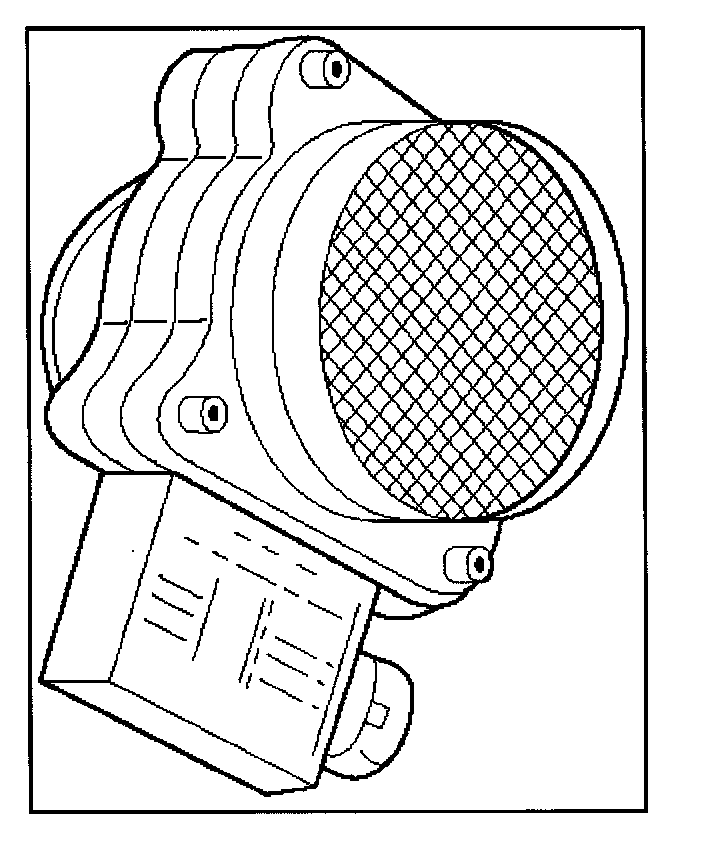
The mass air flow (MAF) sensor measures the difference between the volume and the quantity of air that enters the engine. "Volume" means the size of the space to be filled. "Quantity" means the number of air molecules that will fit into the space. This information is important to the PCM because heavier, denser air will hold more fuel than lighter, thinner air. The PCM adjusts the air/fuel ratio as needed depending on the MAF value. The Tech 2 reads the MAF value and displays it in terms of grams per second (g/sec). At idle, the Tech 2 should read between 4 - 7 g/sec on a fully warmed up engine. Values should change quickly on acceleration. Values should remain stable at any given RPM. A failure in the MAF sensor or circuit will set DTC P0101, DTC P0102, or DTC P0103.
The mass air flow (MAF) sensor measures the difference between the volume and the quantity of air that enters the engine. "Volume" means the size of the space to be filled. "Quantity" means the number of air molecules that will fit into the space. This information is important to the PCM because heavier, denser air will hold more fuel than lighter, thinner air. The PCM adjusts the air/fuel ratio as needed depending on the MAF value. The Tech 2 reads the MAF value and displays it in terms of grams per second (g/sec). At idle, the Tech 2 should read between 4 - 7 g/sec on a fully warmed up engine. Values should change quickly on acceleration. Values should remain stable at any given RPM. A failure in the MAF sensor or circuit will set DTC P0101, DTC P0102, or DTC P0103.
Factory Service Tools
Use the Manual With the Right Hardware
Pair factory procedures with proven DIY tools so the instructions are easier to execute.
Disclosure: Verified tool recommendations may earn an affiliate commission at no cost to you.
When to See a Mechanic
Stop DIY work and contact a certified mechanic immediately if any of the following apply:
- • You smell fuel, burning insulation, or see smoke.
- • Brakes feel soft, pull hard to one side, or make grinding noises.
- • The engine overheats, stalls repeatedly, or misfires under load.
- • You are missing required tools, torque specs, or safe lifting equipment.
- • You are not confident in the next step or safety outcome.