
Safety Warning
DIY auto repair can cause serious injury, fire, or vehicle damage. These guides are for informational purposes only. Always follow OEM torque specs, wear PPE, and consult a certified mechanic if you are unsure. You are solely responsible for your safety.
2013 Hyundai Santa Fe AWD L4-2.4LFACTORY OEM SERVICE PROCEDURE
Control Module: Service and Repair
Removal
CAUTION:
When replacing the TCM, the vehicle equipped with the immobilizer must be performed procedure as below.
[In the case of installing used TCM]
1. Perform "TCM Neutral mode" procedure with GDS.
2. After finishing "TCM Neutral mode", perform "Key teaching" procedure with GDS.
[In the case of installing new TCM]
Perform "Key teaching" procedure with GDS.
CAUTION:
When replacing the TCM, the vehicle equipped with the smart key system (Button start) must be performed procedure as below.
[In the case of installing used TCM]
1. Perform "TCM Neutral mode" procedure with GDS.
2. After finishing "TCM Neutral mode", insert the key (or press the start button) and turn it to the IGN ON and OFF position. Then the TCM learns the smart key information automatically.
[In the case of installing new TCM]
Insert the key (or press the start button) and turn it to the IGN ON and OFF position. Then the TCM learns the smart key information automatically.
1. Turn ignition switch OFF and disconnect the negative (-) battery cable.
2. Disconnect the TCM Connector (A).
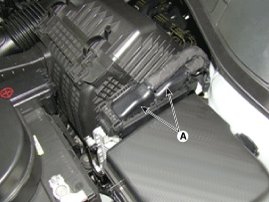
3. Remove the battery.
4. Remove the air cleaner assembly.
5. Remove the mounting bolts (A) and nut (B), and then remove the TCM (C).
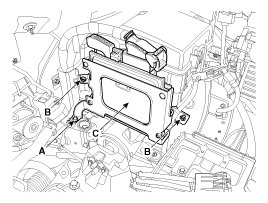
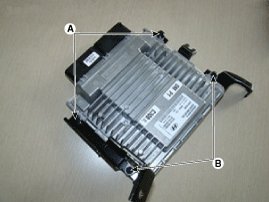
6. After removing the installation nuts (A) and screws (B), remove the TCM (C) from the bracket.
Installation
CAUTION:
When replacing the TCM, the vehicle equipped with the immobilizer must be performed procedure as below.
[In the case of installing used TCM]
1. Perform "TCM Neutral mode" procedure with GDS.
2. After finishing "TCM Neutral mode", perform "Key teaching" procedure with GDS.
[In the case of installing new TCM]
Perform "Key teaching" procedure with GDS.
CAUTION:
When replacing the TCM, the vehicle equipped with the smart key system (Button start) must be performed procedure as below.
[In the case of installing used TCM]
1. Perform "TCM Neutral mode" procedure with GDS.
2. After finishing "TCM Neutral mode", insert the key (or press the start button) and turn it to the IGN ON and OFF position. Then the TCM learns the smart key information automatically.
[In the case of installing new TCM]
Insert the key (or press the start button) and turn it to the IGN ON and OFF position. Then the TCM learns the smart key information automatically.
1. Install in the reverse order of removal.
TCM installation bolt:
9.8 - 11.8 N.m (1.0 - 1.2 kgf.m,7.2 - 8.7 lb-ft)
TCM bracket installation bolt/nut:
9.8 - 11.8 N.m (1.0 - 1.2 kgf.m,7.2 - 8.7 lb-ft)
CAUTION:
- Perform TCM learning after replacing the transaxle to prevent slow transaxle response, jerky acceleration and jerky startup.
TCM Problem Inspection Procedure
1. TEST TCM GROUND CIRCUIT: Measure resistance between TCM and chassis ground using the backside of TCM harness connector as TCM side check point. If the problem is found, repair it.
Specification: Below 1Ohms
2. TEST TCM CONNECTOR: Disconnect the TCM connector and visually check the ground terminals on TCM side and harness side for bent pins or poor contact pressure. If the problem is found, repair it.
3. If problem is not found in Step 1 and 2, the TCM could be faulty. If so, make sure there were no DTC's before swapping the TCM with a new one, and then check the vehicle again. If DTC's were found, examine this first before swapping TCM.
4. RE-TEST THE ORIGINAL TCM: Install the original TCM (may be broken) into a known-good vehicle and check the vehicle. If the problem occurs again, replace the original TCM with a new one. If problem does not occur, this is intermittent problem .
Factory Service Tools
Use the Manual With the Right Hardware
Pair factory procedures with proven DIY tools so the instructions are easier to execute.
Disclosure: Verified tool recommendations may earn an affiliate commission at no cost to you.
When to See a Mechanic
Stop DIY work and contact a certified mechanic immediately if any of the following apply:
- • You smell fuel, burning insulation, or see smoke.
- • Brakes feel soft, pull hard to one side, or make grinding noises.
- • The engine overheats, stalls repeatedly, or misfires under load.
- • You are missing required tools, torque specs, or safe lifting equipment.
- • You are not confident in the next step or safety outcome.