
Safety Warning
DIY auto repair can cause serious injury, fire, or vehicle damage. These guides are for informational purposes only. Always follow OEM torque specs, wear PPE, and consult a certified mechanic if you are unsure. You are solely responsible for your safety.
2012 Hyundai Equus V8-5.0LFACTORY OEM SERVICE PROCEDURE
Engine Oil: Service and Repair
Engine Oil And Filter Replacement
CAUTION:
- Prolonged and repeated contact with mineral oil will result in the removal of natural fats from the skin, leading to dryness, irritation and dermatitis. In addition, used engine oil contains potentially harmful contaminants which may cause skin cancer.
- Exercise caution in order to minimize the length and frequency of contact of your skin to used oil. Wear protective clothing and gloves. Wash your skin thoroughly with soap and water, or use water-less hand cleaner, to remove any used engine oil. Do not use gasoline, thinners, or solvents.
- In order to preserve the environment, used oil and used oil filter must be disposed of only at designated disposal sites.
1. Park the car on level ground.
Start the engine and let it warm up.
2. Drain engine oil.
(1) Remove the oil filler cap.
(2) After lifting the car, remove the oil drain plug (A) and drain oil into a container.

3. Replace the oil filter.
(1) Drain oil in the oil filter by loosening the drain bolt (C).
(2) Remove the oil filter cap (B) from the oil filter body.
(3) Remove the oil filter element (A).

(4) Check and clean the oil filter installation surface.
(5) Check the part number of a new oil filter is same as old one.
(6) Install a new oil filter element and new O-rings.
(7) Apply clean engine oil to the new O-ring.
Lightly screw the oil filter cap into place, and tighten it until the O-ring contacts the seat.
(8) Finally tighten it again by specified tightening torque.
Tightening torque
Oil filter cap :
22.6 - 26.5N.m (2.3 - 2.7kgf.m, 16.6 - 19.5lb-ft)
Drain bolt :
8.8 - 10.8N.m (0.9 - 1.1kgf.m, 6.5 - 8.0lb-ft)
4. Fill new engine oil.
(1) Install the oil drain plug with a new gasket.
Tightening torque :
34.3 - 44.1N.m (3.5 - 4.5kgf.m, 25.3 - 32.5lb-ft)
(2) Fill with new engine oil, after pull out the engine oil level gauge about 10cm (3.9370in).
Capacity
The oil level gauge with Orange color
Total : 8.0L (8.45 US qt, 7.04 lmp qt, 2.112 US.gal)
Oil pan : 6.3L (6.66 US qt, 5.54 lmp qt, 1.663 US.gal)
Drain and refill including oil filter :
6.8L (7.18 US qt, 5.98 lmp qt, 1.795 US.gal)
The oil level gauge with Red color
Total : 8.4L (8.88 US qt, 7.39 lmp qt, 2.218 US.gal)
Oil pan : 6.7L (7.08 US qt, 5.89 lmp qt, 1.769 US.gal)
Drain and refill including oil filter :
7.2L (7.61 US qt, 6.33 lmp qt, 1.900 US.gal)
A. Fill a half oil of the total amount first and do the rest again after about one minute later.
B. Do not fill oil over the 'F' line, checking the level with the oil level gauge.
(3) Install the oil filler cap and oil level gauge.
5. Start the engine and check to be sure no oil is leaking from the drain plug or oil filter.
6. Recheck the engine oil level.
Inspection
1. Check the engine oil quality. Check the oil deterioration, addition of water or coolant, discoloring or thinning. If the quality is visibly poor, replace the oil.
2. Check the engine oil level.
After warming up the engine and then 5 minutes after the engine stop, oil level should be between the "L" and "F" marks in the dipstick.
If low, check for leakage and add oil up to the "F" mark.
NOTE:
Do not fill with engine oil above the "F" mark.
Selection Of Engine Oil
Recommendation (except Middle East): 5W-20/GF4&SM (If not available, refer to the recommended API of ILSAC classification and SAE viscosity number.)
API Classification : SL, SM or above
ILSAC classification : GF3, GF4 or above
SAE viscosity grade : Refer to the recommended SAE viscosity number.
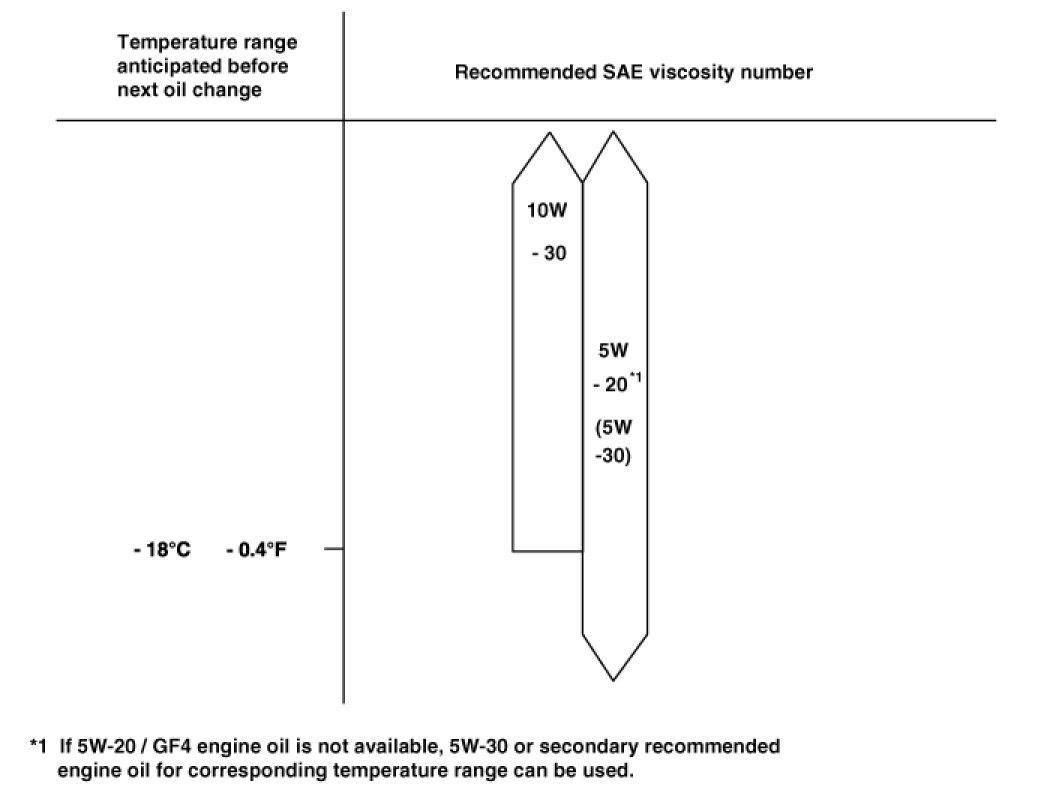
NOTE:
For best performance and maximum protection of all types of operation, select only those lubricants which :
1. Satisfy the requirement of the API or ILSAC classification.
2. Have proper SAE grade number for expected ambient temperature range.
3. Lubricants that do not have both an SAE grade number and API or ILSAC service classification on the container should not be used.
Factory Service Tools
Use the Manual With the Right Hardware
Pair factory procedures with proven DIY tools so the instructions are easier to execute.
Disclosure: Verified tool recommendations may earn an affiliate commission at no cost to you.
When to See a Mechanic
Stop DIY work and contact a certified mechanic immediately if any of the following apply:
- • You smell fuel, burning insulation, or see smoke.
- • Brakes feel soft, pull hard to one side, or make grinding noises.
- • The engine overheats, stalls repeatedly, or misfires under load.
- • You are missing required tools, torque specs, or safe lifting equipment.
- • You are not confident in the next step or safety outcome.