
Safety Warning
DIY auto repair can cause serious injury, fire, or vehicle damage. These guides are for informational purposes only. Always follow OEM torque specs, wear PPE, and consult a certified mechanic if you are unsure. You are solely responsible for your safety.
2012 Hyundai Azera V6-3.3LFACTORY OEM SERVICE PROCEDURE
Vehicle Lifting: Service and Repair
Lift And Support Points
WARNING:
When heavy rear components such as suspension, fuel tank, spare tire, tailgate and trunk lid are to be removed, place additional weight in the luggage area before hoisting. When substantial weight is removed from the rear of the vehicle, the center of gravity may change and can cause the vehicle to tip forward on the hoist.
NOTE:
- Since each tire/wheel assembly weights approximately 30lbs (14kg), placing the front wheels in the luggage area can assist with the weight distribution.
- Use the same support points to support the vehicle on safety stands.
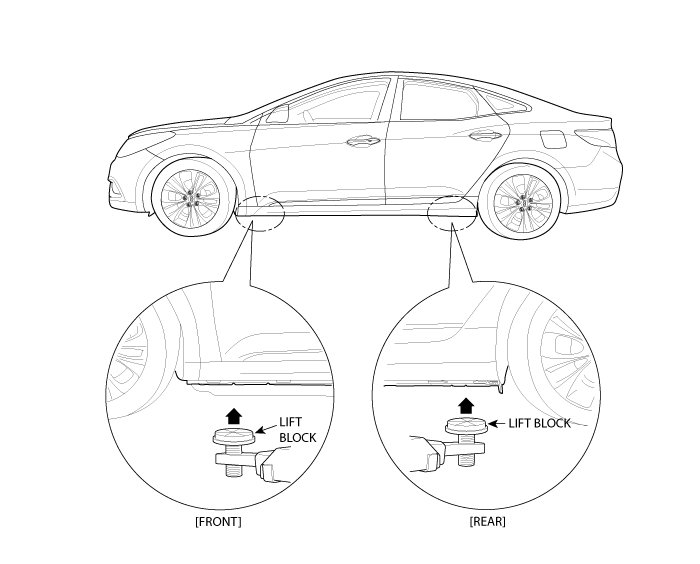
1. Place the lift blocks under the support points as shown in the illustration.
2. Raise the hoist a few inches (centimeters) and rock the vehicle to be sure it is firmly supported.
3. Raise the hoist to full height to inspect the lift points for secure support.
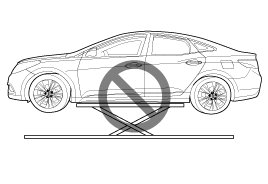
WARNING:
Using scissors lift

Using a scissors lift may cause damage of the side out seal molding panel because the lift point is located higher than side out seal molding panel.
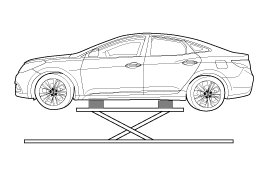
Place wooden or rubber blocks (more than 50mm (1.9685in) in height) between lift and vehicle lift point to prevent damage of the side out seal molding panel.
Using 2 post lift
Using a 2 post lift, there can be interference in lift arm and side out seal molding panel so that it can be damaged.
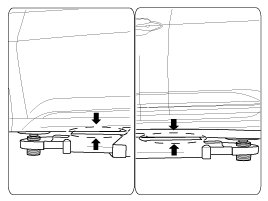
Adjust the telescopic pad height (3-stage arm : more than 185mm (7.2835in), 2-stage arm : more than 195mm (7.6772in)) before lift up vehicle.
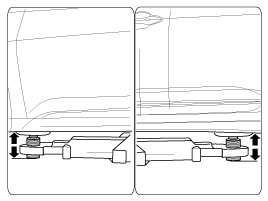
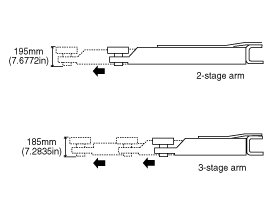
Check the contact surface between lift arm and side out seal molding panel during lift up the vehicle.
Factory Service Tools
Use the Manual With the Right Hardware
Pair factory procedures with proven DIY tools so the instructions are easier to execute.
Disclosure: Verified tool recommendations may earn an affiliate commission at no cost to you.
When to See a Mechanic
Stop DIY work and contact a certified mechanic immediately if any of the following apply:
- • You smell fuel, burning insulation, or see smoke.
- • Brakes feel soft, pull hard to one side, or make grinding noises.
- • The engine overheats, stalls repeatedly, or misfires under load.
- • You are missing required tools, torque specs, or safe lifting equipment.
- • You are not confident in the next step or safety outcome.