
Safety Warning
DIY auto repair can cause serious injury, fire, or vehicle damage. These guides are for informational purposes only. Always follow OEM torque specs, wear PPE, and consult a certified mechanic if you are unsure. You are solely responsible for your safety.
2003 Hyundai Tiburon L4-2.0LFACTORY OEM SERVICE PROCEDURE
Scan Tool Testing and Procedures
BCM FAILURE DIAGNOSIS USING HI-SCAN(PRO)
1. BCM (Body Control Module) is an integrative type control unit, and it includes following functions.
1. ETACS (various time & alarm control functions etc)
2. Receiver function of remote doer lock
3. Performs communication with Hi-scan(pro)

2. Located in a junction box (power supply and circuit joint contact formation), and integrated shape.
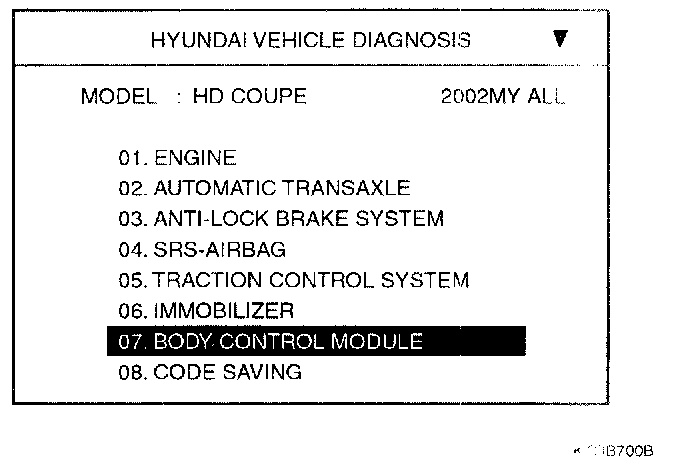
3. Firstly, to diagnose BCM functions, select the menu of "10 HD COUPE" mode and "07 BODY CONTROL MODULE" [ENTER].

4. Then the following screen will be displayed.


5. Though self-diagnosis (failure code output) is not provided, we can find out the failure parts more rapidly by monitoring input/output values and forced drive in failure diagnosis.
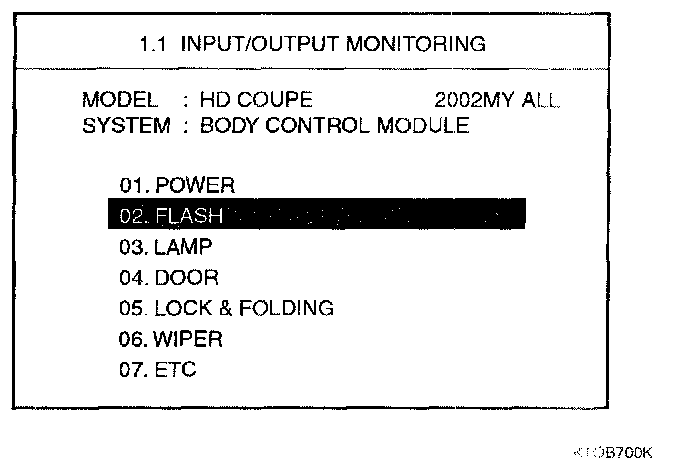
If you want to check the current values of input/output values of BCM, select "01 INPUT/OUTPUT MONITORING" and press [ENTER] then the following screen will be displayed.
It provides BCM input/output condition such as power supply condition, flash function, lamp condition, door condition, locking unit and mirror folding state, wiper circuit and so on.
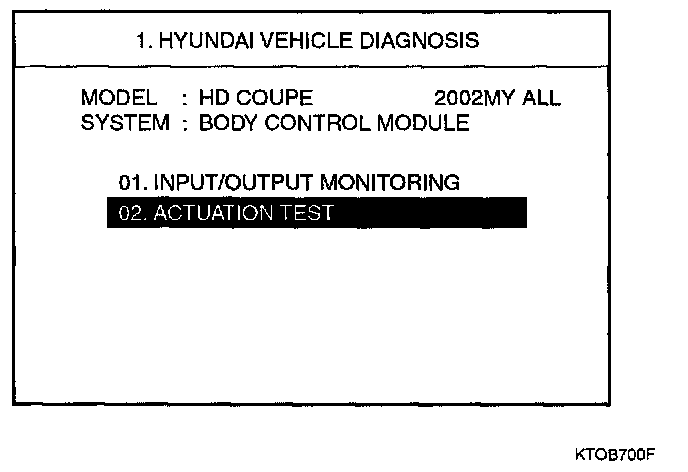
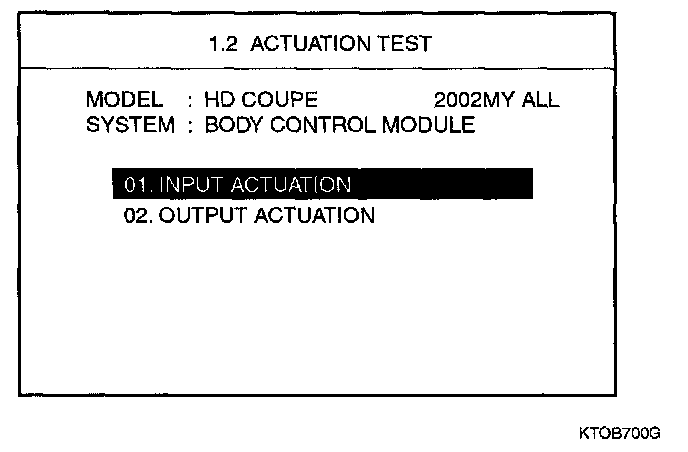
6. If you want forced drive of BCM input factors, select "01 INPUT ACTUATION" after selecting "02.ACTUATION TEST".

7. Press [ENTER], and then the following screen will be displayed.
This functions testing by inputting input factors into BCM.
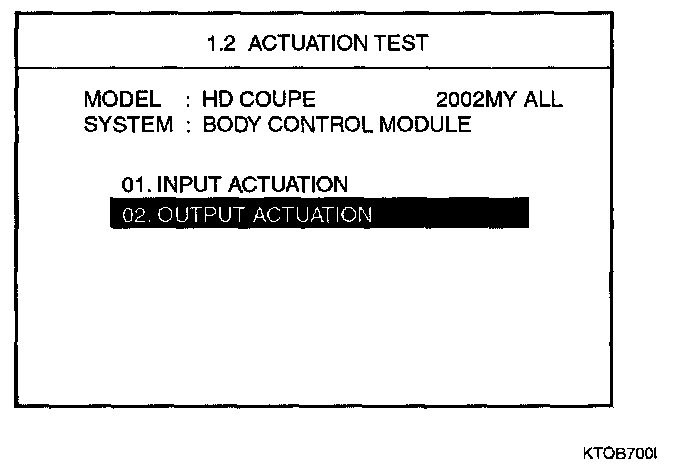

8. If you want forced drive of BCM output factors, select "02 ACTUATION TEST" after selecting "02 OUTPUT ACTUATION", and then press [ENTER].
This functions forced drive testing directly against BCM output factors.
9. Examples of BCM self-diagnosis application
1. Symptom lamp is not operating when left turn signal switch is turned on.
2. Failure diagnosis Following are the expected failure ranges.
1. Poor switch contact of multi-function switch
2. Input wiring malfunction
3. BCM malfunction
4. Output wiring malfunction
5. Left turn signal lamp malfunction
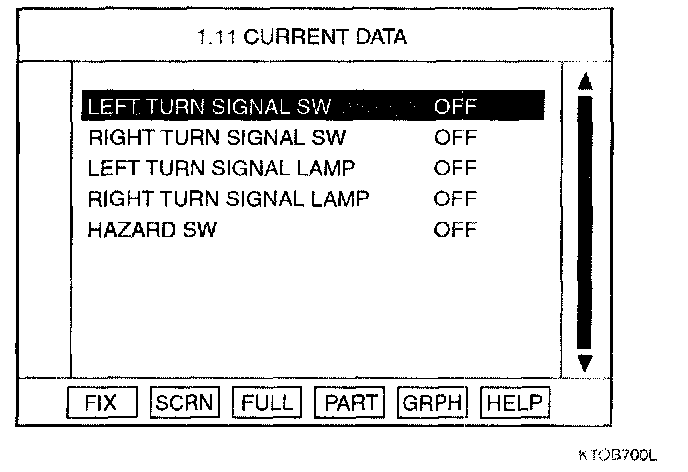
3. Practice input/output monitoring first to approach the above problem rapidly.
1. When switch input is not normal, => Possibility of malfunction in multi-function contact or input circuit.
2. Though, switch input is normal, when turn signal lamp output is not normal => Possibility of BCM malfunction.
3. If both are normal, => Possibility of malfunction in output wiring or lamp.
4. To diagnose BCM control function, perform forced drive.

INPUT FACTOR FORCED DRIVE

OUTPUT FACTOR FORCED DRIVE
1. When multifunction Switch or BCM input circuit are probably of problem in the above 3-1), check the lamp operation by inputting input factors compulsorily into BCM.
If BCM is normal, lamp blinks when turn signal switch (BCM input factor) in inputted compulsorily. If the lamp does not blink, drive output factors compulsorily.
=> Multi-function switch => Wiring => Diagnose circuit failure before BCM input terminal.
2. Deliver output signals (lamp drive signal) to lamp compulsorily to test BCM output terminal.
Turn signal lamp (output factor) will blink. If it is normal when driven compulsorily.
=> BCM output terminal => Wiring => Check any malfunction in BCM control and output circuit by directly diagnosing circuit to load (lamp).
1. BCM (Body Control Module) is an integrative type control unit, and it includes following functions.
1. ETACS (various time & alarm control functions etc)
2. Receiver function of remote doer lock
3. Performs communication with Hi-scan(pro)
2. Located in a junction box (power supply and circuit joint contact formation), and integrated shape.
3. Firstly, to diagnose BCM functions, select the menu of "10 HD COUPE" mode and "07 BODY CONTROL MODULE" [ENTER].
4. Then the following screen will be displayed.
5. Though self-diagnosis (failure code output) is not provided, we can find out the failure parts more rapidly by monitoring input/output values and forced drive in failure diagnosis.
If you want to check the current values of input/output values of BCM, select "01 INPUT/OUTPUT MONITORING" and press [ENTER] then the following screen will be displayed.
It provides BCM input/output condition such as power supply condition, flash function, lamp condition, door condition, locking unit and mirror folding state, wiper circuit and so on.
6. If you want forced drive of BCM input factors, select "01 INPUT ACTUATION" after selecting "02.ACTUATION TEST".
7. Press [ENTER], and then the following screen will be displayed.
This functions testing by inputting input factors into BCM.
8. If you want forced drive of BCM output factors, select "02 ACTUATION TEST" after selecting "02 OUTPUT ACTUATION", and then press [ENTER].
This functions forced drive testing directly against BCM output factors.
9. Examples of BCM self-diagnosis application
1. Symptom lamp is not operating when left turn signal switch is turned on.
2. Failure diagnosis Following are the expected failure ranges.
1. Poor switch contact of multi-function switch
2. Input wiring malfunction
3. BCM malfunction
4. Output wiring malfunction
5. Left turn signal lamp malfunction
3. Practice input/output monitoring first to approach the above problem rapidly.
1. When switch input is not normal, => Possibility of malfunction in multi-function contact or input circuit.
2. Though, switch input is normal, when turn signal lamp output is not normal => Possibility of BCM malfunction.
3. If both are normal, => Possibility of malfunction in output wiring or lamp.
4. To diagnose BCM control function, perform forced drive.
INPUT FACTOR FORCED DRIVE
OUTPUT FACTOR FORCED DRIVE
1. When multifunction Switch or BCM input circuit are probably of problem in the above 3-1), check the lamp operation by inputting input factors compulsorily into BCM.
If BCM is normal, lamp blinks when turn signal switch (BCM input factor) in inputted compulsorily. If the lamp does not blink, drive output factors compulsorily.
=> Multi-function switch => Wiring => Diagnose circuit failure before BCM input terminal.
2. Deliver output signals (lamp drive signal) to lamp compulsorily to test BCM output terminal.
Turn signal lamp (output factor) will blink. If it is normal when driven compulsorily.
=> BCM output terminal => Wiring => Check any malfunction in BCM control and output circuit by directly diagnosing circuit to load (lamp).
Factory Service Tools
Use the Manual With the Right Hardware
Pair factory procedures with proven DIY tools so the instructions are easier to execute.
Disclosure: Verified tool recommendations may earn an affiliate commission at no cost to you.
When to See a Mechanic
Stop DIY work and contact a certified mechanic immediately if any of the following apply:
- • You smell fuel, burning insulation, or see smoke.
- • Brakes feel soft, pull hard to one side, or make grinding noises.
- • The engine overheats, stalls repeatedly, or misfires under load.
- • You are missing required tools, torque specs, or safe lifting equipment.
- • You are not confident in the next step or safety outcome.