
Safety Warning
DIY auto repair can cause serious injury, fire, or vehicle damage. These guides are for informational purposes only. Always follow OEM torque specs, wear PPE, and consult a certified mechanic if you are unsure. You are solely responsible for your safety.
2001 Hyundai Santa Fe L4-2.4LFACTORY OEM SERVICE PROCEDURE
Knock Sensor: Testing and Inspection

KNOCK SENSOR
The knock sensor is a piezoelectric device attached to the cylinder block that senses pressure from engine knocking conditions. This vibrational pressure is then converted into a voltage signal which is delivered as output. If engine knock occurs, ignition timing is retarded to suppress it.
Circuit Diagram:

Troubleshooting Procedures:

TROUBLESHOOTING HINTS
1. The MIL is ON or the DTC is displayed on the HI-SCAN PRO under the following condition:
- When the knock sensor signal is not detected, even though the engine is in an overload condition.
- When the knock sensor signal is abnormally low.
Harness Inspection Procedure <2.7 V6>:

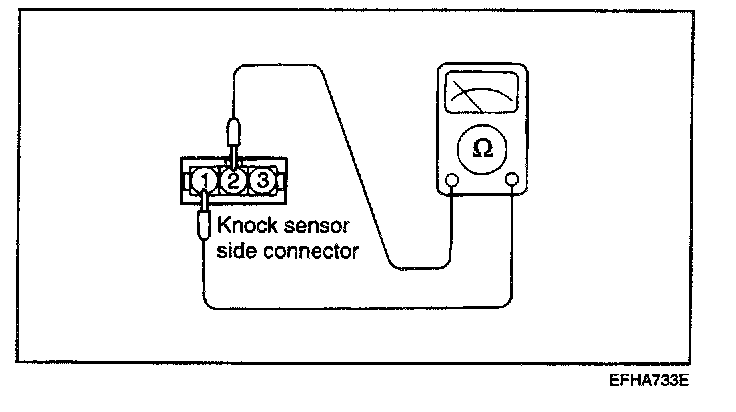
SENSOR INSPECTION
1. Disconnect the knock sensor connector.
2. Measure the resistance between terminals 2 and 3.
Standard value: about 5 Mohm. [at 20 °C (68 °F)]
3. If the resistance is zero, replace the knock sensor. Knock sensor 16 - 8 Nm (160 - 250 kg.cm, 11.8 - 18.4 lb.ft)
4. Measure the capacitance between the terminal 2 and 3.
Standard value: 800 - 1600 pF
Factory Service Tools
Use the Manual With the Right Hardware
Pair factory procedures with proven DIY tools so the instructions are easier to execute.
Disclosure: Verified tool recommendations may earn an affiliate commission at no cost to you.
When to See a Mechanic
Stop DIY work and contact a certified mechanic immediately if any of the following apply:
- • You smell fuel, burning insulation, or see smoke.
- • Brakes feel soft, pull hard to one side, or make grinding noises.
- • The engine overheats, stalls repeatedly, or misfires under load.
- • You are missing required tools, torque specs, or safe lifting equipment.
- • You are not confident in the next step or safety outcome.