
Safety Warning
DIY auto repair can cause serious injury, fire, or vehicle damage. These guides are for informational purposes only. Always follow OEM torque specs, wear PPE, and consult a certified mechanic if you are unsure. You are solely responsible for your safety.
2000 Honda Insight L3-1.0L HybridFACTORY OEM SERVICE PROCEDURE
Campaign - ECM Update
00-042
April 5, 2000
Applies To:
2000 Insight - From VIN JHMZE1...YT000001 thru JHMZE1...YT000440
Product Update: Insight ECM
BACKGROUND
The engine may not start it the ambient temperature is below 0°F (-20°C).
CUSTOMER NOTIFICATION
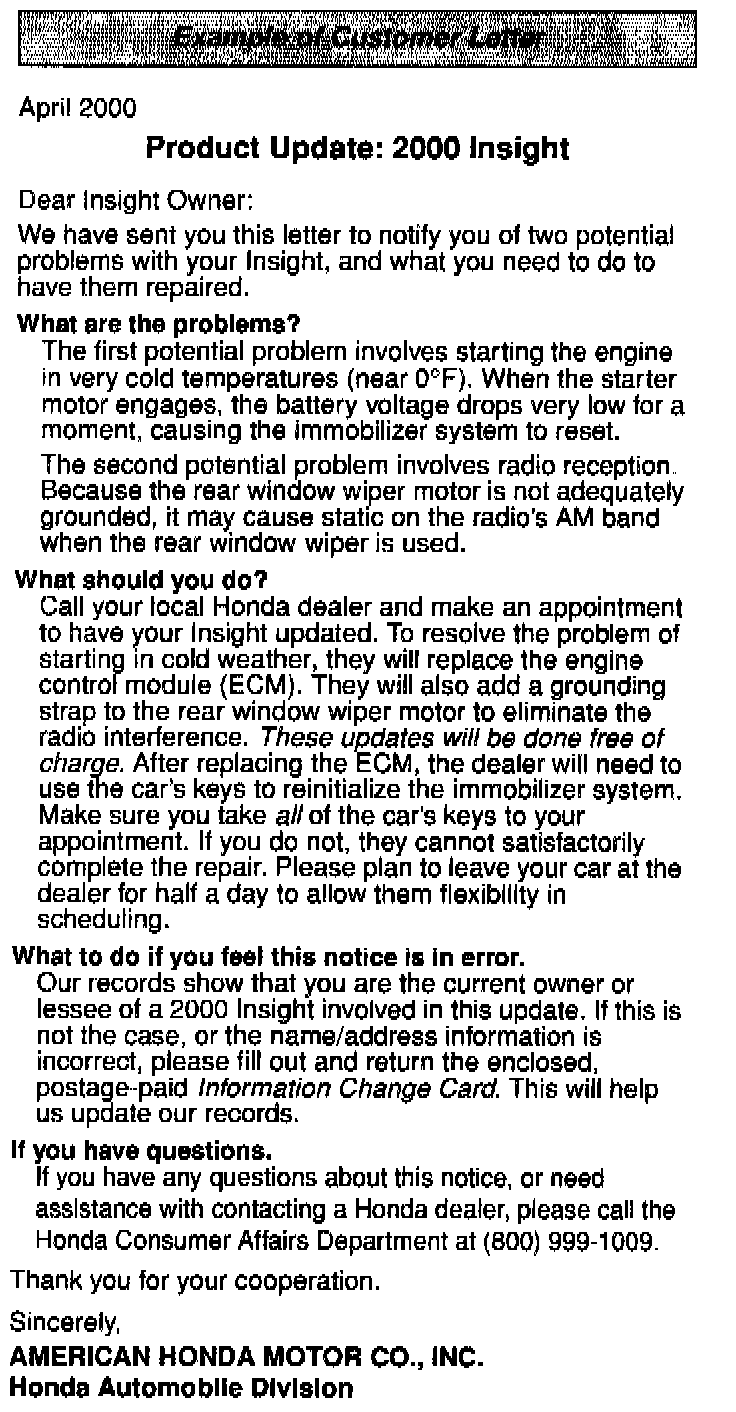
All owners of affected vehicles will be mailed a notification of this campaign. An example of a customer notification is shown.
CORRECTIVE ACTION
Replace the ECM (engine control module) with an improved unit. After the ECM replacement, the immobilizer system must be reinitialized. Make sure you have all the customer's keys.
PARTS INFORMATION
Engine Control Module:
P/N 06380-PHM-A00, H/C 6441117
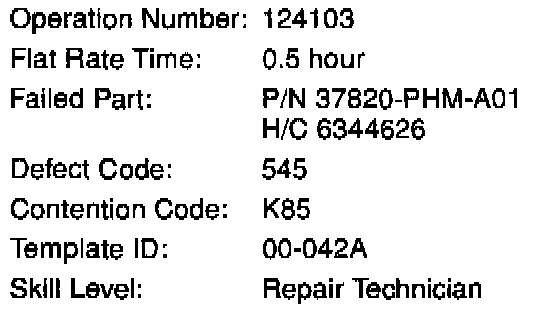
WARRANTY CLAIM INFORMATION
REPAIR PROCEDURE
1. Carefully remove the passenger's side door sill trim.

2. Remove the two carpet hold-down clips on the door sill.
3. Remove the carpet hold-down clip in the passenger's footwell under the glove box. Pull back the carpet.
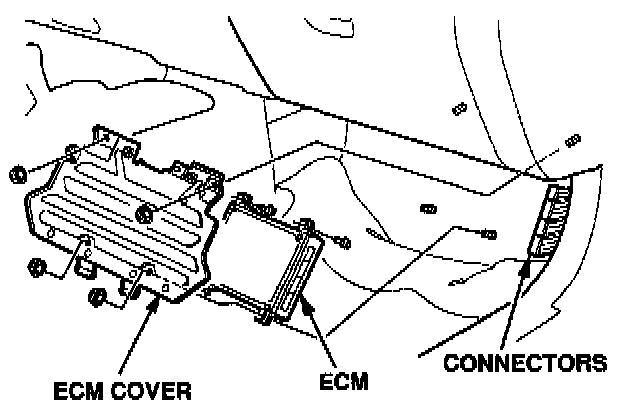
4. Remove the ECM cover mounting nuts.
5. Pivot the lower edge of the ECM cover off the mounting studs. Lift the upper edge of the cover off the mounting studs, then pull the cover down and back so it clears the evaporator drain tube.
6. Remove the two bolts mounting the ECM to the cover. Disconnect the ECM connectors.
7. Install the new ECM in the reverse order of removal.
8. Reinstall the carpet and the door sill trim.
9. Connect the PGM Tester to the data link connector (DLC).
10. Use the PGM Tester to program the customer's immobilizer key codes into the ECM. Verity that all the keys will start the engine.

11. Center-punch a completion mark above the first character (J) of the engine compartment VIN.

Disclaimer
April 5, 2000
Applies To:
2000 Insight - From VIN JHMZE1...YT000001 thru JHMZE1...YT000440
Product Update: Insight ECM
BACKGROUND
The engine may not start it the ambient temperature is below 0°F (-20°C).
CUSTOMER NOTIFICATION
All owners of affected vehicles will be mailed a notification of this campaign. An example of a customer notification is shown.
CORRECTIVE ACTION
Replace the ECM (engine control module) with an improved unit. After the ECM replacement, the immobilizer system must be reinitialized. Make sure you have all the customer's keys.
PARTS INFORMATION
Engine Control Module:
P/N 06380-PHM-A00, H/C 6441117
WARRANTY CLAIM INFORMATION
REPAIR PROCEDURE
1. Carefully remove the passenger's side door sill trim.
2. Remove the two carpet hold-down clips on the door sill.
3. Remove the carpet hold-down clip in the passenger's footwell under the glove box. Pull back the carpet.
4. Remove the ECM cover mounting nuts.
5. Pivot the lower edge of the ECM cover off the mounting studs. Lift the upper edge of the cover off the mounting studs, then pull the cover down and back so it clears the evaporator drain tube.
6. Remove the two bolts mounting the ECM to the cover. Disconnect the ECM connectors.
7. Install the new ECM in the reverse order of removal.
8. Reinstall the carpet and the door sill trim.
9. Connect the PGM Tester to the data link connector (DLC).
10. Use the PGM Tester to program the customer's immobilizer key codes into the ECM. Verity that all the keys will start the engine.
11. Center-punch a completion mark above the first character (J) of the engine compartment VIN.
Disclaimer
Factory Service Tools
Use the Manual With the Right Hardware
Pair factory procedures with proven DIY tools so the instructions are easier to execute.
Disclosure: Verified tool recommendations may earn an affiliate commission at no cost to you.
When to See a Mechanic
Stop DIY work and contact a certified mechanic immediately if any of the following apply:
- • You smell fuel, burning insulation, or see smoke.
- • Brakes feel soft, pull hard to one side, or make grinding noises.
- • The engine overheats, stalls repeatedly, or misfires under load.
- • You are missing required tools, torque specs, or safe lifting equipment.
- • You are not confident in the next step or safety outcome.