
Safety Warning
DIY auto repair can cause serious injury, fire, or vehicle damage. These guides are for informational purposes only. Always follow OEM torque specs, wear PPE, and consult a certified mechanic if you are unsure. You are solely responsible for your safety.
1992 Geo Metro L3-61 1.0LFACTORY OEM SERVICE PROCEDURE
Compression Check: Testing and Inspection
Fuse Location:
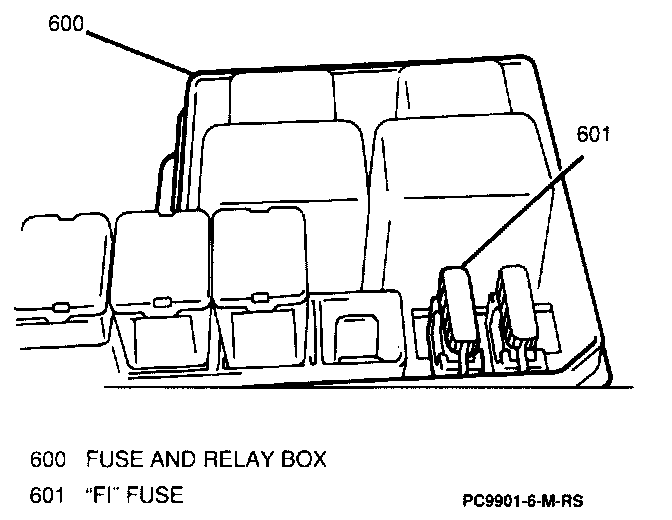
Compression Gage Installation:
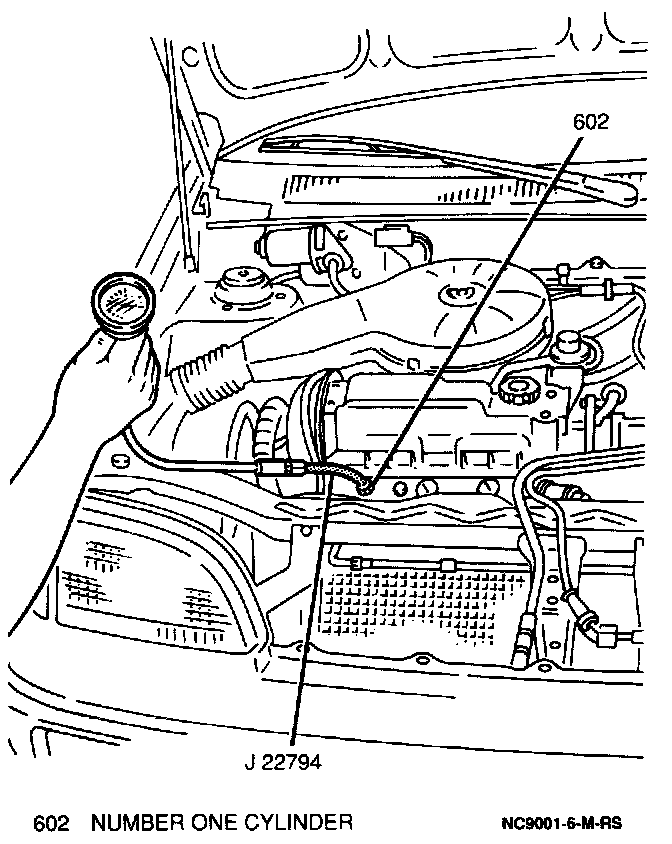
Compression Test:
To diagnose valve or piston faults and poor engine operation, a compression test must be performed to determine the cylinder compression pressure. When checking cylinder compression. the throttle must be wide-open, all three spark plugs removed and the battery at or near full charge. Test each cylinder four times.
Testing Procedures
Tool Required: J 22794 Spark Plug Port Adapter.
1. Start engine and allow it to reach normal operating temperature.
2. Turn ignition switch to "LOCK."
3. Remove all three spark plugs and disconnect distributor electrical connector.
4. Remove "FI" fuse from fuse and relay box.
5. Install a J 22794 and a compression gage into a spark plug hole.
6. Disengage the clutch (manual transaxle equipped vehicles) to lighten starting load on the engine and depress the accelerator pedal to the floor (wide-open throttle).
7. Crank engine (with a fully charged battery) to take four pressure readings.
Measure:
- The highest pressure reading on the compression gage.
- Standard compression pressure is 1,400 kPa (199 psi) at 400 rpm.
- Minimum allowable compression pressure is 1,100 kPa (156.4 psi) at 400 rpm.
8. Repeat compression test procedures for remaining two cylinders.
Important:
- The maximum allowable compression pressure difference between any two cylinders is 100 kPa (14.2 psi) at 400 rpm.
9. Remove the J 22794 and compression gage from the engine.
10. Install all three spark plugs and connect the distributor electrical connector.
11. Install "FI" fuse to fuse and relay box.
Evaluation:
- Normal operation - If the cylinder compression pressure increases quickly and evenly to the compression standard 1,400 kPa (199 psi) at 400 rpm), the pistons, piston rings and valves are operating normally.
- Piston rings faulty - If the cylinder compression is low on the first stroke and tends to increase on following strokes (but does not reach the compression standard), the probable cause is the piston rings are faulty. The addition of oil should improve the compression pressure considerably.
- Valves faulty - If the cylinder compression is low on the first stroke and does not increase on following strokes, the probable cause is that the valves are faulty. The addition of oil does not significantly improve the compression pressure.
Factory Service Tools
Use the Manual With the Right Hardware
Pair factory procedures with proven DIY tools so the instructions are easier to execute.
Disclosure: Verified tool recommendations may earn an affiliate commission at no cost to you.
When to See a Mechanic
Stop DIY work and contact a certified mechanic immediately if any of the following apply:
- • You smell fuel, burning insulation, or see smoke.
- • Brakes feel soft, pull hard to one side, or make grinding noises.
- • The engine overheats, stalls repeatedly, or misfires under load.
- • You are missing required tools, torque specs, or safe lifting equipment.
- • You are not confident in the next step or safety outcome.