
Safety Warning
DIY auto repair can cause serious injury, fire, or vehicle damage. These guides are for informational purposes only. Always follow OEM torque specs, wear PPE, and consult a certified mechanic if you are unsure. You are solely responsible for your safety.
1989 Geo Spectrum L4-91.5 1.5LFACTORY OEM SERVICE PROCEDURE
Preliminary Inspection
Fig. 1 Suspension Geometry:
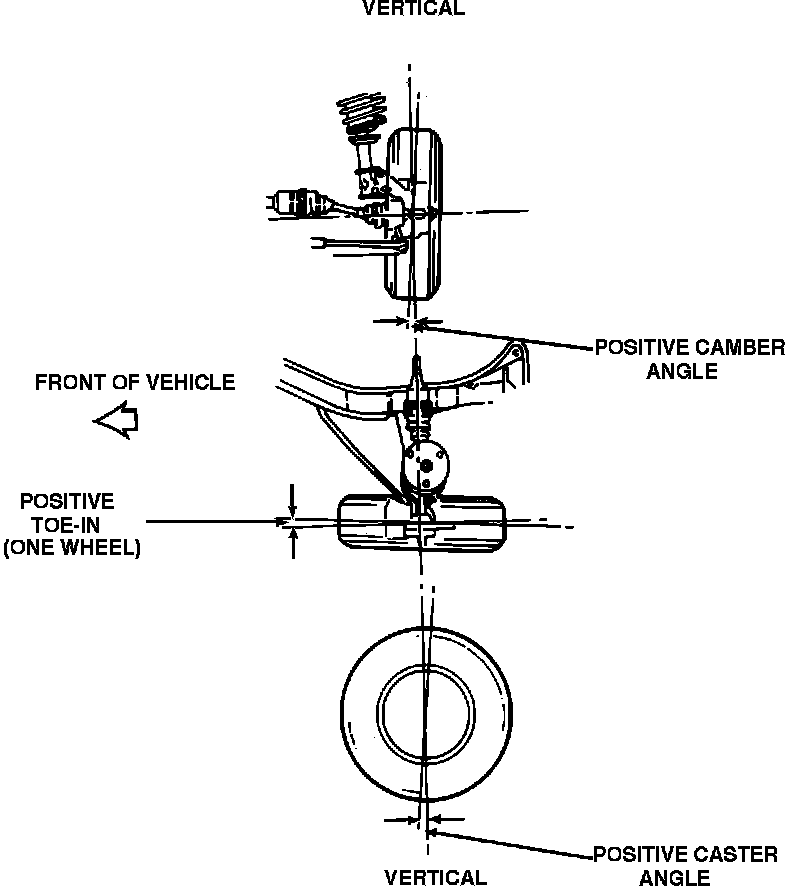
Wheel alignment, is the angular relationship between the wheels, suspension attaching parts and ground. The angle of the knuckle away from the vertical, pointing in or out of wheels, tilt of the wheels from vertical (when viewed from front of vehicle) and tilt of suspension members from vertical (when viewed from side of vehicle), all of these are involved in proper alignment, Fig. 1.
Steering and vibration problems are not always the result of alignment. An additional problem to be checked is tire lead due to worn or improperly manufactured tires. ``Lead'' is the deviation of the vehicle from a straight path on a level road without hand pressure on the steering wheel.
To insure correct alignment readings and alignment specifications, the following checks and inspections should be made.
1. Check tire for proper inflation and thread wear.
2. Check for loose ball joints and tie rod ends. If excessive looseness is noted, replace defective parts before adjusting toe.
3. Check for wheel and tire assembly run-out.
4. Check trim heights. If not within specifications, correct before adjusting toe.
5. Check for loose control arms.
6. Check for loose or missing stabilizer bar components.
7. Consideration must be given to excess loads, such as tool boxes, etc. If excess load is normally carried in vehicle, it should remain during alignment checks.
Factory Service Tools
Use the Manual With the Right Hardware
Pair factory procedures with proven DIY tools so the instructions are easier to execute.
Disclosure: Verified tool recommendations may earn an affiliate commission at no cost to you.
When to See a Mechanic
Stop DIY work and contact a certified mechanic immediately if any of the following apply:
- • You smell fuel, burning insulation, or see smoke.
- • Brakes feel soft, pull hard to one side, or make grinding noises.
- • The engine overheats, stalls repeatedly, or misfires under load.
- • You are missing required tools, torque specs, or safe lifting equipment.
- • You are not confident in the next step or safety outcome.