
Safety Warning
DIY auto repair can cause serious injury, fire, or vehicle damage. These guides are for informational purposes only. Always follow OEM torque specs, wear PPE, and consult a certified mechanic if you are unsure. You are solely responsible for your safety.
2012 Ford Edge AWD V6-3.7LFACTORY OEM SERVICE PROCEDURE
Electronic Engine Controls
Electronic Engine Controls
The 2.0L GTDI electronic engine controls consist of the:
- PCM.
- Cylinder Head Temperature (CHT) sensor.
- Camshaft Position (CMP) sensor.
- Crankshaft Position (CKP) sensor.
- Intake Air Temperature (IAT) sensor.
- Manifold Absolute Pressure (MAP) sensor.
- Manifold Absolute Pressure and Temperature (MAPT) sensor.
- Heated Oxygen Sensor (HO2S).
- Catalyst Monitor Sensor (CMS).
- Variable Camshaft Timing (VCT) oil control solenoid.
- Fuel Rail Pressure (FRP) sensor.
- Knock Sensor (KS).
- Engine Coolant Temperature (ECT) sensor.
The 3.5L and 3.7L electronic engine controls consist of the:
- PCM.
- Cylinder Head Temperature (CHT) sensor.
- Camshaft Position (CMP) sensor.
- Crankshaft Position (CKP) sensor.
- Mass Air Flow (MAF) sensor.
- Heated Oxygen Sensor (HO2S).
- Catalyst Monitor Sensor (CMS).
- Variable Camshaft Timing (VCT) oil control solenoid.
- Knock Sensor (KS).
The PCM:
- accepts input from various engine sensors to compute the fuel flow rate necessary to maintain a prescribed air/fuel ratio throughout the entire engine operational range.
- outputs a command to the fuel injectors to meter the appropriate quantity of fuel.
The CHT (Cylinder Head Temperature) sensor:
- sends the PCM a signal indicating cylinder head temperature.
- resistance decreases as cylinder head temperature increases.
The CMP (Camshaft Position) sensor:
- sends the PCM a signal indicating camshaft position used for fuel synchronization.
The CKP (Crankshaft Position) sensor:
- sends the PCM a signal indicating crankshaft position.
- is essential for calculating spark timing.
The MAF (Mass Air Flow) sensor:
- uses a hot wire sensing element to measure the amount of air entering the engine. Air passing over the hot wire causes it to cool.
The HO2S (Heated Oxygen Sensor) :
- creates a voltage signal dependent on exhaust oxygen content.
- provides feedback information to the PCM used to calculate fuel delivery.
The CMS (Catalyst Monitor Sensor) :
- monitors oxygen content after it flows through the catalytic converter.
- provides a voltage to the PCM used to calculate catalytic converter integrity.
The VCT (Variable Camshaft Timing) oil control solenoid:
- is an electrically controlled hydraulic valve that directs engine oil to the variable camshaft. Once the PCM transmits a signal, the solenoid moves a valve spool, directing oil into the camshaft phaser cavity. This action changes valve timing by either inducing an advance or retard condition. The camshaft is, thereby repositioned in relation to crankshaft timing and allows for optimum engine performance and lower emissions.
The KS (Knock Sensor) :
- is used to detect engine detonation.
- sends a voltage signal to the PCM.
- is able to provide a signal which retards the ignition timing, as necessary.
The IAT (Intake Air Temperature) sensor: - 2.0L GTDI
- measure the temperature of the air leaving the ACL (Air Cleaner).
The Manifold Absolute Pressure (MAP) sensor: - 2.0L GTDI
- it senses engine load.
- generates a signal that is proportional to the amount of vacuum in the intake manifold
The Manifold Absolute Pressure and Temperature (MAPT) sensor: - 2.0L GTDI
- provide precise measurements of manifold absolute pressure and manifold air temperature.
The Fuel Rail Pressure (FRP) sensor: - 2.0L GTDI
- measures the pressure of the fuel rail and sends these signals to the PCM.
The Engine Coolant Temperature (ECT) sensor: - 2.0L GTDI
- sends the PCM a signal indicating engine coolant temperature.
- voltage decreases as coolant temperature increases.
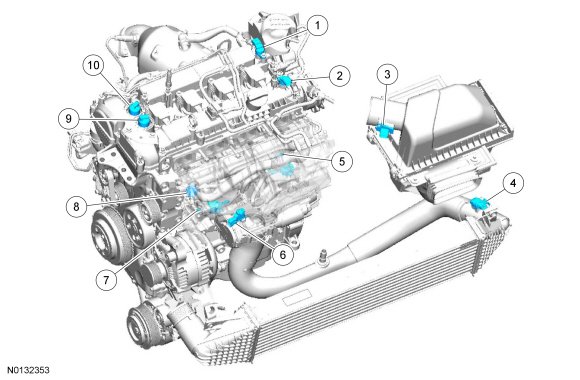
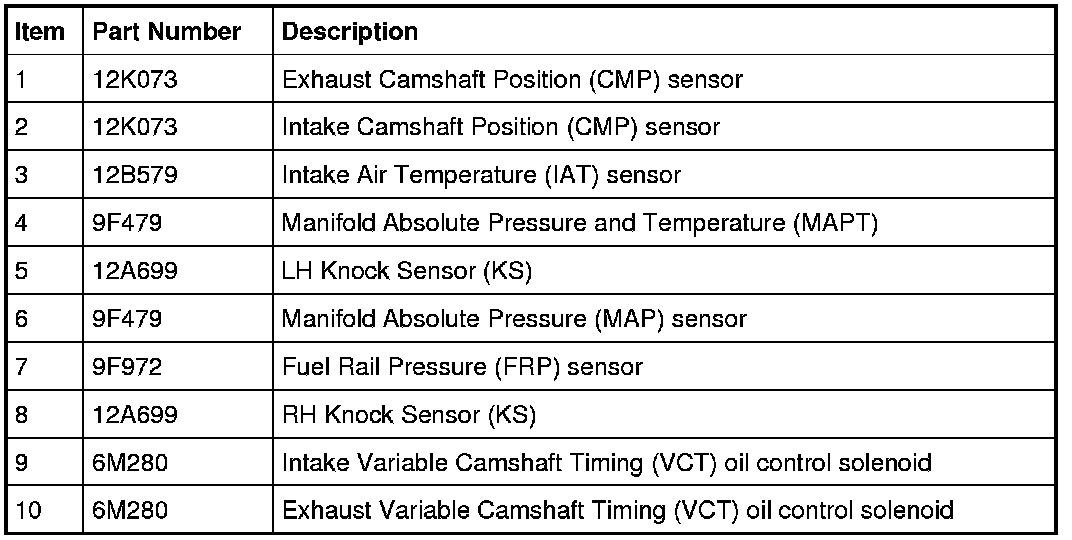
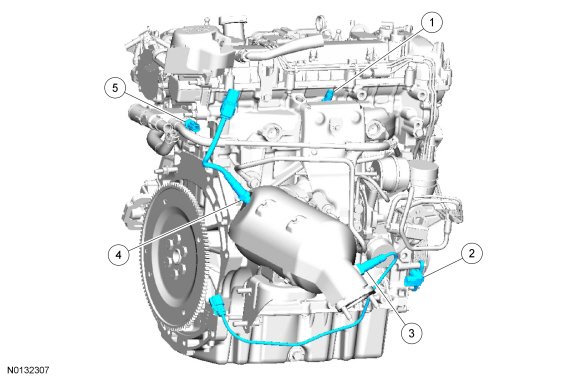
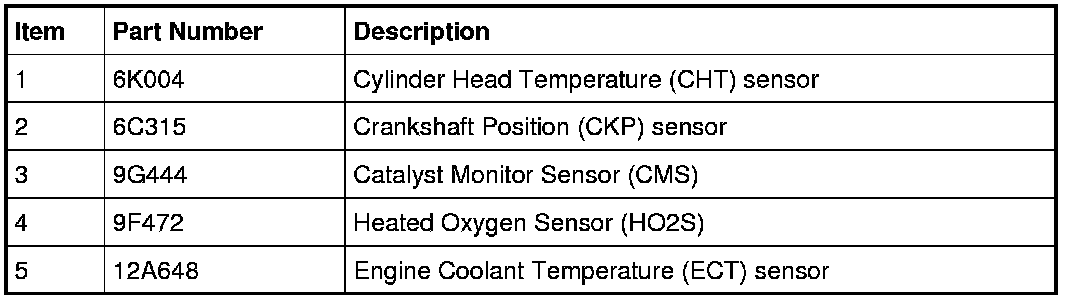
Component Location - 2.0L GTDI
Front Engine View
Rear Engine View
Component Location - 3.5L and 3.7L
Refer to Engine Control Components - Exploded View, 3.5L and 3.7L [1][2]Computers and Control Systems.
Factory Service Tools
Use the Manual With the Right Hardware
Pair factory procedures with proven DIY tools so the instructions are easier to execute.
Disclosure: Verified tool recommendations may earn an affiliate commission at no cost to you.
When to See a Mechanic
Stop DIY work and contact a certified mechanic immediately if any of the following apply:
- • You smell fuel, burning insulation, or see smoke.
- • Brakes feel soft, pull hard to one side, or make grinding noises.
- • The engine overheats, stalls repeatedly, or misfires under load.
- • You are missing required tools, torque specs, or safe lifting equipment.
- • You are not confident in the next step or safety outcome.